Databuddy Analytics raises $500,000 from Y Combinator
Wamda
- US-based AI-powered analytics startup Databuddy Analytics has raised more than $560,000 in total funding, including $500,000 in Seed funding from Y Combinator, alongside investments from Maza Ventures and through the a16z Scout programme.
- Founded in 2026 by Palestinian entrepreneur Issa Nassar, Databuddy Analytics develops an AI-powered product analytics platform that helps businesses identify conversion drops, customer friction and product issues through automated investigations and actionable insights.
- The funding will support the development of more advanced AI investigation capabilities, additional integrations, targeted hiring and improved customer onboarding, as the company seeks to expand its user base.
Press release:
Databuddy Analytics, the AI-driven analytics platform, has raised $500,000 in Seed funding from Y Combinator as it launches its AI intelligence platform. With investment from Maza Ventures and through the a16z Scout programme, Databuddy has raised more than $560,000 to date.
The company's new AI analytics platform investigates conversion drops, customer friction and product issues on a team's behalf and brings the findings to them. Unlike the traditional web analytics approach, the platform proactively shows what changed and why, without the need to dig through reports and filters. Databuddy has grown to serve more than 3,000 businesses in the first few months since launch.
"Teams don't want more charts; they want to know what's broken and what to do about it," says Issa Nassar, Founder of Databuddy. "We built Databuddy so that the answer is one question away. Y Combinator's backing lets us move faster on that and put it in front of far more teams."
Issa Nassar grew up in Palestine, started coding at age 11 and dropped out of university. He was accepted into Y Combinator at 20, becoming the youngest founder in the Middle East to be accepted into Silicon Valley’s iconic accelerator.
Tambi Jalouqa, Managing Partner at Maza Ventures, shared, "Most founders start by explaining the market. Issa started by showing us what he had built. Databuddy is one of those products that looks deceptively simple, which is usually a sign that someone has spent a lot of time thinking about the problem. Issa has the combination we look for at Maza: he's deeply technical, moves unusually fast, and seems more interested in making something people want than in looking like a startup founder. Those are often the founders worth betting on early."
The funding will support deeper AI investigation capabilities, additional integrations and targeted hiring. Databuddy will also invest in onboarding and migration support, helping more teams connect their existing data and put the platform to work.
October 25th 2026, 4:48 am
UAE healthtech Vitalls secures $1.5 million investment from EST Growmore
Wamda
- UAE-based healthtech startup Vitalls has secured a $1.5 million investment commitment from Singapore-based EST Growmore, the investment arm of EST Group, as part of its seed round, with an option for a further $1 million investment.
- Founded in 2023 by Mehdi Bouchenak, Vitalls develops an AI-powered digital health passport that enables individuals and families to securely store, manage and share their medical records across healthcare providers and countries.
- The investment will support the development and rollout of Vitalls' digital health passport, targeting internationally mobile individuals, families and enterprises.
- Under the agreement, EST Growmore will join the seed round as an anchor investor, while the two companies will explore distribution, product development and strategic partnerships across EST Group's telecommunications and healthcare investment portfolio.
Press release:
Vitalls, the digital health passport platform, and EST Growmore Pte. Ltd., [investment arm of EST Group], today announced, during the Abu Dhabi Future Health Summit, an agreement under which EST Growmore will invest US 1.5 million in Vitalls’ seed round, with an option to invest a further US 1 million.
The agreement was signed by Mehdi Bouchenak, Founder of Vitalls, and Dr. Sindhu Bhaskar, Chairman of EST Group.
The investment reflects a shared conviction that people should own their health history and carry it with them wherever they live, work or travel. EST Growmore joins as anchor investor in the seed round.
Addressing the fragmentation of health records across borders
People move between cities, countries and healthcare systems, but their medical history rarely moves with them. Records remain scattered across clinics, laboratories and borders, in different languages and formats. The result is repeated tests, delayed care and incomplete information when it matters most. Vitalls gives individuals one secure, user-controlled place to own their complete health record and share it, with consent, with any provider they choose.
Strategic synergies across the EST Growmore ecosystem
Beyond capital, the partnership opens access to EST Growmore's investment ecosystem, including [group telecom and healthcare portfolio companies]. The two companies will explore synergies across distribution, partnerships and product development to speed Vitalls' growth in the region and internationally.
Mehdi Bouchenak, Founder and CEO of Vitalls, said, "This agreement is a major step for Vitalls. More than the capital, it confirms that the problem we set out to solve is real and urgent. When an investor of Dr. Sindhu Bhaskar's experience commits after looking closely at what we have built, it tells us the need is understood. Patient-owned health records are no longer a niche idea. They are where healthcare is going."
Dr. Sindhu Bhaskar, Chairman of EST Group, said, "We studied the problem Vitalls is solving, and we are convinced. Millions of people live, work and travel away from home while their health records stay scattered across clinics and countries. Vitalls puts that history back in the patient's hands. We also see strong synergies across our investment ecosystem, and we intend to put that network to work to help Vitalls grow faster."
October 25th 2026, 4:48 am
INVE raises $300,000 from Outliers VC to scale eventtech platform across GCC
Wamda
- Saudi Arabia-based eventtech startup INVE has raised $300,000 in a Pre-Seed funding round from Outliers VC, which previously served as the company's first paid business design partner.
- Founded in 2024 by Abdulrahman Alabdulkarim, INVE operates a digital event management platform for individuals and businesses, offering personalised invitations, RSVP management, guest profiles, branded registration pages and digital entry passes.
- The company's consumer platform has supported 250 events across more than 60 cities and towns in Saudi Arabia and the GCC, sending over 35,000 invitations and recording an 88% RSVP response rate. Its business platform launched in August 2026.
- The funding will support team expansion, brand development and customer acquisition, as INVE scales its consumer and business platforms across Saudi Arabia and the GCC, with longer-term plans to expand into North Africa, other African markets and Europe.
Press release:
INVE, a Saudi-based technology company that provides personalised invitations and event-management tools for consumers and businesses, has raised $300,000 in pre-seed funding from Outliers Venture Capital. INVE will use the investment to bring its business platform, launched in August 2026, to more companies and to grow its consumer product, proven with weddings, into the go-to for every occasion.
For business hosts, guest information is often scattered between spreadsheets, inboxes, and WhatsApp conversations, so details gathered for one event may get lost when preparations begin for the next gathering. INVE keeps a living profile for every guest that enriches automatically as they engage, holding whatever a host cares to know, from dietary preferences and interests to their full attendance history, ready for every future event.
Hosts use that information to personalise invitations sent from their own email addresses and company WhatsApp numbers without rebuilding guest lists or repeatedly requesting the same information. RSVP pages, registration pages and digital entry passes also carry the host’s branding, keeping their identity visible throughout the guest experience. INVE’s business platform is built for companies that treat their events as part of their brand, from technology companies, venture firms and financial services businesses to the agencies that host on their behalf.
Founder Abdulrahman Alabdulkarim, now 23, built the first version of INVE in 2024 to simplify invitations and RSVP management for his sister’s wedding. The solution grew into a consumer product that has supported 250 events in over 60 cities and towns in Saudi Arabia and the GCC, sending more than 35,000 invitations with an 88% RSVP response rate. With both products live, INVE will invest in its team, brand and channels to scale them, from weddings and birthdays to business dinners and summits.
Abdulrahman Alabdulkarim, Founder and CEO, INVE, said, "The guest experience doesn't start when someone walks through the door, and it doesn't end when they leave. From the first invitation to the next time you host, every interaction matters. But creating that experience often means juggling spreadsheets, messages, and different tools, with valuable guest information fragmented across them. We're building INVE to bring the entire hosting experience together, making it easier to host at any scale while building on the relationships that matter. Our vision is for INVE to become the infrastructure behind how people and businesses host across the Gulf. With Outliers behind us, we're bringing that vision to more hosts across the region.”
Outliers, an operator-led venture capital firm backing early-stage founders, became INVE’s first paid business design partner before investing. The firm has been using the platform to manage invitations and guest communications under its brand, including for its forthcoming Builder Summit.
Sarah AlSaleh, General Partner at Outliers VC, said, "Working with INVE as a design partner before investing gave us conviction in both the product and Abdulrahman’s ability to execute. He combines deep technical expertise with an instinctive understanding of hospitality in the region, turning something deeply personal into technology that can scale without losing its human touch. INVE brings that same philosophy to both consumer and business engagement, making every interaction more intentional and every relationship more valuable. We’re proud to back Abdulrahman and the team as they redefine how people and businesses connect."
INVE’s self-service product is accessible internationally, while its immediate customer acquisition priorities are Saudi Arabia and the GCC. Longer-term ambitions include developing its business customer base in North Africa, other African markets and Europe.
A software engineer by background, Alabdulkarim previously worked on backend and infrastructure systems at Lean Technologies. He graduated from King Fahd University of Petroleum and Minerals, where he was the university’s second recipient of the President’s Medal for Entrepreneurship for INVE.
October 25th 2026, 4:48 am
UAE's Ziina secures central bank approvals for retail payments and exchange services
Wamda
Press release:
Ziina, the UAE’s homegrown consumer and business financial platform, has secured its Retail Payment Services Category III license and authorization to conduct Exchange Business Category IV activities under its existing Stored Value Facility license from the Central Bank of the UAE (CBUAE), becoming the first homegrown UAE fintech company to hold regulatory authorizations spanning all three activities.
The approvals mark the completion of Ziina’s latest phase of regulatory licensing with the CBUAE and represent a significant milestone in the company’s growth. Together, these licenses give Ziina the regulatory foundation to expand the range of financial services it offers consumers and merchants through one platform, from receiving and holding money to spending, domestic payments and international transfers.
Ziina first received its Stored Value Facility license in 2024, authorizing the company to launch its digital wallet. The newly awarded Retail Payment Services Category III license significantly expands its regulated capabilities, covering merchant acquiring, payment aggregation, and domestic fund transfers. The license provides full regulatory authorisation for Ziina’s merchant acceptance products, including payment links, QR payments, Tap to Pay and its online payment gateway.
In August 2026, the CBUAE also authorized Ziina to conduct Exchange Business Category IV activities under its existing Stored Value Facility license, originally granted in June 2024. This additional authorization expands Ziina’s regulated capabilities to include international money transfers through digital channels, including directly through the Ziina app.
Faisal Toukan, Co-Founder and CEO at Ziina said:
“We’re thankful for the continued support of the Central Bank of the UAE. These licenses give us the regulatory framework to build faster and go further. When we launched Ziina in the UAE, we believed that we could build the next generation of financial products from this market, for the region. That conviction has only grown. Today, people use different apps and providers for different parts of their financial lives. We want to bring more financial services into one platform, from spending and holding money to sending it abroad. When more of your financial life is in one place, you have more control over your money. Our ambition is to take what we build here to enable financial freedom across the Arab world.”
The milestone comes as Ziina reaches scale. The company now serves more than 500,000 customers annually, processes more than $1.5 billion in annualised payment volume and is used by one in 10 UAE SMEs. The wider UAE market is also growing at significant scale. CBUAE’s Annual Report 2025 shows that retail transfers processed through the UAE Funds Transfer System reached AED 9.9 trillion across 114.9 million transactions in 2025, with transaction value up 19.9% and transaction volume up 17.8% year on year. The figures point to a large and increasingly active market for digital financial services in the UAE.
Ziina is investing in the products, technology and infrastructure to bring more financial services onto one platform, starting in the UAE and extending across the Arab world.
-ENDS-
Ziina
Dima Zalatimodima.zalatimo@ziina.com
Bridges Communications
Simran Randhawasimran@bridges-communications.com +44 7548277648
Notes to Editors
About ZiinaZiina is a UAE based licensed fintech platform founded in 2020 by Faisal Toukan, Sarah Toukan and Talal Toukan. Built for consumers and businesses alike, Ziina provides a fast and secure way to spend, receive, and manage money. Its mission is to enable financial freedom for every person in the Arab World.
Ziina combines award winning design with products that support everyday financial needs, including instant transfers, customizable payment links, QR code payments, Tap to Pay on iPhone and Android, and the Ziina Card available through Apple Pay and Google Pay. Its lifestyle membership program, Ziina Violet, offers benefits from the UAE’s most loved brands and zero currency fees on global spends with the Ziina card.
Licensed by the Central Bank of the UAE, Ziina is committed to transparency, offering its services without initiation fees or hidden charges. With its user-friendly interface and growing ecosystem, Ziina is a trusted financial partner to over 500,000 annual business and consumer users in the UAE.
More information at ziina.com
October 25th 2026, 4:48 am
CapQuest closes $1 million pre-Seed funding to expand globally
Wamda
- UAE-based fintech startup CapQuest has raised $1 million in a pre-Seed funding round, led by Oraseya Capital and AMKM Family Office, to accelerate product development and international expansion.
- Founded in 2023 by Antoine Bruna, Marco Banfi and Anvita Varshney, CapQuest operates an equity management platform that enables startups and established businesses to manage ownership structures, capitalisation tables, employee stock ownership plans (ESOPs), vesting schedules, fundraising transactions and shareholder communications.
- The funding will support product development, increased automation, enhanced equity management tools and commercial expansion, as the company seeks to grow its international customer base.
Press release:
CapQuest, a Dubai-based equity management platform, has announced the successful closing of its $1 million Pre-Seed funding round, led by Oraseya Capital and AMKM Family Office.
Founded by Antoine Bruna, Marco Banfi, and Anvita Varshney, CapQuest is transforming how companies manage equity, ownership, and investor relations. The platform enables startups, scaleups, and established businesses to manage their cap tables, employee equity plans (ESOPs), vesting schedules, fundraising transactions, and shareholder communications through a single, centralised solution.
Designed to replace fragmented spreadsheets and manual processes, CapQuest helps companies simplify complex equity operations, improve transparency, and maintain accurate ownership records throughout their growth.
Growing International Traction
Since its launch, CapQuest has established a growing international presence, serving companies across 11 countries, with a strong focus on the Middle East, Europe and emerging markets.
Its client portfolio includes notable companies such as Holo, Erad, Avenia, and Teylor, reflecting increasing demand for modern equity management infrastructure among high-growth businesses.
CapQuest's continued expansion highlights the growing importance of effective equity governance as companies navigate fundraising, employee ownership, and increasingly complex shareholder structures.
Accelerating Growth and Product Innovation
The funding will accelerate product development, expand CapQuest's commercial presence, and enhance its equity management capabilities through greater automation and more advanced tools.
“This funding represents an important milestone for CapQuest and a strong validation of our vision,” said Antoine Bruna, CEO & Co-Founder of CapQuest. “Equity management remains unnecessarily complex for many companies, particularly as they scale and expand internationally. We’re building the infrastructure to make equity management more accessible, transparent, and efficient.
With a growing international customer base and an expanding suite of products, CapQuest aims to become a leading platform for equity and investment management, connecting companies, shareholders, and investors within a unified ecosystem.
October 25th 2026, 4:48 am
MNT-Halan completes IPO as retail tranche attracts over 41,500 subscription orders
Wamda
- Egyptian fintech MNT-Halan has begun trading on the Egyptian Exchange (EGX) under the ticker HALN.CA, following an initial public offering (IPO) that saw strong demand from institutional and retail investors.
- The IPO involved the sale of 320 million existing ordinary shares, representing 20% of MNT-Halan's issued share capital, by existing shareholder MNT Investments B.V. The offering comprised 272 million shares allocated to institutional and other private-tranche investors and 48 millshares allocated tos to retail investors.
- The private tranche was 11.2 times oversubscribed, rising to 19.4 times excluding cornerstone investors, while the public tranche was 43.6 times oversubscribed, attracting more than 41,500 subscription orders.
- Founded in 2018 by Mounir Nakhla, with roots dating back to 2009, MNT-Halan provides lending, payments, investment and e-commerce services through subsidiaries including Halan and Tasaheel. The group has served approximately 7.9 million customers and disbursed more than EGP 178 billion in financing since inception, as of June 30, 2026.
- The listing marks MNT-Halan's transition into a publicly traded company as it seeks to expand its financial services ecosystem, strengthen customer engagement and reach more customers through its technology platform.
Press release:
MNT Tech Holding for Financial Investments SAE (the “Company” or “MNT-Halan”) celebrated today the commencement of trading in its shares on the Egyptian Exchange (EGX), under the ticker symbol HALN.CA, following strong investor demand for its initial public offering (IPO). The milestone was marked by a bell-ringing ceremony attended by senior government officials, financial regulators, EGX leadership, MNT-Halan’s board members, executives and representatives of the banks, asset managers and advisors involved in the offering.
The listing represents a significant milestone in MNT-Halan’s growth journey, opening a new chapter for the Company as a publicly traded business. Founded in 2018, with roots dating back to 2009, MNT-Halan has grown into a diversified financial services platform offering solutions across lending, payments, investments and e-commerce. Through the Company’s subsidiaries encompassing Halan and Tasaheel, amongst other subsidiaries (together the “Group”), the Group has served approximately 7.9 million customers since inception, with approximately 1.9 million active customers annually, and disbursed more than EGP 178 billion in financing as of 30 June 2026. Its technology-driven ecosystem and extensive distribution network enable it to meet a broad range of financial needs and expand access to financial services across Egypt.
The IPO attracted strong demand from both institutional and retail investors. The Private Tranche was 11.2 times oversubscribed and 19.4 times excluding cornerstone investors, while the Public Tranche was 43.6 times oversubscribed, attracting more than 41,500 subscription orders. The offering comprised the sale of 320 million existing ordinary shares by MNT Investments B.V., representing 20% of MNT-Halan’s issued share capital prior to the closing of the subscription process. Of these, 272 million shares were allocated to the Private Tranche and 48 million to the Public Tranche.
Omar Radwan, Chairman of the Egyptian Exchange (EGX), said, "MNT-Halan has demonstrated an inspiring model of how ambitious ideas and ventures can evolve into leading institutional entities capable of leveraging technology and innovation to serve millions of citizens. Today, through its entry into the capital market, the company reaffirms that the stock exchange offers the most efficient and equitable avenue for providing liquidity and financing future expansion through a diverse range of instruments, while strengthening its brand positioning and enhancing its corporate governance.”
Radwan added that listing and offering shares on the capital market for major companies and institutions goes beyond merely raising capital and diversifying funding sources at the lowest possible cost. Rather, it serves primarily as a vital safeguard for ensuring their long-term sustainability and continuity across generations by institutionalising sound corporate governance practices, promoting transparency, and safeguarding shareholders’ wealth.
Mounir Nakhla, Founder, Chief Executive Officer and Managing Director of MNT-Halan, said, "We are proud to begin trading on the Egyptian Exchange, marking an important milestone in
our journey. The strong demand for our IPO reflects investors’ confidence in Egypt, the financial ecosystem we have built, and our growth trajectory. As we enter this next phase, we remain focused on broadening our product ecosystem, deepening customer engagement and leveraging our proprietary technology to reach more customers and drive sustainable growth. We thank the Egyptian government, the CBE, the FRA, the EGX, our banking partners, asset managers and everyone who contributed to bringing this offering to fruition. We are also grateful to every international investor, family office, and individual who are helping us create a lasting, positive impact in Egypt.”
Citigroup Global Markets Limited and EFG Hermes Promoting and Underwriting S.A.E. acted as Joint Global Coordinators and Joint Bookrunners for the Offering. Gibson, Dunn & Crutcher LLP acted as U.S. and English legal counsel, and Matouk Bassiouny & Hennawy acted as Egyptian legal counsel, in each case to MNT-Halan and the Selling Shareholder. White & Case LLP acted as U.S. and English legal counsel, and MHR & Partners in association with White & Case LLP, acted as Egyptian legal counsel in each case to the Joint Global Coordinators and Joint Bookrunners.
October 25th 2026, 4:48 am
theQA raises over $550,000 to scale AI-driven consumer research in Kuwait
Wamda
- Kuwait-based AI-powered market research startup theQA has raised more than $550,000 in a Pre-Seed funding round, backed by a Kuwaiti family office and strategic angel investors.
- Founded in 2025 by Ahmad Al Ebrahim and Hussain Ali AlNashaba, theQA provides a digital consumer research platform that enables businesses, agencies and researchers to create AI-assisted surveys, reach targeted audiences and collect consumer insights to inform business decisions.
- Since launching in April 2025, the company has built a panel of more than 20,000 verified participants and recorded revenue growth in every quarter of 2026, with revenue nearly doubling since January.
- The funding will support the expansion of its operations in Kuwait, the development of AI-powered research tools and enhancements to its consumer insights and data analysis capabilities.
Press release:
theQA, Kuwait’s first AI-powered consumer research platform, has raised over US$550,000 in a pre-seed round backed by a Kuwaiti family office and strategic angel investors. The funding will support scaling the platform in Kuwait.
theQA enables businesses, agencies, and researchers to create surveys, target relevant audiences in Kuwait, and collect consumer feedback to inform their decisions. Its AI-assisted survey builder and workflows help turn research briefs into questionnaires, supporting studies on consumer preferences, brand perceptions, and new product concepts.
Launched in April 2025, theQA has grown to over 20,000 verified panel members. Revenue has grown every quarter this year, almost doubling since January.
Commenting on the investment, Ahmad Al-Ebrahim, Co-Founder and CEO of theQA, said:
“We started theQA with a simple goal: to make it easier for businesses to understand the people they serve. Consumer research has traditionally required significant time, effort, and resources, and we saw an opportunity to make that process simpler and more accessible.
Reaching over 20,000 participants in a short period has reinforced our belief in the need for this platform. This investment will help us build on that progress, strengthen our capabilities, and make consumer insights more accessible to businesses across Kuwait.”
Hussain Al-Nashabah, Co-Founder and CTO of theQA, added:
“Our focus has always been on simplifying the research process, from asking the right questions to reaching the right people and understanding the results. We’re continuing to develop tools that reduce the time and effort required to conduct research, including the practical use of AI where it adds value.
This investment will allow us to improve the platform, introduce new capabilities, and help businesses turn consumer feedback into actionable decisions.”
Ahmad Al Ebrahim and Hussain Ali AlNashaba are co-founders of theQA.
October 25th 2026, 4:48 am
Female private capital leaders to convene in UAE for Berkana's Art of Capital
Wamda
Press release:
Berkana is bringing together 40 female single family office principals, investment decision-makers and entrepreneurs from around the world for Art of Capital: The Women of Influence, taking place on October 22–23, 2026, across Dubai and Abu Dhabi.
The invitation-only gathering will convene the women who are actively shaping the future of private capital, with each participant allocating a minimum of $1 million annually into impactful ventures.
The event will open at Noor Royal Museum in Dubai, hosted by Sheikha Noor, entrepreneur, investor and Founder & Chairwoman of Noor Royal Holding, before continuing in Abu Dhabi with curated experiences at the Sheikh Zayed Grand Mosque and Louvre Abu Dhabi, where Berkana is proud to be an official corporate partner.
The Abu Dhabi gathering is supported by Hongqi, the Chinese luxury automotive brand, providing premium transportation for event guests, alongside leading global family offices, Berkana members, and prominent investment and family office networks, including 361 Firm and Maison IG, and several corporate partners: Decahydron and Smart Management Properties.
A New Generation of Female Capital
Art of Capital: The Women of Influence is designed to create a private environment where women controlling and deploying significant capital can exchange ideas, discover investment opportunities and build long-term relationships across markets.
The gathering will bring together single family office principals, senior investment decision-makers and entrepreneurs, with a focus on impact, innovation, strategic capital and the growing influence of women in global wealth creation.
“Women are increasingly becoming some of the most influential allocators of private capital globally. Art of Capital is about bringing these women into one room — not simply to discuss wealth, but to shape where capital goes next.”
— Genia Xasis, CEO & Founding Partner, Berkana
The two-day program will combine private investment conversations, curated networking and cultural experiences across Dubai and Abu Dhabi, creating an environment for meaningful relationships and long-term collaboration.
For registration, click here.
October 25th 2026, 4:48 am
FinBursa unveils AI-native platform to streamline private markets operations
Wamda
- FinBursa has launched FinBursa 360, an AI-powered platform designed to integrate investment management workflows, deal execution, fundraising and investor relations for private markets firms.
- Founded in 2024 and co-founded by Ismail Badereldine, a former BlackRock director, FinBursa provides an integrated platform combining investment CRM, deal management, virtual data rooms (VDR), investor onboarding, fundraising and reporting tools for private equity, venture capital, private credit and other investment firms.
- The newly launched platform features five specialised AI agents and a coordinating orchestrator, enabling firms to analyse deal pipelines, identify potential investors or buyers, support due diligence and generate research insights using data from across their operations.
- FinBursa 360 allows firms to automate workflows while maintaining human oversight, with AI-generated investor outreach requiring approval before being sent. The platform also supports custom branding and can be deployed within days, according to the company.
Press release:
FinBursa launches FinBursa 360 – the intelligent front office for private markets, built to run a firm end to end: investment CRM, deal management from origination to execution, virtual data rooms (VDR), fundraising campaign management, investor onboarding, investor reporting, and portals for investors and counterparties, all on one system of record used by both the sell side and the buy side.
Until now, a private markets firm's technology has been a mix of legacy systems and disconnected tools. FinBursa resolves this challenge with one system, under one contract, that holds the firm's relationships, deals, documents, and the counterparties it works with, with AI built in by design.
"Most private markets firms have spent heavily on AI and say it isn't delivering yet. AI is only as useful as the information it can access and the actions it is permitted to take. For many firms, that information sits in five or six systems," said Ismail Badereldine, co-founder and CEO of FinBursa. "Building or buying an AI layer across those systems is expensive and slow. Every new feature means more integration work, the firm has to keep permissions consistent across all of them, and it needs constant maintenance as each vendor changes its own system. We built FinBursa differently: one system for relationships, deals, and documents, and the investors, buyers, and advisers the firm works with, with AI built in. The orchestrator agent sees the full record and acts within one set of permissions and one audit trail, without another layer of technology to pay for or maintain.”
AI Built Into The Platform, Not Wrapped Around It FinBursa's AI comprises five live specialized agents covering relationships, deals from origination to pitch, due diligence and execution, data rooms, fundraising and research – supported by an orchestrator that coordinates them across the firm's record.
Rather than operating inside isolated applications, the orchestrator draws on connected information across the firm's front office, including emails and meetings, deal histories, data room activity and questions, fundraising and investor activity, documents, notes, and any pertinent news. It uses this context to answer questions and provide source-backed insights for deal origination, preparation, due diligence, fundraising, and investor relations; and rank daily priorities for the team.
A firm can ask the agents to identify investors or buyers suited to a deal. Drawing on previous deals, data room activity, and CRM history, the agents can suggest matches and draft the outreach for the team to review. Nothing is sent without human approval.
Built For Where Private Markets Are GoingFinBursa was co-founded by Ismail Badereldine, a former BlackRock director with more than two decades of experience in financial markets and investment technology, including at eFront, alongside investment banking and private markets veterans. Its leadership team has specialized experience building and running the industry's leading institutional platforms.
"Private markets are growing and getting more competitive: more investors to serve, more deals to manage, and more data and compliance requirements," said Badereldine. "AI can carry much of that work, but only if it can see the firm's data and act within its permissions. By bringing those capabilities into one system, we are enabling firms of all sizes to move faster and compete more effectively without adding complexity.”
Live in Days, Not Months FinBursa 360 can be configured to each firm's workflows and branding, allowing clients to operate under their own brand. Firms can go live in days rather than months. FinBursa is ISO 27001:2022 certified and SOC 2 Type 1 attested.
October 25th 2026, 4:48 am
Saudi proptech Ghanem raises $1.5 million pre-seed extension
Wamda
- Saudi Arabia-based proptech startup Ghanem has raised an additional $1.5 million in a pre-seed extension round, backed by real estate companies and strategic angel investors, bringing the round's total to $8.6 million. Its previous $7.1 million financing included participation from Al-Romaih Group, while Waad VC has also invested in the company.
- Founded in 2025 by Saleh Waheed Al-Ghamdi and Amr Essam, Ghanem operates a fractional real estate ownership platform that allows individuals and institutions to invest in income-generating properties in Saudi Arabia, with minimum investments starting at SAR 1,000, depending on the opportunity.
- The additional funding will support product development, diversification of property investment opportunities and strategic partnerships, as the company expands its fractional ownership services.
Press release:
Ghanem, a company that specialises in fractional real estate ownership in Saudi Arabia, has closed an additional $1.5 million in funding, with participation from real estate companies and a group of strategic angel investors.
The funding extends the company’s pre-seed round, which previously raised $7.1 million with participation from Al-Romaih Group, bringing the total round, including the extension, to $8.6 million. Waad VC has also invested in the company.
The announcement follows a series of operational milestones for Ghanem. These include the execution of several real estate investment transactions through the company, a registered user base now numbering in the thousands, and the start of rental income distributions to investors without any payment disruptions.
Ghanem successfully issued digital ownership deeds to 580 individuals participating in the first income-generating real estate investment opportunity offered through the Ghanem app, documenting their fractional ownership stakes in the property.
Ghanem has also signed an agreement for digital integration with the Real Estate Registry (RER) and activated the connection, which is now live. This enables fractional ownership interests to be registered and deeds to be issued in investors’ names as part of an integrated digital experience. The initiative forms part of the platform’s technical and operational development and its efforts to simplify the property ownership process.
The company joined the regulatory sandbox of Saudi Arabia’s Real Estate General Authority (REGA) several months ago and launched its fractional ownership product within that environment, allowing the model to be tested and developed under regulatory supervision.
Ghanem provides access to Saudi real estate investment through fractional ownership of income-generating properties, with amounts starting at SAR 1,000, depending on the opportunity. The model combines the potential for rental income with ownership of a stake in a tangible real estate asset, which may support long-term investment stability. Properties undergo verification, due diligence and valuation before being offered on the platform, including reviews of ownership and relevant documents and valuations by accredited valuers.
All of Ghanem’s products have been approved as Sharia-compliant by the Sharia committee.
Saleh Waheed Al-Ghamdi, CEO and Co-Founder of Ghanem, said, "We are working to make property ownership more accessible through a clear digital experience and ownership documented in the investor’s name. We have executed real estate investment transactions, distributed monthly dividends with zero delays, attracted thousands of registered users, and activated our digital integration with the Real Estate Registry. These achievements give us a practical foundation on which to develop our services and improve the investor experience.”
Al-Ghamdi added, "This pre-seed extension provides important support for the next stage of our journey. We value our investors’ trust and the participation of real estate companies and strategic partners with direct market experience. We look forward to drawing on this expertise to develop our product, diversify real estate opportunities, and build partnerships that support Ghanem’s growth, while continuing to develop our solutions within the Real Estate General Authority’s regulatory sandbox.”
Ghanem was founded in 2025 by Saleh Waheed Al-Ghamdi and Amr Essam to develop fractional real estate ownership solutions and serve individuals and institutions in the Saudi market.
October 25th 2026, 4:48 am
Tarabut secures $50 million to deepen Saudi embedded finance push
Wamda
- Bahrain-founded fintech infrastructure company Tarabut has secured $50 million (SAR187 million) in strategic financing from Riyad Bank, X-Tech Fund managed by SAB Invest, GIB Saudi Arabia, Zamil Group and Kanoo Ventures, alongside other regional institutions. The transaction remains subject to regulatory approvals, including from the Saudi Central Bank (SAMA).
- Founded in 2017 by Abdulla Almoayed, Tarabut operates regulated financial infrastructure across Saudi Arabia, the UAE and Bahrain, connecting banks, businesses and consumers through open banking and embedded finance technology. The company opened its regional headquarters in Riyadh in 2025.
- The new financing will be used to deepen Tarabut’s presence in Saudi Arabia and develop end-to-end embedded finance infrastructure, combining customer verification, credit decisioning and financing within digital journeys offered under partner financial institutions’ brands.
- The financing is Tarabut’s largest disclosed round since its $32 million Series A in 2023, which was led by Pinnacle Capital with participation from Visa, Tiger Global and Aljazira Capital. Tarabut also acquired UK account-to-account payments company Vyne in 2024 and Bahrain-based AI company Servable earlier in 2026.
Press release:
Bahrain-founded financial infrastructure company Tarabut has secured $50 million (SAR187 million) in strategic financing as it deepens its focus on embedded finance and SME lending infrastructure in Saudi Arabia.
The financing includes participation from Riyad Bank, X-Tech Fund managed by SAB Invest, GIB Saudi Arabia, Zamil Group and Kanoo Ventures, the venture investment arm of Yusuf bin Ahmed Kanoo Group, alongside other regional institutions. The transaction remains subject to regulatory approvals, including approval from the Saudi Central Bank (SAMA).
Founded in 2017 by Abdulla Almoayed, Tarabut operates financial infrastructure across Saudi Arabia, the UAE and Bahrain. Originally focused on open banking, the company has expanded its offering into embedded finance, payments and credit decisioning, connecting financial institutions with businesses and consumers through its infrastructure.
Tarabut opened its regional headquarters in Riyadh in 2025, as Saudi Arabia became an increasingly central market for the company. It has reached connectivity with the Kingdom’s major banks and works with financial institutions including Saudi National Bank, Alinma Bank and SAB.
The new capital will be used to deepen Tarabut's operations in Saudi Arabia and develop end-to-end embedded finance journeys, bringing verification, credit decisioning and financing together within a single digital process.
Rather than lending directly from its own balance sheet, Tarabut provides infrastructure that allows financial institutions to use customer-permissioned financial information and real-time cash-flow data to assess borrowers and distribute financing through third-party platforms.
A key focus for the company is SME financing, where lenders have traditionally relied on historical financial statements and other static documentation when assessing businesses.
Tarabut's technology allows financial institutions to complement those documents with real-time financial behaviour and cash-flow information, giving lenders a more current view of a company's financial position and potentially shortening the time required to make financing decisions.
“The biggest prize is SME finance,” said Abdulla Almoayed, founder and CEO of Tarabut. “Financial institutions want to serve more creditworthy businesses, and our infrastructure helps them turn real financial behaviour into a clearer picture for decision-making.”
Tarabut's infrastructure is already being used in a number of financial services products in Saudi Arabia. American Express Saudi Arabia has used the company's open banking technology to assess credit-limit increase requests, including for self-employed and non-salaried customers. Saudi National Bank (SNB) has also announced an SME point-of-sale lending product powered by Tarabut and distributed through payments company Geidea, while Tarabut has partnered with SAB on embedded finance.
The company says it has processed more than five billion API calls across Saudi Arabia, the UAE and Bahrain.
The latest financing follows Tarabut's $32 million Series A in 2023, led by Pinnacle Capital with participation from Visa, Tiger Global and Aljazira Capital. Before that, the company had raised $25 million across Seed and Pre-Series A rounds in 2021.
Tarabut has also expanded its technology through acquisitions. In 2024, it acquired UK account-to-account payments company Vyne, adding payment initiation capabilities to its open banking infrastructure. Earlier in 2026, it acquired Bahrain-based AI engineering company Servable, adding synthetic data, model training and AI-powered decisioning capabilities for regulated financial institutions.
The $50 million financing will support Tarabut's next phase of expansion in Saudi Arabia, with the company expected to roll out further products and integrations as it develops its embedded finance offering.
September 16th 2026, 2:01 am
Saudi fintech barq closes $329.5 million Series A
Wamda
- Saudi fintech barq has closed a $329.5 million Series A round at a $1.85 billion valuation, with participation from Noon Investments, Sohar International Bank, and M20 Fund.
- Founded in 2023 by Ahmed Alenazi, barq is a Saudi Central Bank (SAMA)-licensed financial technology company offering digital payments and money-transfer services through its app.
- The latest financing gives barq a $1.85 billion valuation, placing the Saudi fintech firmly in unicorn territory.
Press release:
Saudi digital payments company barq has closed a $329.5 million Series A funding round at a valuation of $1.85 billion, following rapid growth in its user base and transaction volumes since its launch.
The round saw participation from Noon Investments, Sohar International Bank, and M20 Fund.
The new valuation places barq among Saudi Arabia's fintech unicorns and comes around two years after the company launched its services to users.
Headquartered in Riyadh, barq is a financial technology company licensed by the Saudi Central Bank (SAMA), offering digital payments and other financial services through its platform.
The company is led by founder and CEO Ahmed Alenazi, who previously served as CEO of Saudi digital payments company stc pay.
barq says it has surpassed 15 million users from more than 210 nationalities within two years, as it continues to expand its range of digital financial services and products.
The total value of funds processed through the platform has also exceeded SAR440 billion ($117.3 billion) since launch, reflecting the growing transaction volume across its services.
The company has been expanding its payments offering beyond domestic transactions. Earlier this year, barq partnered with Alipay+ to enable cross-border QR payments, allowing its users to make payments at supported merchants across more than 220 markets globally.
The Series A funding will support barq's next phase of growth, with the company planning to strengthen operational efficiency, accelerate the development of products and services, invest in new financial and technology solutions, and enter additional regional and international markets.
The $1.85 billion valuation also makes barq one of the region's faster-growing fintech companies to cross the $1 billion valuation threshold following its market launch.
September 16th 2026, 2:01 am
Tabby hits $6.5 billion valuation after $233 million Series F
Wamda
- Saudi Arabia-headquartered fintech Tabby has raised $233 million in a Series F equity round at a $6.5 billion valuation, led by existing investor Blue Pool Capital, with participation from existing shareholders HSG, Wellington Management and Arbor Ventures.
- Founded in 2019 by Hosam Arab and Daniil Barkalov, Tabby started as a buy now, pay later (BNPL) provider and has since expanded into broader financial services.
- The funding will support Tabby’s expansion beyond BNPL into broader credit and money-management products in Saudi Arabia and the UAE. In Saudi Arabia, the company holds consumer and SME finance licences and owns SAMA-licensed digital wallet Tweeq, while in the UAE it has secured a Stored Value Facilities licence to offer Tabby Cash.
- Tabby says it has been profitable since 2023 and currently processes more than $18 billion in annualised transaction volume, with 25 million registered users and 70,000 business partners across its markets.
- The new valuation represents a roughly 44% increase from the $4.5 billion valuation Tabby reached following a secondary share sale in October 2025 and is nearly double the $3.3 billion valuation attached to its $160 million Series E in February 2025.
Press release:
Tabby has raised $233 million at a $6.5 billion valuation in an equity round led by Blue Pool Capital, with participation from existing shareholders HSG, Wellington Management and Arbor Ventures.
The company has been profitable since 2023 and today processes more than $18 billion in annualised transaction volume across 25 million registered users and 70,000 business partners. The new capital will support the next stage of growth as Tabby expands beyond its buy now, pay later offering into broader financial services in Saudi Arabia and the UAE.
The round includes a liquidity option for employees. Tabby has run share tenders since 2023 and has facilitated more than $100 million in share sales, giving current and former employees the opportunity to realise part of the value they helped create.
Over the past year, Tabby has secured licences to expand its financial services to customers and businesses. In Saudi Arabia, the Saudi Central Bank has granted Tabby consumer and SME finance licences, allowing it to offer larger and longer-term financing to consumers and working capital to businesses. Tabby also acquired Tweeq, a SAMA-licensed digital wallet, extending its capabilities into accounts, cards and transfers.
In the UAE, Tabby secured a Stored Value Facilities licence from the Central Bank of the UAE to launch Tabby Cash, an alternative to a debit account with no account or card fees. Customers earn cashback on card spending and can send money locally and internationally.
Hosam Arab, CEO and Co-Founder of Tabby, said: "We began with a button at an online checkout to help people spread costs over time. Everything since, every product and every licence, has come back to the same idea: people deserve more from their money. This round means we can build further on that, without changing how we think about growth or discipline."
Christopher Wu, Chief Investment Officer at Blue Pool Capital, said: “Tabby has demonstrated an impressive ability to innovate for their customers, evolving beyond payments to become the trusted platform for millions of people managing, spending and growing their money across the region. We are proud of our partnership with Tabby over the past three years, and we are excited to continue supporting the impressive growth of the company with this financing.”
The transaction remains subject to applicable regulatory approvals, including approval from the Saudi Central Bank (SAMA).
September 16th 2026, 2:01 am
Breadfast expands into restaurant delivery with Breadfast Food
Wamda
Breadfast Expands Its Everyday Convenience Platform with Breadfast Food
Breadfast announces the official launch of Breadfast Food, following a successful beta period that saw strong customer adoption. The service expands Breadfast’s everyday convenience platform with restaurant delivery as part of its long-term vision to bring more of customers’ daily needs together through one trusted app. Breadfast Food enables customers to discover and order from a curated selection of restaurants directly through the Breadfast app, providing a seamless way to access another everyday need without leaving the platform. The official launch marks the latest milestone in Breadfast’s evolution toward delivering a broader range of services through one integrated ecosystem.
What began as a platform transforming the grocery shopping experience has grown into a broader ecosystem designed around how people live every day. Today, Breadfast brings together groceries, bakery, coffee, pharmacy, and restaurant delivery within one integrated experience, reflecting the company’s ambition to simplify access to everyday essentials through one trusted platform.
Breadfast Food represents the next phase of the company’s growth, building on the advanced technology platform, established logistics network, and supply chain expertise that Breadfast has developed over the years. As consumer expectations continue to evolve, connected digital experiences have become increasingly important, allowing people to access multiple everyday services through one platform rather than relying on separate apps.
The service gives customers access to a curated selection of their favourite restaurants, alongside exclusive offers and discounts updated daily, delivering greater value with every order. Breadfast Food is supported by a delivery experience designed to be fast, reliable, and consistent with the high standards customers already associate with the Breadfast brand.
Built on Breadfast’s technology platform, established logistics network, and operational expertise, Breadfast Food delivers a seamless experience across the company’s growing ecosystem of services. The platform also creates new opportunities for restaurant partners by connecting them with a growing customer base and providing an ecosystem designed to support their business growth and strengthen their market presence.
Beyond expanding choice for customers, Breadfast Food also supports local restaurants and food brands by providing greater access to customers and creating new opportunities to grow their businesses and strengthen their presence in the market. As the service continues to expand, it is also expected to create hundreds of new job opportunities for delivery riders, reflecting Breadfast’s ongoing commitment to supporting the local economy and creating sustainable employment opportunities.
Muhammad Habib, Co-Founder and Chief Operating Officer of Breadfast, said:
“Our customers don’t think about groceries, meals, coffee, or personal care as separate services. They simply want the easiest and most reliable way to get everything they need in their daily lives. That’s the thinking behind Breadfast Food. It brings together customers’ favourite restaurants, exclusive daily offers and discounts, and a fast, reliable delivery experience within the Breadfast platform. As we continue to grow, we’ll keep expanding our services by bringing more everyday services to the platform while expanding our presence across Egypt. In doing so, we’ll create more opportunities for our partners, generate more jobs, and move closer to our vision of building Egypt’s leading everyday convenience platform.”
The official launch comes as Egypt’s digital commerce landscape continues to evolve, with consumers increasingly expecting faster, more connected, and more seamless digital experiences. Breadfast believes the future of everyday convenience lies in bringing together the services people use most through one trusted platform, creating greater value for customers while opening new opportunities for restaurant partners to grow.
Looking ahead, Breadfast will continue expanding its restaurant partner network, strengthening its presence across Egypt, and investing in technology, operational excellence, and customer experience. The company plans to continue expanding the availability of Breadfast Food to more governorates as it grows its nationwide presence, allowing more customers to benefit from Breadfast’s integrated everyday convenience platform.
As the company continues to grow, it remains focused on delivering greater value for customers while supporting the long-term growth of its partners and contributing to the continued development of Egypt’s local business ecosystem.
About Breadfast
Breadfast is an Egyptian technology company building Egypt’s leading everyday convenience platform. Through a growing ecosystem of products and services, Breadfast brings together groceries, bakery, coffee, pharmacy, restaurant delivery, and other daily essentials in one trusted app. AI sits at the core of how the platform runs, predicting what customers will order, deciding what to stock and produce, and routing every delivery. Combined with an advanced logistics network and a customer-first approach, this lets Breadfast deliver seamless, reliable experiences designed around its customers’ everyday needs.
September 14th 2026, 6:46 pm
AMAN, Bokra and Erada join GIZ-backed venture debt programme in Egypt
Wamda
Press release:
AMAN Holding, Bokra and Erada Finance have joined Scale It Forward, an initiative launched by GIZ Egypt and enpact to advance the adoption of Venture Debt in Egypt.
The three financial institutions signed framework agreements with enpact during a launch ceremony in Cairo, becoming the programme’s first Financial Institution partners and marking their commitment to exploring and piloting Venture Debt solutions designed to support high-growth businesses seeking alternative financing options.
Scale It Forward was co-developed by GIZ Egypt and enpact to introduce Venture Debt as an alternative financing instrument for Egyptian scaleups seeking growth capital without equity dilution. The programme brings together financial institutions and high-growth scaleups with the aim of expanding access to non-dilutive financing, building the financial sector’s capacity to design and deliver Venture Debt products, and creating a structured pathway for the adoption of Venture Debt within Egypt’s entrepreneurial ecosystem.
Egypt’s startup ecosystem has continued to evolve, increasing demand for a wider range of financing instruments to support businesses beyond the early stages of growth. While equity financing remains an important source of growth capital, Venture Debt can provide scaleups with an additional financing option that allows them to raise capital while maintaining ownership.
Under the programme, GIZ Egypt will provide participating Financial Institutions with technical assistance to support the design and deployment of Venture Debt products within a controlled pilot environment. The institutions will also gain access to a pipeline of selected scaleups.
As part of the pilot, participating Financial Institutions will identify promising scaleups from the programme pipeline, while selected businesses will receive tailored support to prepare for Venture Debt financing.
Financial Institutions will provide Venture Debt financing starting from the equivalent of €5,000 per business, matched by €5,000 in non-repayable financial support provided through the programme.
By combining support for scaleups with financial sector capacity building, Scale It Forward aims to demonstrate how Venture Debt can complement existing equity financing options and provide founders with greater flexibility as they scale.
“Today's signing event represents the official launch of the Scale It Forward programme. By bringing together three forward-looking financial institutions, AMAN, Erada Finance, and Bokra, we are taking a significant step towards establishing Venture Debt as a practical and scalable financing solution that enables ambitious scaleups in the Egyptian market to scale their businesses, create jobs, and grow without sacrificing equity,” said Rawan Bassam, Country Manager of enpact in Egypt.
Sherif Younis, Head of Project Job Partnerships and SME Promotion in Egypt (JP-SME) at GIZ Egypt, added: “Securing these partnerships is a pivotal milestone in our mission to support sustainable growth for Egyptian businesses. By working alongside committed financial institutions, we are not only expanding access to Venture Debt for scaleups seeking growth capital, but also strengthening the financial sector’s capacity to develop and deploy this financing instrument in a structured and sustainable way, contributing to long-term economic growth.”
Scale It Forward is co-developed and implemented by the Deutsche Gesellschaft für Internationale Zusammenarbeit (GIZ) GmbH in Egypt and enpact, under the patronage of Invest for Jobs – the Special Initiative “Decent Work for a Just Transition”, on behalf of the German Federal Ministry for Economic Cooperation and Development (BMZ).
September 14th 2026, 6:46 pm
BRKZ secures $31 million to scale AI-powered construction procurement
Wamda
- Saudi Arabia-based construction technology startup BRKZ has secured $31 million in new capital, comprising a $13 million Series B equity round co-led by Wa’ed Ventures and 500 Global, with participation from BECO Capital and ANB Capital, and an $18 million growth debt commitment from Stride Ventures.
- The $18 million debt commitment forms part of BRKZ's previously announced $30 million venture debt facility with Stride Ventures, rather than a separate new $18 million facility. BRKZ has now raised more than $70 million in equity and debt since inception.
- Founded in 2022 by Ibrahim Manna and headquartered in Riyadh, BRKZ operates an AI-enabled procurement platform connecting contractors and businesses with local and international suppliers of building materials and raw materials, while providing sourcing, pricing, logistics and flexible payment solutions.
- The company will use the new capital to develop its AI-powered quotation, pricing and fulfilment capabilities, deepen its integration across the building materials supply chain, expand embedded financing, and scale cross-border sourcing and trading, including supply corridors with China and India.
- BRKZ's Series B remains open to additional strategic investors, according to the company. Earlier in 2026, it also received an undisclosed strategic investment from SIC, the investment arm of the Saudi Industrial Development Fund.
Press release:
BRKZ, a leading technology-enabled building materials procurement platform in Saudi Arabia, today announced it has secured $31 million in new capital to fuel its next phase of growth, including advancing its AI-powered pricing and fulfillment engine and rolling out embedded financing solutions for its network of contractors and suppliers.
The funding includes $13 million in Series B equity, co-led by Wa'ed Ventures, a venture capital arm of Aramco, and 500 Global, with participation from BECO Capital and ANB Capital. Alongside the equity round, existing financing partner Stride Ventures has committed $18 million in growth debt under BRKZ's previously announced $30 million venture debt facility, supporting working capital and flexible payment terms for customers.
The round comes as BRKZ records strong growth. Revenue is on track to triple in 2026, following 2.5x year-on-year growth in 2025, while the company continued to expand amid significant geopolitical and supply-chain disruption across the Middle East. Its growth reflects the need for digitized procurement, pricing transparency, and reliable fulfillment across the construction material supply chain.
BRKZ now serves more than 1,500 contracting companies and 150 building materials factories, supported by approximately 2,100 local and international suppliers. Since inception, the company has sold more than $133 million (SAR 500 million) in raw, local, and imported building materials and has processed more than $1.37 billion (SAR 5.13 billion) in RFQs through its platform.
Building materials account for a significant share of construction project costs, yet procurement remains highly fragmented and relies on manual sourcing, negotiations and disconnected logistics processes. BRKZ provides contractors, distributors and factories with a single platform to source local, imported and raw materials. It combines its Saudi supplier network with international sourcing capabilities and manages pricing, quality assurance, logistics and flexible commercial terms through a single procurement relationship.
"The past twelve months have reinforced why we built BRKZ," said Ibrahim Manna, Founder and CEO of BRKZ. "Even amid significant regional and supply-chain disruptions, we achieved record growth because contractors and factories still need reliable access to materials, competitive pricing and dependable fulfillment. Having spent our first years building the supply network, infrastructure and data to digitize procurement at scale, we can now make that infrastructure significantly smarter and, with this funding, extend our reach across Saudi Arabia and the region."
"Our continued investment in BRKZ reflects our confidence in the company’s ability to make building materials procurement more efficient, connected and data driven. We look forward to supporting the team as they further advance their AI capabilities and scale their impact across Saudi Arabia and the wider region," said Anas Alghatani, CEO, Wa'ed Ventures.
"Building materials procurement is one of the largest, least digitized categories in the Saudi economy, and BRKZ has methodically built the infrastructure and data needed to solve it at scale," said Amjad Ahmad, Managing Partner at 500 Global. "Our decision to co-lead this round was driven by the team's demonstrated execution: BRKZ sustained growth despite significant regional supply-chain disruption because contractors rely on the platform to deliver. This speaks to the strong operational foundation. We look forward to supporting the team as they deepen their AI capabilities, expand embedded financing, and grow across the region."
BRKZ has spent the past three years building a proprietary building materials dataset of approximately 38 million structured data points across 13,000+ product records and 2,100+ supplier profiles. This data now supports an AI pricing engine trained on approximately 40,000 RFQs, predicting buy and sell prices and recommending relevant suppliers for each order. 84% to 89% of predictions fall within 5% of the final transacted price, reducing a traditionally manual pricing process to a near-instant workflow while procurement teams retain final oversight.
AI agents also run parts of BRKZ's day-to-day operations. Nusa, the company's delivery agent, autonomously processes bulk-cement deliveries by reading delivery-note photos sent by transporters over WhatsApp, matching them to orders, verifying quantities and closing completed deliveries, with staff stepping in on exceptions. Approximately three-quarters of delivery notes are now processed without manual override. Payment-term decisions are also AI-assisted, drawing on BRKZ's proprietary payment-behaviour history, with final approval remaining with the company's finance team.
The new capital will be used to:
Advance BRKZ's AI capabilities across quotation, pricing and fulfilment, automating more of the procurement journey
Deepen vertical integration across the supply chain, from raw materials sourcing to last-mile delivery
Scale cross-border sourcing and trading, expanding direct supply corridors with China, India and other major manufacturing markets to improve material availability, pricing and sourcing flexibility
Earlier in 2026, BRKZ also received a strategic investment from SIC, the investment arm of the Saudi Industrial Development Fund (SIDF), reflecting SIC's confidence in BRKZ's vision to digitize procurement, strengthen local supply chains and contribute to the Kingdom's Vision 2030 industrial objectives.
BRKZ supplies contractors and businesses participating in major developments including The Red Sea Project, Diriyah, Qiddiya, ROSHN and King Salman Park. As the company enters its next phase of growth, BRKZ remains open to additional strategic investors joining the Series B.
BRKZ has now raised more than $70 million in total capital since inception across equity and debt.
September 14th 2026, 6:46 pm
Sira Community Jordan marks four-year anniversary
Wamda
Press release:
Four years after Sira Community first began bringing professionals together in Jordan, the community celebrated its fourth anniversary with رَبْعَتْنا (Rab3etna), an evening centered on one of the most important lessons it has learned along the way: meaningful community is built through belonging.
Founded in Jordan in 2022, Sira began with a belief that professionals grow best when they can be real with themselves, with each other, and with the spaces they are part of. Since then, it has grown into a regional professional community across Jordan and the UAE, bringing together diverse people around shared values, genuine connection, and personal and professional growth.
Over those four years, there has been plenty to measure: collaborations sparked, jobs created, businesses supported, introductions that opened doors, and opportunities that changed trajectories. But for its fourth anniversary, Sira deliberately chose to celebrate something harder to quantify: the relationships underneath those outcomes, and the small moments that turned a network of professionals into a community people genuinely feel part of.
That idea gave the anniversary its name: رَبْعَتْنا.
In Jordanian Arabic, rab3ena speaks to our people, our circle, the people we feel we belong with. It also carries a subtle nod to Sira Jordan entering its fourth year. But its deeper meaning lies in what has happened between those two points: strangers became familiar faces, professional introductions became friendships, and, somewhere along the way, a group of individuals became each other’s people.
Sira has come to understand belonging through the small signals that accumulate over time. The conversation that continues after an event. Someone checking in because they noticed you have not been around. An introduction made without expecting anything in return. A coffee that begins professionally and becomes a friendship. The familiar faces that make entering a room easier each time.
Repeated often enough, those moments communicate something much bigger: I know you. I see you. You matter here.
The fourth-anniversary experience was designed around five of those Signals of Belonging: Being Seen, Being Welcomed, Being Challenged, Being Supported, and Being Remembered. Rather than telling Sira’s story through achievements or titles, each signal was brought to life through the real experiences of members and the different ways the community has shown up in their lives.
Guests encountered stories of members finding support through difficult personal and professional transitions, being encouraged to pursue ideas and interests, having their perspectives challenged, finding people who showed up when they needed them, and experiencing the quieter moments of recognition and care that made them feel they had a place within the community.
Because after four years, Sira has also learned that belonging cannot be built by founders or community managers alone.
“People often thank Zara and me for creating Sira, but belonging is not something we could ever create on our own,” said Ayah Saeed, Co-Founder. “We can curate the people, create the spaces, set the values, and protect the culture. But all of you here are the ones who turn those things into community.”
That distinction feels particularly relevant today. As “community” becomes a word increasingly used by brands, businesses, and organizations, Sira’s four-year journey has reinforced the difference between gathering people and building something they genuinely want to remain part of. Bringing people into a room is only the beginning. Building the trust, consistency, relationships, and shared responsibility that turn those people into rab3a is the work that follows.
The evening also recognized the partners who have become part of that journey and that rab3a. Bank al Etihad, Sira’s anniversary partner, translated the theme of belonging into a collective tapestry created by guests throughout the night. Each person added their own thread to the piece, gradually creating something that could only exist through everyone’s individual contribution.
“When you find a partner who truly understands what you’re trying to build, they become part of the story too,” said Zara Najjar, Co-Founder. “Bank al Etihad understood this idea of belonging from the beginning — that something much bigger is created when individual people and connections come together.”
Sira extends its thanks to Bank al Etihad for supporting the anniversary and, more importantly, for understanding the strength and importance of belonging at its core.
As Sira Jordan enters its fifth year, there will be new people, new relationships, and new chapters to build. But what the community hopes to protect is remarkably simple: the conditions that allow people to become each other’s people.
About Sira Community
Sira is a values-based regional professional community for people who want to grow personally and professionally through genuine connection. Founded in Jordan in 2022 and now operating across Jordan and the UAE, Sira brings together diverse professionals across industries and backgrounds through curated experiences, programs, resources, and ongoing community support.
At its core, Sira is built around the belief that meaningful relationships, shared values, and trust create the conditions for people to connect, learn from one another, build together, and grow.
To learn more or apply, register for a discovery call via their website: https://www.sira.network.
September 14th 2026, 6:46 pm
Synapse Analytics secures $13 million Series A led by Partech
Wamda
- UAE-based AI startup Synapse Analytics has raised $13 million in a Series A round led by Partech, with participation from Algebra Ventures and Silicon Badia, bringing its total funding to $17 million.
- Founded in 2018 by Ahmed Abaza and Galal Elbeshbishy, Synapse Analytics develops an agentic AI decisioning platform for regulated financial institutions, enabling credit and risk teams to build, test, modify and deploy policies while retaining control over their data and decision-making infrastructure.
- The new funding will be used to grow the team, accelerate product development and expand Synapse Analytics' international presence.
Press release:
Synapse Analytics, an AI company that builds agentic decisioning infrastructure for regulated financial institutions putting policy control directly in the hands of credit and risk teams, announced today that it has raised $13 million in a Series A funding round, bringing the total raised to $17 million since inception. Terms of the transaction and valuation were not disclosed.
The round was led by Partech, a global technology investment firm, with additional participation from Algebra Ventures and Silicon Badia. The new capital will be used to scale the team, accelerate product development and expand international market reach.
Synapse Analytics Co-founder and CEO Ahmed Abaza said, "Our mission is to give financial institutions the intelligence and decision infrastructure they need to make faster, more secure decisions to reduce risk, unlock growth and build stronger customer relationships. Partech’s investment reflects the momentum we have built and gives us the backing of a leading global technology investor to pursue the next stage of that ambition.”
Headquartered in Abu Dhabi, UAE, and working with banks, non-banking financial institutions, fintechs and telcos across the Middle East, Africa and Latin America, Synapse Analytics has transformed how financial institutions make risk-based decisions.
As financial institutions automate more of their processes, they face the fundamental challenge that capturing the speed, efficiency and sophistication of AI-native models means sending sensitive data outside the institution and relying on infrastructure they do not control.
Synapse Analytics was built to remove that trade-off. Its decisioning solution can be deployed in any environment within the institution’s own perimeter — on-premise, in private, in public or sovereign cloud, or air-gapped — allowing banks and financial institutions to automate decisions across onboarding, credit, fraud and AML while retaining control of their data, policies and the intelligence generated by every decision. Synapse Analytics’ proprietary models run entirely within the client’s infrastructure, supporting compliance and control without sacrificing capability.
With Synapse Analytics solutions, Risk and Credit teams can change policies directly and test the impact against historical data before deployment, giving institutions the ability to introduce AI at scale without giving up the governance and control required in regulated financial services.
With the adoption of digital financial services rising, financial institutions around the world are under growing pressure to make faster and more secure risk-based decisions at a larger scale while meeting the regulatory and data-governance requirements of the markets in which they operate. Synapse is at the heart of this shift, giving institutions the necessary infrastructure to succeed.
Commenting on the investment, Lewam Kefela, Principal at Partech, said, “We're excited to back Synapse Analytics as it builds the category-leading decisioning infrastructure for banks and financial institutions across the Middle East, Africa and Latin America. Ahmed, Galal and their team have the technical depth and execution to scale it, and we look forward to supporting their next phase of growth.”
Co-founder and COO, Galal Elbeshbishy, said, “We built Synapse Analytics to help financial institutions make better underwriting decisions. Today, we’re taking that a step further by working with banks, fintechs, and other firms to enable intelligent agents that actively work alongside their teams — helping them build and refine credit policies, continuously enhance underwriting criteria, and monitor portfolios in real time. These agents identify emerging opportunities and risks, help institutions grow their portfolios while reducing risk, and allow them to react quickly as market conditions and borrower behaviour change. Our vision is to create the AI operating system for the new age of finance.”
September 14th 2026, 6:46 pm
What stood out at LEAP 2026
Wamda
An article by Abdullah Al Jaafari, CEO and Founder of Resquad AI
Somewhere on the second day in Riyadh, I stopped photographing the robots and started noticing the lanyards.
LEAP 2026 has a badge tier that sits above VIP. It is called VVIP. Two Vs. I kept seeing it in the corridors of the Riyadh Exhibition and Convention Center, and that small piece of plastic explained the week better than any keynote.
When even VIP status gets segmented, the top of the market has outgrown its own categories. This edition brought together 1,289 investors from 1,016 firms representing $14.5 trillion in assets under management. When that much capital turns up in person, somebody has to invent a room above the VIP room.
Before LEAP, I wrote in this column that I would watch the event through four filters: infrastructure, agentic AI, Arabic-first products and talent. I wanted to judge the week not by how much was announced, but by what those announcements might actually produce.
Four days of LEAP later, here is my scorecard.
One thing needed no filter at all. AI stopped being a topic at LEAP and became the air.
Health, energy, cities, gaming, logistics — every stage seemed to become an AI stage. Electricity made a similar journey a century ago: first an industry in its own right, then an assumption embedded inside every other industry. At LEAP 2026, AI appeared to cross something close to that line. It is no longer simply a track at the event. Increasingly, it is what every track runs on.
The first filter, infrastructure, delivered the clearest shift of the week: the MoU era is giving way to the commissioning era.
Day one brought more than $15 billion in technology launches, investments and partnerships, according to the Saudi Press Agency. But the announcements that mattered most were not simply pledges. They came with infrastructure already operating or firm delivery dates.
AMD, Cisco and HUMAIN announced that production AI infrastructure powered by AMD Instinct GPUs is now live in Saudi Arabia and serving customers. The companies also plan a much larger expansion, with up to 250 megawatts of additional AI infrastructure beginning in 2027.
AWS confirmed that its first Saudi cloud region will open in December as part of a planned investment of more than $5.3 billion. Microsoft’s Saudi Arabia East data centre region goes live in November. And the HUMAIN AI PC, running Microsoft Windows, is scheduled to become available to enterprise customers on Sept. 20.
Local cloud regions. Local compute. Locally deployed AI hardware.
Sovereign AI got physical this week.
Delivery dates were the real status symbol of this LEAP, and I mean that as a compliment.
Behind many of those dates stands the same actor, and this is the part I most want visitors from other regions to understand.
In many markets, the state’s role in technology is primarily to regulate, procure and occasionally subsidize it. In Saudi Arabia, the government is playing a much broader role: convening companies, directing capital, supporting infrastructure and acting as a major customer.
The more than $15 billion announced on LEAP’s opening day was not occurring in isolation. It sits inside a national technology strategy being executed in public. HUMAIN, a company owned by the Public Investment Fund, was at the centre of many of the week’s major announcements.
Then there is government itself as a technology user.
During LEAP, 62 government entities were recognised for completing the integration of 926 government services into Tawakkalna. The platform has more than 36 million users and handles more than 85 million transactions a day.
I have rarely seen a government this proactive about the technology industry it hosts. Elsewhere, the state often referees the game. Here, it also plays.
The second filter was agentic AI.
My prediction before LEAP was that agents would move from the demo stage to the purchase order — that companies would stop watching them perform and start buying them.
Reality moved in a slightly different direction. Agents began arriving inside software companies already use.
HUMAIN and Microsoft plan to offer HUMAIN ONE alongside Microsoft 365, including Copilot, as an AI productivity bundle for enterprise customers, initially targeting 1 million users across the Middle East and Africa.
That matters because adoption changes when AI becomes part of an existing enterprise workflow rather than another standalone pilot. The distance between experimentation and everyday use becomes much shorter.
And agents grew wheels.
HUMAIN and Applied Intuition announced plans to deploy thousands of autonomous trucks across Saudi logistics corridors by 2030, laying the groundwork for what the companies say would become the world’s largest autonomous trucking network.
The agentic idea is moving beyond office software and into physical systems. One version helps employees navigate enterprise data and workflows. Another will move freight down a highway.
The third filter, Arabic-first products, also moved from aspiration toward deployment.
HUMAIN’s ALLAM Arabic-language model is set to become available through Amazon Bedrock, bringing Arabic-language AI capabilities into one of the world’s major enterprise generative AI platforms.
Adobe, meanwhile, became the first global software company to move AI workloads onto HUMAIN’s infrastructure, migrating regional AI data-captioning workloads to locally hosted infrastructure inside Saudi Arabia.
That distinction matters.
Data residency is no longer being treated only as a compliance requirement. Increasingly, it is part of the product proposition.
HPE offered another version of the same argument with its “Saudi Made, Developed, Deployed” initiative, which connects locally produced infrastructure with Saudi-developed software, implementation and support.
The direction is clear: the conversation is shifting from importing technology to building more of the stack — infrastructure, applications, skills and delivery capability — inside the Kingdom.
And then there was the fourth filter, the one I called the hardest.
Talent.
Before the event, I wrote that talent is the one thing no keynote can announce.
No keynote did.
Nobody stood on the main stage and unveiled 10,000 senior engineers, because engineers cannot be unveiled. They have to be developed, recruited, challenged and retained. That takes years in a way no procurement cycle can compress.
What did change was the language around the gap.
AWS brought a free AI Training Academy to LEAP, pairing infrastructure announcements with skills development. Across the event, training and developer enablement increasingly appeared alongside conversations about cloud capacity and compute.
And on the exhibition floor, at our stand in Hall 5, I watched the same conversation repeat for four days: It began with infrastructure and ended with people.
Nobody asked us where to find GPUs.
Everyone asked where to find engineers who ship.
You still cannot sign an MoU that brings an engineer into existence. Compute capacity can be purchased quickly. A deep pool of builders cannot.
Talent is the last mile of sovereignty.
So this is my scorecard.
Sovereignty now has delivery dates: production AI infrastructure live today, an AI PC on Sept. 20, a Microsoft cloud region in November and an AWS region in December.
The line on the roadmap that still resists a neat delivery date is people — and it is the line every other date ultimately depends on.
And yet, the most hopeful thing I saw at LEAP was not on any stage.
It was the students.
The halls were full of them: young, curious, watching some of the biggest technology companies in the world compete for space in their home market.
You could almost see the conclusion forming without anyone having to explain it to them: This is the world they are going to work in, and it needs them.
No keynote can announce builders. But an event can show 19-year-olds what is being built around them and let ambition do the rest.
Of everything I saw that week, that made me most optimistic.
Which brings me back to the badge.
The VVIP tier tells you the capital has arrived. The delivery dates tell you the infrastructure is arriving, too.
What I want from LEAP 2027 is the third act: a headline number measured not in megawatts or billions, but in builders — developed at the same ambition and scale now being applied to data centers.
The day a keynote can credibly announce that kind of progress, Saudi Arabia will have moved much closer to the sovereignty everyone spent this LEAP talking about.
That is a session I would queue for.
Even without a VVIP badge.
September 14th 2026, 1:01 am
STV’s Emerging Tech & AI Fund secures backing from Arcapita
Wamda
- Saudi venture capital firm STV has secured an investment from global alternative investment manager Arcapita for its Emerging Tech & AI Fund, adding to an institutional investor base that includes Google, regional semi-sovereign entities and endowment investors. The size of Arcapita’s investment was not disclosed.
- The fund targets early-stage, application-layer technology and AI startups, with a focus on supporting their growth across the Middle East and North Africa and international markets.
- The fund has so far invested in four AI-native startups: Sawt, an Arabic-native AI voice agent platform; Clarity, an agentic AI platform for customer service analytics; Signit, a Saudi AI legal technology startup; and Stream, a billing and payments platform for Saudi businesses.
- The partnership is also expected to connect companies developing emerging AI technologies with established businesses across STV and Arcapita’s networks, potentially supporting commercial partnerships and technology adoption.
- Arcapita is an alternative investment manager focused on private equity and real estate, with more than 30 years of operations and over $32 billion in total transaction value.
Press release:
STV, the emerging market venture capital tech investor, announced today that Arcapita, the global alternative investment firm, has invested in its Emerging Tech & AI Fund, backing both where AI is taking the region and STV as the partner to get there.
The fund invests in high-potential, application-layer startups at their earliest stages, with a mandate to accelerate their growth across the Middle East and North Africa and beyond. Arcapita's entry into the fund as an investor adds to a growing base of regional institutional backers, joining Google and a broader group of semi-sovereign and endowment investors already deployed into the fund.
The strong investor commitment seen in this new fund reflects the growing conviction among the region's established institutions in the potential of application-layer AI. This conviction is grounded in a clear global shift: in 2025, the application layer captured more than $19 billion in enterprise spending, with AI-native ventures outearning incumbents two-to-one. STV continues to see the region's technology ecosystem mature, creating the conditions for exceptional companies to scale at an accelerating pace. The collaboration between STV and Arcapita is also expected to create opportunities to connect emerging AI capabilities with established businesses, supporting potential commercial partnerships, technology adoption and knowledge exchange across their respective networks.
Since its launch, the fund has backed four AI-native startups: Sawt, a pioneer in Arabic-native AI voice agents for customer service and one of the fastest-growing B2B startups in the region; Clarity, an agentic AI platform for customer service analytics serving tier-1 customers at home and abroad; Signit, the leading AI legal startup in Saudi Arabia; and Stream, the billing and payments layer powering Saudi businesses.
September 10th 2026, 6:15 am
Zeal secures $10 million for global expansion
Wamda
- Egypt-based fintech Zeal has raised $10 million in a new funding round, bringing its total funding to $14 million. The company did not disclose the investors participating in the round.
- Founded in 2019 by Omar Ebeid and Belal Mohamed, Zeal develops software that integrates with existing payment terminals, enabling physical retailers to identify and reward customers at checkout and turn in-store transactions into customer data.
- The startup currently operates with partners across the UK and Europe, the Middle East and Latin America, and has built a pipeline covering four million payment terminals globally.
- The new capital will be used to activate this global terminal pipeline and scale Zeal’s technology, as the company expands its payment-linked loyalty, customer identification and analytics infrastructure internationally.
- Zeal previously raised $4 million in 2024 in a round led by Raed Ventures and Cur8 Capital, alongside strategic angel investors.
Press release:
Zeal, the payments technology company bringing loyalty and merchant intelligence to payment terminals, today announced a $10 million funding round, taking its total funding to $14 million.
Zeal secures $10 million for global expansionThe company is not disclosing the participants in this round.
Zeal has signed contracts with payment acquirers globally to activate its technology on more than four million card machines over the next 24 months. The funding will support that rollout, deepen integrations across payment environments and expand the tools merchants and payment providers use to understand their businesses. Zeal expects its coverage to grow as it expands its acquirer relationships, with further large enterprise announcements to follow.
The customer relationship often stops at the payment
Online commerce has built customer relationships around connected transactions, loyalty programmes and customer data platforms. In physical commerce, those connections are harder to make. A purchase can pass through a payment terminal without becoming a useful customer insight for the merchant or a clear account signal for the payment provider.
The challenge is fragmentation. Terminal manufacturers, operating environments, payment applications and acquiring platforms each have their own integration requirements. Connecting that infrastructure to a retailer’s loyalty engine or customer data workflows takes more than adding another app at the counter. It requires coordination across the payments ecosystem and a supported route from the transaction to the systems that can use it.
One product, configured around the merchant
Zeal brings loyalty into supported payment-terminal journeys. Merchants can configure stamps or points, add optional phone-number capture, or connect an existing loyalty engine. These are configurations of one Zeal loyalty product, designed to fit different merchant programmes and payment setups.
The same environment gives merchants customer insight and gives acquirers, payment service providers and ISOs a clearer view of their merchant estate. Merchant Health highlights changes in transaction volume, terminal activity, payment declines and trading inactivity so teams can investigate what has changed and decide where to focus account conversations.
“A card payment should be the start of a more useful customer relationship,” said Omar Ebeid, co-founder and CEO of Zeal. “The hard part is connecting the fragmented infrastructure behind the counter. We have spent years working across that ecosystem. With signed acquirer contracts covering more than four million card machines, this funding supports the next 24 months of activation and the next stage of Zeal’s growth.”
Why this matters now
Payment terminals are becoming software platforms as well as acceptance devices. Android-based terminal ecosystems can now support business applications alongside payments, creating a practical route to bring loyalty and customer insight into checkout. The commercial challenge is making those capabilities work across fragmented payment environments and delivering them through trusted acquirer relationships.
Merchants want loyalty that fits the way customers already pay, alongside insight they can use to improve the business. Payment providers need a proposition that supports those merchants beyond processing a transaction. The opportunity is to bring the customer experience and the account relationship into the same conversation.
Zeal’s distribution model works through payment acquirers and other payment partners. That creates a route to existing terminal estates while allowing each deployment to account for the provider’s platform, the terminal environment and the merchant’s requirements. The signed contracts establish the planned activation footprint; implementation will take place over the next 24 months.
“A useful product at checkout depends on the infrastructure underneath it,” said Belal Mohamed, co-founder and CTO of Zeal. “Our work is to connect terminal journeys, loyalty and merchant insight across different payment environments so partners can bring a consistent proposition to their merchants.”
Earlier backing and recognition
Zeal’s earlier backers include Saudi Arabia’s Raed Ventures, Pinnacle Capital and CUR8 Capital. Raed Ventures’ Raed III fund counts Saudi Venture Capital (SVC) among its investors.
Zeal was named Team of the Year at the UK FinTech Awards 2026, where co-founder and CTO Belal Mohamed was named Innovator of the Year. The company is also part of the Scale Up by Endeavor programme.
September 10th 2026, 6:15 am
PayTabs strikes $100 million+ deal for Amazon Payment Services MENA
Wamda
- Saudi Arabia-based fintech PayTabs Group has agreed to acquire Amazon Payment Services’ operations in the Middle East and North Africa in a transaction valued at more than $100 million.
- Founded in 2014 by Abdulaziz Fahad Al-Jouf, PayTabs provides payment infrastructure spanning payment processing, transaction switching and payouts. The acquisition is expected to significantly expand its scale and footprint across the region.
- Amazon Payment Services, formerly PayFort, operates across nine MENA markets and serves more than 3,500 businesses, supporting global card networks as well as regional payment methods including Mada, Knet and Meeza.
- Following completion of the transaction, the combined business is expected to process more than SAR150 billion ($40 billion) in transactions annually.
Press release:
Saudi Arabia's PayTabs Group and Amazon Payment Services have agreed to a transaction that would transfer Amazon's Middle East and North Africa payments operations to PayTabs — a deal that would significantly consolidate the region's fragmented payments landscape.
PayTabs has spent years building banking connectivity, regulatory licenses and AI-driven payment infrastructure largely outside the spotlight. The transaction would bring that strategy into sharper focus, significantly expanding the Saudi-born company's scale and position in the regional payments market.
Both parties have approved the transaction, the deal valued north of $100 million. The agreement would cement PayTabs' position as the largest MENA payments infrastructure provider with proprietary end-to-end solutions spanning payment processing, automated switching and payouts on a single platform.
Continuity is expected to be a priority, with minimal disruption anticipated during the integration, alongside faster onboarding and stronger local compliance across the combined operation.
The deal would significantly increase PayTabs' regional scale, with the combined entity expected to process more than SAR 150 billion annually.
September 8th 2026, 9:55 am
Kuwait's Dawraty secures $2 million seed backed by Qatar Development Bank
Wamda
- Kuwait-based edtech startup Dawraty has secured an investment from Qatar Development Bank (QDB) as part of a $2 million seed round, valuing the company at $10 million. The round remains open to additional investors and is expected to close at the end of November 2026.
- Founded by Ryan Dougherty and Hamad AlThunayan, Dawraty operates a bilingual, AI-powered learning platform focused on healthcare education, professional certification and exam preparation, delivering accredited learning in Arabic and English.
- Dawraty follows a primarily B2B/institutional model, working with universities, medical colleges, hospitals, professional training academies, school networks and government training bodies. Its partners include Kuwait University, the University of Bahrain, Bahrain Institute of Banking and Finance, Belvedere Group and Johns Hopkins for continuing medical education.
- The startup currently operates across Kuwait, Qatar, Bahrain and Jordan and recently established its first contracted institutional revenue in Qatar through a partnership and reseller agreement with the Qatar Finance and Business Academy (QFBA).
- The funding will support Dawraty’s regional expansion across healthcare education, professional certification and exam preparation, as it looks to grow its institutional partnerships and bilingual learning offering.
Press release:
Kuwait-based education technology startup Dawraty has secured an investment from Qatar Development Bank (QDB) as part of a $2 million Seed funding round aimed at supporting its regional expansion across healthcare education, professional certification and exam preparation.
The round values Dawraty at $10 million and remains open to additional co-investors, with its final close expected at the end of November 2026. QDB's investment followed a due diligence process conducted through its 2026 Accelerator Program.
Founded by Dr Ryan Dougherty and Hamad AlThunayan, Dawraty operates a bilingual, AI-powered learning platform that enables institutions to deliver and track accredited education and professional training in Arabic and English.
Rather than focusing primarily on direct-to-consumer learning, Dawraty works with universities, medical colleges, professional training academies, hospital groups, school networks and government training bodies. The company enters new markets through institutional partnerships and reseller agreements.
Dawraty currently operates across Kuwait, Qatar, Bahrain and Jordan. Its institutional partners include Kuwait University, the University of Bahrain, Bahrain Institute of Banking and Finance, Belvedere Group and Johns Hopkins for continuing medical education.
The startup is also expanding its presence in Qatar, where it recently signed a master partnership and reseller agreement with the Qatar Finance and Business Academy (QFBA). The agreement represents Dawraty's first contracted institutional revenue in Qatar and will make its platform available to students and professionals in the country's business sector.
The new funding will support Dawraty's expansion across its existing and new markets as it scales its bilingual learning infrastructure and broadens its offering across healthcare and other areas of professional education.
September 8th 2026, 9:55 am
Saudi AI startup Gaia secures $1.5 million to scale enterprise platform
Wamda
- Saudi Arabia-based enterprise AI startup Gaia has raised $1.5 million in a pre-Seed round led by Seedra Ventures.
- Founded in 2026 by Badr Al-Malluh and Mohammad Rababah, Gaia provides a sovereign AI platform that connects enterprise knowledge, files, emails, systems and workflows while keeping organisational data within the company’s environment.
- The platform combines enterprise search, a generative AI assistant and AI agents, allowing employees to retrieve permission-aware information and automate workflows across connected business systems.
- The company will use the funding to continue developing its platform and work with Saudi enterprises as they adopt AI across their operations.
Press release:
Gaia was founded by Badr Al-Malluh, Co-Founder and CEO, and Mohammad Rababah, Co-Founder and CPTO. Gaia is a Saudi sovereign AI platform for enterprises that connects knowledge, files, systems, emails and workflows into a single operational intelligence layer where data never leaves the organisation.
Employees search across everything the company knows but with permission awareness so no one sees what they don't already have access to, get generative AI answers grounded in their own data with cited sources; and hand cross-system work to AI agents with important steps routed to a person for approval.
Enterprises today operate across disconnected systems, including email, files, CRM, ERP, and other business applications. Industry research shows that 60% of employees cannot find the information they need at the company, 30% of their time is lost gathering context, and 70% of leaders of large enterprises cite data security as a barrier to AI adoption. This fragmentation leads to delayed and wrong decisions, duplicated work, repetitive manual processes, compliance risks, and the loss of institutional knowledge when employees leave.
Gaia becomes the organisation's one brain to find, understand, and act on their knowledge. Enterprise Search provides instant, cited answers across every connected system, showing exactly which file, thread, or record the information came from. The AI Assistant is generative AI that knows the business, delivering answers grounded in the organisation's knowledge base with inline links to original sources. Purpose-built AI Agents go beyond answering questions to complete tasks across applications, automate recurring work such as summaries and reports, and run full workflows. Gaia remains permission-aware, while high-risk agent actions are routed for human approval before execution.
“Enterprise knowledge is often fragmented across systems, emails, documents, and teams, limiting an organisation's ability to operate effectively. Gaia transforms that knowledge into actionable intelligence, enabling enterprises to make faster better decisions, improve productivity, and automate work securely without the fear of data ever leaving the organisation."
Badr Al-Malluh, Co-Founder and CEO of Gaia
The company continues developing its platform and working with enterprises to apply AI to real operational challenges.
As Saudi organisations accelerate their digital transformation in line with Vision 2030, Gaia aims to provide the trusted AI foundation they need to operate more efficiently, strengthen decision-making, and unlock the full value of their organisational data.
September 8th 2026, 9:55 am
Keep Converting closes $2 million pre-seed led by Nuwa Capital, COTU Ventures
Wamda
- UAE-based AI-powered e-commerce startup Keep Converting has raised $2 million in a pre-seed round led by Nuwa Capital and COTU Ventures as the company emerges from stealth.
- Founded in 2025 by Mohammad El Mougi and Manuel Prinz, Keep Converting provides an AI-powered conversion optimisation platform that generates personalised product-page experiences for individual e-commerce shoppers based on factors including how they reached the website and what they are looking for.
- The funding will be used to onboard more merchants and expand Keep Converting’s engineering team, with a focus on developing its AI-powered conversion and cross-client intelligence capabilities.
Press release:
Keep Converting, the AI-native conversion optimisation platform for e-commerce, today exited stealth with a $2 million pre-seed round led by Nuwa Capital and COTU Ventures and disclosed an average 64% conversion-rate lift across active client deployments in the United States, Europe, and the Gulf.
E-commerce brands have spent a decade competing on traffic — SEO, paid ads, influencer reach — and AI-driven discovery is now reshaping where shoppers come from: ChatGPT answers product questions, and Perplexity surfaces brands. The channel keeps changing, but one problem hasn't been solved: when a shopper finally lands on a product page, 98% leave without buying. Keep Converting was built to close that gap.
Keep Converting is an AI-powered platform that builds a fully personalised website experience for every individual visitor in real time. A shopper arriving from a ChatGPT recommendation for “the best running shoes for sore feet” sees a product page that leads with comfort, support, and runner reviews. A shopper arriving from a TikTok ad for the same brand sees an entirely different page — built around the moment, the creator, and the trend that brought them there. Same product, same brand, two different experiences — generated and served instantly, refined on every visit.
The platform has produced thousands of product page variants for brands across consumer electronics, home appliances, beauty, fragrance, lifestyle, and accessories. On a single product page, multiple AI-generated versions run side by side, with Keep Converting's closed-loop system continuously promoting the version most likely to convert and generating fresh variants as it learns. Keep Converting is pre-integrated with Shopify, WooCommerce, Adobe Commerce, Zid, Salla, and other major commerce platforms — client setup takes approximately 10 minutes, and most brands see measurable conversion lift within two weeks of going live.
“Everyone says AI will kill the merchant website. We bet the opposite. Shoppers still want to visit the site, see the real product, and connect with it before they buy. So Keep Converting transforms every product page into the form that speaks to each shopper and lets the site win the AI shift instead of just surviving it. We've now proven it works, and the next chapter is bringing it to every merchant,” said Mohammad El Mougi, founder and CEO of Keep Converting.
Mougi previously served as Chief Product Officer at Vezeeta, the leading health-tech platform in the Middle East, and earlier led marketing at Vodafone. Co-founder Manuel Prinz previously served as Head of Product at TikTok Shop US and on the product management team at Walmart.
“At TikTok Shop and Walmart, I watched the world's best commerce teams ship one personalisation framework after another and still hit the same wall — a recommendation engine here, a banner test there, none of it touching the page itself,” said Prinz. “Keep Converting is the first platform that rebuilds the actual experience per shopper. That's the unlock.”
The $2 million pre-seed will fund onboarding the next wave of merchants and growing the engineering team behind the platform's cross-client intelligence — every visit anywhere on the network sharpens performance everywhere. Merchants interested in joining the next cohort can request access at keepconverting.ai.
September 8th 2026, 9:55 am
Carly secures investment from Pinnacle to support next phase of growth
Wamda
- Saudi Arabia’s Pinnacle Growth & Secondary Fund has invested in Carly, a Saudi automotive commerce platform, through a combination of primary and secondary shares. The financial terms of the transaction were not disclosed.
- Founded in 2026 by Faisal Raza, Carly operates a digital platform within Saudi Arabia’s automotive sector, serving a growing customer base and facilitating automotive transactions through its platform.
- The investment will support Carly’s next phase of growth and expansion within Saudi Arabia’s automotive and mobility market.
- In 2023, Carly closed a $1 million investment round.
Press release:
Saudi Arabia-based Pinnacle Growth & Secondary Fund has invested in automotive commerce platform Carly through a transaction combining primary and secondary shares. The financial terms of the investment were not disclosed.
The transaction forms part of Pinnacle’s strategy of investing in growth-stage companies using flexible investment structures, including both primary capital and secondary share purchases.
Carly operates an automotive commerce platform in Saudi Arabia, serving a growing customer base and facilitating transactions through its digital platform.
Pinnacle said the investment is intended to support Carly’s next phase of growth and strengthen its position in Saudi Arabia’s automotive market, while contributing to the development of the Kingdom’s technology and mobility ecosystem.
Pinnacle Capital is a Saudi investment company headquartered in Riyadh and licensed by the Capital Market Authority to conduct investment management and securities arranging activities.
September 8th 2026, 9:55 am
Velents enters Bahrain through strategic partnership with stc Bahrain
Wamda
- Saudi Arabia-based AI startup Velents has expanded into Bahrain through a strategic partnership with stc Bahrain, signed on the sidelines of LEAP 2026 in Riyadh, building on its existing presence in Saudi Arabia and Egypt.
- Founded by Mohamed Gaber, Velents develops agentic AI solutions for enterprises, enabling businesses to deploy autonomous digital agents to automate workflows, reduce manual processes and support decision-making.
- Under the partnership, Velents and stc Bahrain will launch an exclusive suite of agentic AI product bundles for enterprise customers in Bahrain, integrating Velents’ technology into stc Bahrain’s B2B offering.
- The partnership is designed to provide Bahraini businesses with locally delivered AI infrastructure and tools, allowing deployments to comply with local regulatory and data requirements.
- The Bahrain entry marks the latest step in Velents’ regional expansion as the startup looks to scale its enterprise AI offering across the MENA region.
Press release:
Building on its rapid regional expansion across Saudi Arabia and Egypt, AI startup Velents is driving its growth momentum forward by expanding into Bahrain following a strategic agreement signed with stc Bahrain on the sidelines of LEAP 2026 in Riyadh. The partnership aims to launch an exclusive suite of Agentic AI product bundles tailored for enterprise customers across the Kingdom.
This milestone partnership solidifies Velents' position as a key pioneer bringing autonomous digital agents to Middle Eastern enterprises. By integrating Velents' applied artificial intelligence directly into stc Bahrain's extensive B2B ecosystem, the partnership bypasses traditional third-party vendor friction to deliver localised, sovereign AI tools directly to local businesses.
“Every telecom in the region is talking about becoming a techco. stc Bahrain just did it. From today, an enterprise in Bahrain can get autonomous AI agents the same way it gets connectivity — from one local provider, under one agreement, governed by local rules,” Mohamed Gaber, Founder and CEO of Velents, said.
He added, "We built Velents on a simple principle: AI should run wherever regulation requires, in the language the customer actually speaks. stc Bahrain shares that conviction, and together we’re giving Bahraini enterprises access to AI that lives inside the Kingdom’s own digital infrastructure — not rented from abroad.”
Through Velents’ autonomous agentic AI capabilities and stc Bahrain’s robust technological infrastructure, enterprise clients can seamlessly deploy digital agents to automate complex workflows, streamline manual operations, and accelerate decision-making.
Hesham Mustafa, Chief Business and Wholesale Officer at stc Bahrain, added, "Our agreement with Velents brings practical and powerful AI capabilities directly to Bahrain’s enterprise sector. This initiative gives local organisations the autonomous tools required to boost operational efficiency, compete on a regional scale, and drive real digital performance."
The expansion underscores Velents’ ongoing growth trajectory as it scales its AI ecosystem across the MENA region, equipping enterprises with autonomous digital agents without the complexity of managing multiple third-party vendors.
September 7th 2026, 11:23 am
Phoenix Venture Partners leads $3.5 million round in UAE fintech Sav
Wamda
- UAE-based consumer fintech Sav has raised $3.5 million in a pre-Series A round led by Abu Dhabi-based Phoenix Venture Partners (PVP), with participation from co-investors from the investor base of Phoenix Venture Partners Innovation Fund (PVPIF).
- Founded in 2022 by Purvi Munot and Mithil Ajmera, Sav provides an AI-powered personal finance platform that enables users to aggregate and manage their financial accounts, savings, investments, credit, payments and other financial products through a single ecosystem.
- The latest round brings Sav’s total funding to approximately $6 million, following around $2.5 million raised in previous rounds.
- The funding will primarily support Sav’s expansion into Saudi Arabia, alongside product development, strengthening its AI infrastructure and accelerating user acquisition across the GCC.
Press release:
Phoenix Venture Partners Limited (PVP), an Abu Dhabi-based venture capital fund manager, today announced that it has led a US$3.5 million Pre-Series A financing round in Sav, an autonomous consumer fintech platform leveraging artificial intelligence and open finance infrastructure to help consumers save, invest, manage credit, and build wealth through a unified financial ecosystem.
The financing also included participation from several co-investors drawn from the investor base of Phoenix Venture Partners Innovation Fund CEIC Limited (PVPIF).
Founded by Purvi Munot and Mithil Ajmera, Sav is building a lifestyle-led financial platform that enables consumers to aggregate and manage all their financial accounts in one place while automating key financial decisions through its proprietary AI infrastructure, SavCore.
The platform combines savings, investments, gold, payments, , and commerce into a single ecosystem. Operating under a DFSA Category 4 license in the UAE, Sav is expanding across the GCC, with Saudi Arabia representing a key strategic growth market.
The investment reflects PVP's conviction that the next wave of fintech innovation in the region will emerge not from payment infrastructure itself, but from the financial products and consumer experiences being built on top of it.
"Purvi and Mithil are exactly the type of founders we seek to back: ambitious, visionary, and relentlessly execution-focused," said Steve Khayat, Founder and CEO of Phoenix Venture Partners.
Commenting on the broader evolution of fintech in the region, he added: "The next chapter of GCC fintech won't be defined by payments. It will be defined by what gets built on top of payment rails: lending, insurance, wealth management, and embedded finance.
Infrastructure creates platforms. Platforms create ecosystems.
We believe Sav is exceptionally positioned to capitalize on this shift through its AI-first approach to financial wellness, saving, and wealth creation."
PVP's investment thesis is further informed by firsthand operational experience within the region's fintech ecosystem.
"While BNPL changed how consumers access spending, we believe the next major shift will be access to AI-led money management)," said Faris Al-Obaid, Co-Founder and Executive Director of Phoenix Venture Partners.
Expanding on the firm's investment thesis, he added: "Sav is helping consumers build wealth rather than simply finance consumption. That's a powerful long-term trend and one we believe remains significantly underappreciated."
Having played a direct role in the scaling journey of one of the GCC's leading Buy Now, Pay Later (BNPL) platforms, Faris believes the next major fintech category is already beginning to emerge.
Sav's Co-founder and CEO, Purvi Munot, welcomed Phoenix Venture Partners as the lead investor in the round: She added: “A generation is building wealth for the first time, across more borders than any before it, and the financial system was never designed for them. Their accounts sit in different countries, their credit history resets every time they move, and no institution ever sees the whole picture. We are building the platform that does: one that understands a person's entire financial life and acts on it, so their money works as hard and moves as freely as they do. From our first conversations, the PVP team understood that ambition. This partnership will accelerate our expansion into Saudi Arabia, deepen our AI capabilities, and take us closer to a future where financial intelligence is not a privilege reserved for the few, but infrastructure available to everyone.”
Sav has raised approximately US$2.5 million in previous funding rounds and has demonstrated strong early growth supported by efficient customer acquisition economics and diversified revenue streams spanning interchange income, wealth management fees, commerce commissions, and subscriptions.
The US$3.5 million Pre-Series A round will primarily support the company's go-to-market expansion into Saudi Arabia, while accelerating product development, AI infrastructure, and user acquisition across the GCC.
September 7th 2026, 11:23 am
Creative Investments Holding secures $20 million first close, targets $50 million
Wamda
- Abu Dhabi-based Creative Investments Holding (Creative Holding) has secured $20 million in initial commitments at the first close of its founding round, subject to definitive agreements, as it targets a total raise of up to $50 million.
- Creative Holding was founded by luxury and brands executive Mohamed Talaat Khalifa (MTK) through his investment arm Leo Equities, in partnership with founding investors Onsi Sawiris, Ali Abubakr and Egypt’s Micro, Small and Medium Enterprises Development Agency (MSMEDA).
- With a presence in Abu Dhabi, Cairo and Milan, the investment company plans to acquire, create and scale businesses primarily in Egypt and the wider MENA region across food and culinary experiences, hospitality, fashion and retail, and lifestyle and entertainment.
- Creative Holding plans to take controlling and strategic stakes in companies, providing growth capital and operational infrastructure to help regional brands scale internationally.
Press release:
Creative Investments Holding (“Creative Holding”), an investment company dedicated to the creative industries, today announced the conclusion of its founding round, with initial aggregate commitments of USD 20 million at first close subject to definitive agreements, targeting a total raise of up to USD 50 million.
Creative Holding is being established by veteran luxury and brands executive Mohamed Talaat Khalifa (“MTK”) through his investment arm Leo Equities, in partnership with founding investors Mr. Onsi Sawiris, Mr. Ali Abubakr, and the Micro, Small and Medium Enterprises Development Agency (“MSMEDA”).
Creative Holding is led by MTK, alongside seasoned finance executive and arts specialist Heba Makhlouf, who leads the platform's finance, governance and compliance functions.
With presence across Cairo, Abu Dhabi and Milan, Creative Holding combines deep regional understanding with European creativity, operational excellence, and long-term investment discipline. The platform will acquire, create and grow distinctive businesses rooted in culture, primarily in Egypt and the wider MENA region with a clear focus on four interconnected creative domains: food and culinary experiences; hospitality; fashion and retail; and lifestyle and entertainment. Creative Holding acquires controlling and strategic stakes and provides growth capital and operational infrastructure to build enduring international champions.
Creative Holding is structured as a long-term capital holding company with a targeted public listing on ADX, Tadawul or LSE within five to seven years.
“The region has world-class heritage, craftsmanship and taste, what it has lacked is a patient, institutional home to grow its brands into international champions. Creative Investments Holding is that home. Culture is our capital,” said Mohamed Talaat Khalifa, Founder and Chief Executive Officer.
The platform launches with an active pipeline, including a potential first acquisition in the heritage food sector and the evaluation of properties for the first Casa Leo boutique hotel, Creative Holding's proprietary hospitality concept.
September 7th 2026, 11:23 am
MENA startup funding jumps to $375 million in August 2026
Wamda
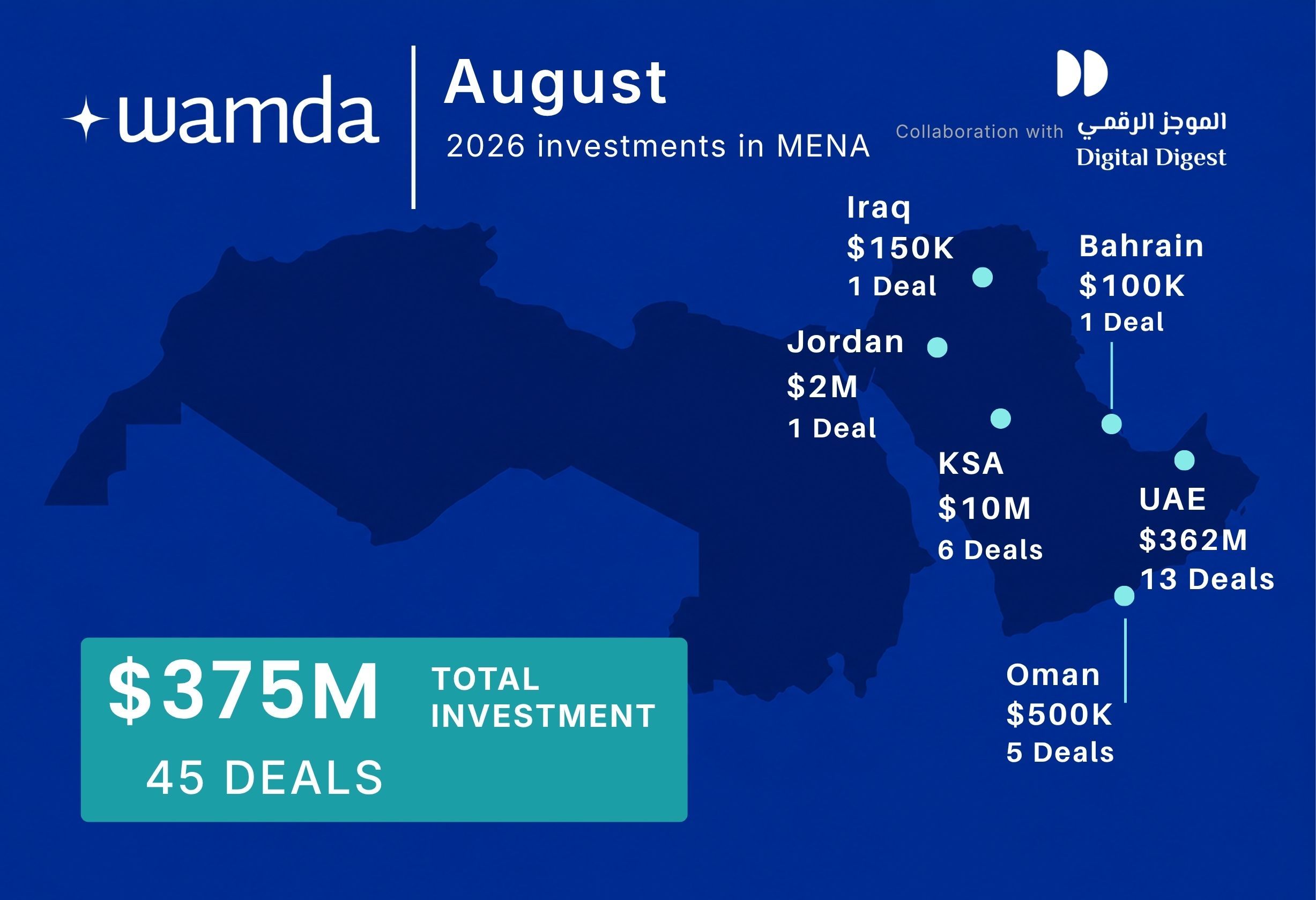
Startup funding across the Middle East and North Africa more than doubled in August 2026, even as dealmaking slowed sharply, with 27 startups raising a combined $375 million.
The total was 117% higher than July and 11% above August 2025. Yet the deal count fell 40% month-on-month, highlighting how heavily the month’s performance depended on a small number of large transactions.
The biggest was Moove’s $250 million Series C, which alone accounted for two-thirds of all capital deployed in August.
Still, the composition of funding marked a significant improvement from July. Debt accounted for only about 2% of total capital in August, compared with 56% the previous month, meaning the rebound was overwhelmingly driven by equity rather than structured financing.
The UAE returns to the top
The UAE reclaimed its position as MENA’s most-funded startup ecosystem in August, overtaking Saudi Arabia, which had led the regional rankings in July.
UAE startups raised $362 million across 13 deals, accounting for nearly 97% of all capital deployed in the region during the month. The total was largely driven by Moove’s $250 million round and Fasset’s $68 million Series C.
Saudi Arabia ranked a distant second, with six startups securing a combined $10.25 million.
Egypt, traditionally one of MENA’s three largest startup markets, recorded no startup funding rounds in August. Jordan moved into third place with $2 million from a single transaction.
Capital also reached some of the region’s smaller ecosystems. Five Omani startups attracted an estimated $500,000, while Iraq recorded a disclosed $150,000 round. Bahrain registered one transaction estimated at $100,000.
Moove pushes mobility to the top as fintech slips
Moove’s megadeal propelled mobility to the top of the sector rankings, with the company’s $250 million round accounting for all funding allocated to the sector.
Fintech slipped to second place despite attracting $83.8 million across six startups. Enterprise AI ranked third, with six startups raising a combined $21 million, while healthtech companies secured $9 million across two deals.
The sector rankings again underline the extent to which a single large transaction can reshape monthly funding data, particularly when overall deal activity remains subdued.
Later-stage funding returns
August also marked the return of sizable later-stage rounds.
Moove and Fasset raised a combined $318 million through two Series C transactions, accounting for almost 85% of all capital deployed during the month.
Early-stage companies nevertheless continued to dominate by deal count, with 22 startups at pre-seed, seed and Series A stages raising a combined $38 million.
Debt financing played only a limited role during the month. Naran’s $10 million financing was announced as a mix of debt and equity, while overall debt represented about 2% of August’s total funding.
B2B startups continue to capture most capital
Business-focused startups retained their position as investors’ preferred destination, attracting $282.5 million across 15 transactions, or about three-quarters of all capital raised in August.
Business-to-consumer startups secured $87 million across six deals, while companies operating across both B2B and B2C models raised $5.5 million through another six transactions.
Funding remains overwhelmingly male-led
The gender funding gap remained pronounced.
Male-founded startups secured $361 million across 22 deals, accounting for more than 96% of all capital deployed during the month.
Female-founded startups raised $8.5 million across two transactions, while mixed-gender founding teams attracted $5.5 million through three deals.
A concentrated rebound
August delivered a substantially stronger headline than July, and the sharp reduction in debt financing provides a more encouraging signal for equity investment. But the recovery remains highly concentrated.
One company accounted for two-thirds of the month’s funding, the UAE captured almost 97% of total capital, and the number of transactions fell 40% from July.
With one month remaining in the third quarter, MENA startups have raised about $547.6 million since the beginning of July — roughly half the amount deployed during July and August 2025.
The region also continues to operate against a volatile geopolitical backdrop, with renewed US-Iran hostilities and disruptions to shipping through the Strait of Hormuz weighing on markets and investor visibility.
August therefore offers evidence that investors remain willing to deploy substantial equity into select MENA companies, but it does not yet indicate a broad-based recovery. September’s deal flow will show whether the rebound can extend beyond megadeals and translate into wider investor participation.
These monthly reports are a collaboration between Wamda and Digital Digest.
September 7th 2026, 11:23 am
Salla acquires Saudi payments company Paylink
Wamda
- Saudi Arabia-based e-commerce platform Salla has acquired Saudi fintech Paylink as part of its strategy to expand its financial services and payment capabilities. The financial terms of the transaction were not disclosed.
- Founded in 2017 by Ammar AlTwaijri and Abdulelah Alsayegh, Paylink provides electronic payment solutions for businesses and merchants and is licensed by the Saudi Central Bank (SAMA) to provide e-commerce payment services.
- The acquisition will integrate Paylink’s payments infrastructure with Salla’s commerce ecosystem, enabling the company to develop payment acceptance and management solutions across online and physical sales channels.
- Salla plans to expand its point-of-sale payment offering, including SoftPOS, while using Paylink’s infrastructure to support international payments, multiple currencies and different payment methods.
Press release:
Salla, the leading Saudi platform for e-commerce solutions, announced its acquisition of Paylink, a company specialising in payment solutions, in a strategic step aimed at enhancing Salla's capabilities in the fintech sector and expanding the scope of financial solutions that enable merchants to manage and grow their businesses.
Paylink is a Saudi fintech company that carries the "Saudi Tech" label and is licensed by the Saudi Central Bank to provide e-commerce payment services. Over the past years, it has developed a specialised technical infrastructure in electronic payment solutions serving companies and merchants in the Kingdom.
This acquisition is part of Salla's strategy to build an integrated ecosystem that supports merchants at various stages of their business growth and to expand the platform's role beyond enabling sales and operations, reaching more advanced and smarter financial services built around the needs of merchants and their businesses.
By combining the capabilities of Salla and Paylink, Salla seeks to develop a more integrated experience for receiving and managing payments, whether in e-commerce or physical sales channels, paving the way for providing smart payment solutions at points of sale, including SoftPOS technologies that expand the merchant's ability to receive payments easily and flexibly wherever the sale occurs.
Paylink's capabilities also support Salla's direction towards enabling merchants to reach customers outside the local market and receive payments from around the world, as its infrastructure supports international sales cases, multiple currencies, and various payment methods, opening up greater opportunities for Saudi brands to grow and expand regionally and globally.
The step combines Salla's deep experience in the commerce sector and the needs of tens of thousands of merchants with the technical and regulatory expertise developed by Paylink in the payments sector, establishing a new phase of integration between commerce and financial services and giving the merchant a system more capable of keeping pace with their business growth and expansion into new channels and markets.
Nawaf Hariri, Founder and CEO of Salla, said:
"Since Salla's inception, our goal has been to enable merchants to build and grow their businesses through an integrated ecosystem that reduces complexity and provides them with the tools they need to grow. We believe that financial services are a natural extension of this vision; our acquisition of Paylink adds important capabilities and expertise to Salla that will help us build smarter and more integrated payment solutions and enable our merchants to receive payments wherever their customers are, whether online or at points of sale, inside and outside the Kingdom."
The acquisition reflects Salla's continued investment in the infrastructure for the future of commerce and the development of an ecosystem that links commerce, payments, and financial services in a more integrated manner, supporting the growth of Saudi brands within the Kingdom and helping them expand regionally and reach new markets and customers.
September 4th 2026, 9:54 am
Saudi autotech Syarah raises $12 million from Impact46
Wamda
- Saudi Arabia-based autotech startup Syarah has raised $12 million in a new funding round from Impact46 to expand its online marketplace for new and used cars across the Kingdom. The stage of the round was not disclosed.
- Founded in 2015 by Salah Sharef and Fayez Alanazi, Syarah operates an online automotive marketplace that allows customers to browse and purchase new and used vehicles digitally and have them delivered to their location.
- The investment will support Syarah’s nationwide expansion, as well as the continued development of its digital platform and delivery operations. The company has not disclosed a detailed breakdown of how the capital will be deployed.
- In 2024, Syarah closed a $60 million Series C round, led by Artal Capital, with participation from Elm, Impact46, Tawuniya, and Derayah Ventures.
Press release:
Saudi online automotive marketplace Syarah has raised $12 million in a new investment from Impact46 to expand its presence across Saudi Arabia’s new and used car market. The company did not disclose the stage of the funding round.
Syarah operates a digital car-buying platform that enables consumers to browse new and used vehicles, complete much of the purchasing process remotely and have their selected vehicle delivered directly to them, reducing the need to visit a traditional dealership.
The company already serves customers across all regions of Saudi Arabia and has handled thousands of purchases, according to Arab Founders. Its model combines an online automotive marketplace with nationwide vehicle delivery, giving customers outside major cities access to a wider selection of vehicles.
The fresh capital will support Syarah’s efforts to reach more customers across the Kingdom and further develop its digital platform and delivery operations as it scales nationwide. The company has not provided a detailed breakdown of how the investment will be allocated.
September 4th 2026, 9:54 am
Rwaj raises $1.2 million to scale live shopping marketplace
Wamda
- Saudi Arabia-based live shopping startup Rwaj has raised $1.2 million (SAR 4.5 million) in a pre-Seed funding round to scale its social commerce and auction marketplace across the region. The investors in the round were not disclosed.
- Founded in 2024 by Taher Alblowe, Rwaj operates a live social shopping marketplace that enables sellers to livestream products and sell them at fixed prices or through real-time auctions.
- The funding will be used to accelerate product development and support Rwaj’s growth and expansion across the region.
Press release:
Jeddah-based live shopping startup Rwaj has raised $1.2 million (SAR 4.5 million) in a pre-Seed funding round as it looks to scale its live social shopping and auction marketplace across the region. The investors participating in the round were not disclosed.
Founded in 2024 by Taher Alblowe, Rwaj provides a social commerce platform that allows sellers to livestream products and offer them either at fixed prices or through timed auctions where buyers can bid in real time.
The startup brings several elements of the live commerce process into a single platform, including livestreaming, bidding, payments and shipping. Payments are held in escrow until buyers confirm delivery, while shipping is handled through integrated carriers. Buyers can pay using Mada, Apple Pay or cards.
Rather than focusing on a single product category, Rwaj is designed for products that benefit from live demonstrations. The platform also incorporates social features that allow buyers to follow sellers, discover new merchants and return to future livestreams.
The company will use the new funding to accelerate product development and expand its presence across the region.
September 4th 2026, 9:54 am
Saudi FlyAkeed secures $25.15 million to scale enterprise travel platform
Wamda
- Saudi Arabia-based corporate traveltech platform FlyAkeed has secured SAR 94.3 million ($25.15 million) in growth funding, combining an equity investment and Murabaha sukuk financing.
- The equity investment was led by Sanabil Investments, a PIF-owned investment company, with participation from Artal Capital, stc Group’s corporate venture capital fund tali ventures, and Aljazira Capital, while Artal Capital led the Murabaha sukuk financing.
- Founded in 2015 by Bassam Almohammadi, FlyAkeed provides a corporate travel management platform that enables businesses to manage flights, hotels, ground transportation, approvals, travel policies and spending through a single system.
- The funding will primarily support the launch and expansion of an embedded deferred-payment offering for large enterprises, allowing corporate customers to settle travel invoices on more flexible payment terms.
Press release:
Saudi Arabia-based corporate travel technology platform FlyAkeed has secured SAR 94.3 million ($25.15 million) in growth funding, combining an equity investment with Murabaha sukuk financing. The financing was announced at LEAP 2026 in Riyadh.
The equity portion was led by Sanabil Investments, an investment company wholly owned by Saudi Arabia’s Public Investment Fund (PIF), with participation from Artal Capital, stc Group’s corporate venture capital fund tali ventures, and Aljazira Capital. Artal Capital also led the Murabaha sukuk financing, providing FlyAkeed with a Shariah-compliant financing structure alongside the equity investment.
Founded in 2015 and headquartered in Riyadh, FlyAkeed operates a corporate travel management platform designed to centralise business travel processes. Employees can book flights, hotels and ground transportation within company policies, while businesses can automate approvals and manage travel policies, workflows and expenditure through a single dashboard.
The company currently serves more than 150 corporate clients across Saudi Arabia, including PIF, Maaden, Golf Saudi and the National Housing Company.
FlyAkeed plans to use the funding primarily to support a new embedded deferred-payment offering for large enterprises. The product is designed to allow corporate customers to settle travel invoices under more flexible payment terms.
The company is targeting Saudi Arabia’s expanding corporate travel market, where business travel expenditure exceeded $10 billion in 2024 and is projected to roughly double by 2033, according to figures cited by FlyAkeed.
“Corporate travel in our region still runs on phone calls, WhatsApp groups and spreadsheets. We are replacing that with an operating system: every trip inside policy, every riyal visible in real time, every approval in seconds,” said Bassam Almohammadi, founder and CEO of FlyAkeed.
“Large enterprises don’t just want better software; they want better payment terms. Now we give them both,” he added.
September 3rd 2026, 12:21 pm
3C Coding School raises $3 million seed for Saudi expansion
Wamda
- Egypt-based edtech startup 3C Coding School has raised $3 million in a seed round led by MRG Economic Group, with participation from investor Amr Saad and a group of strategic angel investors.
- Founded in 2015 by Hossam Hosny and Ahmed Khallaf, 3C Coding School provides coding and technology education for children and young people, offering programmes across software development, data science, AI, machine learning, game development and cybersecurity.
- The funding will be used to enter the Saudi Arabian market, strengthen 3C’s technology infrastructure and accelerate the development and deployment of its AI-powered personalised learning platform.
- The new platform will use AI to analyse students’ learning patterns and progress, support instructors and adapt course content to individual students’ pace and abilities.
Press release:
3C Coding School, a premier platform specialising in coding, technology, and artificial intelligence education for children and youth, has officially closed its $3 million Seed funding round. The direct equity investment was spearheaded by MRG Economic Group, led by Egyptian business leader Mahmoud Ramadan, with participation from prominent investor Amr Saad alongside a group of strategic angel investors.
This capital injection marks a major milestone in 3C Coding School's trajectory. It comes on the heels of impressive operational momentum, with the company expanding its user base to over 120,000 students and delivering a 230% surge in revenue. These metrics underscore the booming regional demand for specialised tech education, highlighting the strength of the market opportunity and the scalability of 3C’s underlying model.
Redefining Tech Education: Moving Beyond Traditional Coding
Co-founded in 2015 by engineers Hossam Hosny and Ahmed Khallaf, 3C Coding School was built to disrupt traditional computer science education for young learners. Moving beyond standard code writing and syntax, the platform focuses on fostering higher-order skills, equipping students with structured logical reasoning, creative problem-solving, and critical thinking.
Over the years, 3C has engineered a comprehensive learning ecosystem featuring diverse educational tracks across cutting-edge fields, including web and mobile app development, data science, AI, machine learning, game development, and cybersecurity.
The school's pedagogical framework centres on hands-on, project-based, and interactive learning. Curricula are carefully tailored to suit distinct age groups and skill levels, ensuring students not only acquire practical coding capabilities but also cultivate a mindset grounded in innovation and continuous inquiry.
To date, 3C has reached more than 120,000 young learners while maintaining a strong financial growth trajectory of 230% in revenue, proving both the efficacy of its curriculum and the growing appetite for specialised digital literacy among youth.
Strategic Roadmap: Saudi Market Expansion & Infrastructure Enhancement
3C Coding School plans to deploy the fresh capital into two core strategic pillars designed to catalyse its next growth phase: expanding into Saudi Arabia and accelerating the deployment of an AI-powered learning platform.
Establishing a Footprint in Saudi Arabia
Regional expansion into the Kingdom of Saudi Arabia stands at the forefront of 3C's immediate goals. The company aims to establish a formidable market presence, capitalising on the Kingdom’s rapidly accelerating digital economy, burgeoning EdTech sector, and skyrocketing demand for future-ready tech skills.
3C is actively refining its market entry strategy to deliver tailored educational tracks aligned with local requirements. The company plans to leverage strategic local partnerships to rapidly scale its student body and customer base across the Kingdom.
This move forms part of a broader vision to transition 3C from an Egypt-focused market leader into a multinational EdTech powerhouse capable of replicating its model across multiple high-growth Middle Eastern markets.
Next-Generation Tech: AI-Driven Personalized Learning
To redefine the student experience, 3C is channelling a significant portion of the investment into building a state-of-the-art, AI-powered learning platform.
By leveraging proprietary artificial intelligence algorithms, the new platform will analyse individual learning habits, assess real-time progress, support instructors, and dynamically adjust course content to match each student’s unique pace and capabilities.
Through this technological evolution, 3C aims to move past static e-learning formats, delivering an intelligent, highly personalised, and scalable educational framework capable of seamlessly serving millions of students across diverse geographies.
This investment in core infrastructure ensures that 3C's offerings remain data-driven, adaptive, and fully aligned with the fast-moving future of global educational technology.
Growth Highlights at a Glance
3C Coding School’s recent trajectory reflects a powerful growth story in the Middle Eastern tech ecosystem:
- Over 120,000 students empowered across specialised tech tracks.
- 230% increase in revenue growth.
- Continuous refinement of a scalable, resilient business model since 2015.
- Broad dynamic tracks covering AI, machine learning, software development, and cybersecurity.
- Hands-on, practical, project-centric learning model.
- Strategic shift from local market leadership toward aggressive regional scaling.
Looking ahead, 3C aims to leverage this foundation to solidify its market position, prioritising Saudi Arabia as its primary growth vector while continuing to innovate at the intersection of AI and education.
A Strategic Turning Point
Reflecting on the company’s trajectory, Hossam Hosny, Founder of 3C Coding School, stated: "When we launched 3C in 2015, we were driven by a core belief that technology would become an indispensable part of every child’s future. Coding isn't just for future software engineers; it is a fundamental medium for teaching kids how to think, innovate, and solve complex problems."
He added: “Over the years, through constant learning and development, we have built a vibrant ecosystem encompassing more than 120,000 students. For us, that number represents far more than market traction; it represents over 120,000 lives impacted and empowered to navigate the future. This funding round marks a strategic turning point, not merely because of the financial backing, but because of the deep confidence our investors have placed in our vision to build a transformative EdTech platform for the entire region."
Hosny highlighted that securing institutional backing from MRG Economic Group, led by Mahmoud Ramadan, alongside Amr Saad and leading angel investors, brings far more than capital. It supplies strategic depth, market access, and valuable industry expertise necessary for large-scale expansion.
"We don't view the next phase as simple geographic expansion," Hosny added. "It is an opportunity to reinvent how the next generation interacts with and learns technology. That is why AI development lies at the very heart of our forward-looking strategy. Our ultimate mission is to bring accessible, high-impact tech education to millions of young minds across the region, transforming them from mere consumers of technology into the creators and innovators of tomorrow."
Stepping Into an Ambitious New Chapter
Echoing this enthusiasm, Ahmed Khallaf, Co-Founder of 3C Coding School, noted: "Securing a $3 million Seed round is a landmark milestone for 3C. However, we see this investment not as a final destination but as the launching pad for an even more ambitious chapter in our journey."
Khallaf underscored that since day one, 3C's mission transcended standard coding instruction, striving instead to reshape how young minds approach challenges and harness technology to shape their world.
He pointed out that reaching 120,000 students and driving 230% revenue growth validates the strong market demand for high-calibre tech education across Egypt and the broader MENA region.
"This strategic investment, led by MRG Economic Group and our esteemed investment partners, gives us the firepower to accelerate our technical infrastructure, elevate our core product offerings, enter the Saudi market, and fast-track the deployment of our AI platform," Khallaf concluded. "The future of education will be personalised, intelligent, and deeply integrated with technology. 3C is committed to leading that transformation, building one of the region's top EdTech platforms, and equipping millions of students with the critical skills required to excel in a rapidly evolving digital world."
September 3rd 2026, 12:21 pm
OmniOps, HPE sign MoU at LEAP to advance sovereign AI solutions
Wamda
Press release:
OmniOps, Saudi Arabia's sovereign AI infrastructure technology company, today announced at LEAP the signing of a Memorandum of Understanding (MoU) with HPE to develop sovereign AI solutions that bring together HPE’s ‘Saudi Made’ infrastructure and OmniOps’ Saudi-developed AI platforms and in-country deployment capabilities. Aligned with HPE’s Saudi Made, Developed & Deployed (SMDD) initiative, the collaboration aims to help government and enterprise organisations accelerate AI adoption while strengthening digital sovereignty and local technology capabilities.
Combined with OmniOps' deployment infrastructure and enterprise AI management capabilities, this collaboration creates an end-to-end stack in which the servers, infrastructure and AI management layers are built in Saudi Arabia and operating within its jurisdiction.
While data residency and local model deployment have become central to sovereign AI strategies, organizations are increasingly looking further down the technology stack at the infrastructure their workloads run on. By integrating locally produced compute with locally operated AI infrastructure and software, OmniOps is extending that control from hardware through deployment and enterprise AI management.
Through the collaboration, HPE and OmniOps plan to combine locally produced infrastructure with Saudi-developed AI platforms and in-country deployment expertise to help organizations move from AI experimentation to production. Reflecting the vision of the SMDD initiative, the companies aim to develop sovereign AI solutions that can be validated, deployed and supported within the Kingdom, while creating new opportunities to commercialize Saudi technology innovation.
"Achieving sovereignty across an entity’s tech stack means careful consideration at every level,” Mohammed Altassan, Founding CEO of OmniOps, commented: “Today, our customers across government, aviation and financial services require more control and transparency. Running our own software on servers produced here in the Kingdom means we can answer all three of their immediate needs: where their data sits, who built the platform running on top of it and where the hardware underneath it comes from. That is what a genuinely sovereign stack looks like, and it is what the National Strategy for Data and AI was built to enable."
Mohammad Alrehaili, VP & Managing Director for the Middle East at HPE, said: “This collaboration with OmniOps brings the vision of Saudi Made, Developed & Deployed to life and will give organizations in Saudi Arabia a strong foundation for deploying sovereign AI at scale. Together we will help accelerate AI adoption and support the continued growth of the Kingdom’s technology ecosystem.”
OmniOps' offering is anchored by Bunyan, its AI inference platform, which enables organizations to deploy and manage AI workloads across cloud, on-premises and air-gapped environments according to their security, regulatory and operational requirements. Bunyan gives organizations access to leading LLMs hosted in the Kingdom, alongside the infrastructure and building blocks needed to securely adopt and deploy GenAI across their organizations. Its hardware-agnostic architecture also allows OmniOps to integrate locally produced compute while preserving customer choice across different AI infrastructure providers.
September 3rd 2026, 12:21 pm
Saudi Nayla lands $18 million to expand micro-business financing
Wamda
- Saudi Arabia-based fintech Nayla has secured approximately $18 million in a pre-Series A round, comprising a mix of equity and debt financing.
- The equity portion was led by Idrisi Ventures, with participation from Suhail Ventures and other strategic investors, while BLOMINVEST led the debt facility.
- Nayla was built through Sanabil Studio and says it is the first venture launched by the studio to close an institutional funding round.
- Founded in 2024 by Shaqran Alyahya and Khalid Naili, Nayla provides AI-powered lending solutions for micro-businesses in Saudi Arabia, focused on providing faster access to digital financing.
- The new capital will be used to accelerate Nayla’s AI-powered lending products and expand financing access for micro-businesses across Saudi Arabia.
- In 2024, Nayla secured $4 million in seed funding, led by Sanabil Venture Studio by Stryber.
Press release:
Saudi Arabia-based fintech Nayla has closed an approximately $18 million pre-Series A funding round comprising a mix of equity and debt financing, the company announced at LEAP 2026 in Riyadh.
The equity portion of the round was led by Idrisi Ventures, with participation from Suhail Ventures and other strategic investors, while BLOMINVEST led the debt facility.
Nayla was built through Sanabil Studio and said the latest financing makes it the first venture launched by the studio to successfully close an institutional funding round.
The company provides AI-powered lending solutions aimed at expanding access to fast, digital financing for micro-businesses across Saudi Arabia.
Nayla plans to use the new capital to accelerate the development of its AI-powered lending solutions and significantly expand the availability of financing to micro-businesses across the Kingdom.
The company said its expansion is aligned with Saudi Arabia’s Vision 2030 objectives and the role of micro-enterprises in the Kingdom’s economic development.
Nayla thanked its investors and partners for their backing and said it would continue developing its financing products to support the growth of its customers and their businesses.
September 3rd 2026, 12:21 pm
Saudi AQAR plans up to $480,000 strategic investment in Syria’s Doushesh
Wamda
- Saudi Arabia-based real estate platform AQAR has signed a memorandum of understanding with Syrian classifieds company Doushesh for a strategic investment of up to $480,000.
- The proposed investment will be structured through a Simple Agreement for Future Equity (SAFE), with the capital to be deployed in tranches linked to agreed growth milestones.
- Founded in 2025 by Alaaeddin Zarzour and Zafer Odabashi, Doushesh provides a classifieds marketplace, covering real estate, vehicles, electronics, furniture, jobs, and services.
- The investment is intended to support the growth and expansion of Doushesh’s classifieds platform in Syria, with a wider focus on digital infrastructure in the real estate and classified advertising sectors.
- Earlier this year, Doushesh closed a pre-seed funding round.
Press release:
Saudi Arabia-based real estate platform AQAR has signed a memorandum of understanding with Syrian classifieds company Doushesh, paving the way for a strategic investment of up to $480,000.
Under the proposed transaction, AQAR will invest through a Simple Agreement for Future Equity (SAFE), with the funding to be provided in tranches linked to Doushesh achieving agreed growth milestones.
The investment is intended to support the development and expansion of Doushesh’s classified advertising platform, which serves the Syrian market.
The agreement also seeks to support the development of digital infrastructure for the real estate and classified advertising sectors, as Syria’s entrepreneurial ecosystem begins attracting greater regional interest.
The MoU was signed by Ibrahim Al-Shehail, CEO of AQAR, and Alaa Al-Din Zarzour, CEO of Doushesh.
September 3rd 2026, 12:21 pm
Jordan’s Abwaab acquires Egyptian edtech Eduact
Wamda
- Jordan-based edtech Abwaab has acquired the Egyptian education technology startup Eduact for an undisclosed amount, expanding its offering to include digital infrastructure for teachers and learning centres.
- Founded in 2020 in Egypt by Adham Hamed and Ali Hisham, Eduact provides a SaaS platform that enables independent teachers and learning centres to manage content, grading, payments and workflows spanning online and offline education.
- Founded in Jordan in 2019 by Hamdi Tabbaa, Sabri Hakim and Hussein AlSarabi, Abwaab provides curriculum-aligned digital learning and assessment products and currently operates across six MENA markets.
- Abwaab plans to integrate Eduact’s technology into its wider platform and use its regional reach to expand the product to more teachers and learning centres in Egypt and other markets.
- The transaction marks Abwaab’s second acquisition in 2026, following its acquisition of Egyptian university admissions startup Apex Education earlier this year.
Press release:
Jordan-based education technology company Abwaab has acquired Egyptian edtech startup Eduact for an undisclosed amount, as it expands its platform beyond student-focused digital learning to provide technology infrastructure for independent teachers and learning centres.
Founded in Egypt in 2020 by Adham Hamed and Ali Hisham, Eduact provides software-as-a-service tools for independent educators and small learning centres. Its platform allows users to manage video content, grading and payments while connecting workflows across physical and online learning.
The acquisition will bring Eduact’s technology and relationships with Egyptian educators into Abwaab’s broader platform. Abwaab plans to use its technology, content and regional distribution network to extend Eduact’s offering to more teachers and learning centres across Egypt and other markets.
Founded in Jordan in 2019 by Hamdi Tabbaa, Sabri Hakim and Hussein AlSarabi, Abwaab provides curriculum-aligned online learning, assessments and other education services. The company currently operates across six markets in the MENA region.
“We’ve always believed that transforming education in the Arab world isn’t about one company doing everything; it’s about finding the best teams solving real problems on the ground and building with them,” said Hamdi Tabbaa, co-founder and CEO of Abwaab. He added that Eduact had spent years building relationships with teachers and learning centres across Egypt.
The transaction is Abwaab’s second acquisition this year. Earlier in 2026, it acquired Egypt-based Apex Education, which specialises in international university admissions, extending Abwaab’s offering into higher education preparation and admissions advisory.
September 3rd 2026, 12:21 pm
BitOasis names Jonathan Rigg CEO to lead next phase of growth
Wamda
Press release:
BitOasis, a CoinDCX company and one of the Middle East and North Africa's pioneer and leading regulated digital asset platforms, today announced the appointment of Jonathan Rigg as Chief Executive Officer.
Mr. Rigg succeeds Ola Doudin, who co-founded BitOasis in 2016 and has led the company over the past years to become the region's most established crypto platform.
The appointment marks the next stage in BitOasis's development as it deepens its presence across the MENA region. The platform has recorded approximately $8.5 billion in spot trading volume and serves a client base spanning retail investors, family offices and institutions across the UAE, Bahrain and the wider market.
"Over the years, we've worked to build more than a company; we've helped kickstart and lay the foundations for the digital asset industry across the region, and with that BitOasis has become one of the most trusted crypto brands across the GCC. From navigating an emerging market, achieving important regulatory milestones to serving more than a million customers in the region, every achievement has been the result of exceptional commitment towards our mission from day one. I couldn't be more confident in handing the business over to Jonathan, whose experience and leadership make him the right person to lead BitOasis through its next phase of growth," said Ola Doudin, Co-Founder of BitOasis.
"I am delighted to welcome Jonathan to the BitOasis family. He joins us as Chief Executive Officer at an important moment for the business, and I am confident his experience will help take the platform into its next chapter. I am deeply grateful to Ola for building an exceptional brand and an equally exceptional team, one that has been instrumental in enabling access to crypto across the region," said Sumit Gupta, Co-Founder of CoinDCX. In 2024, CoinDCX, India's leading crypto exchange, acquired BitOasis.
Mr. Rigg is a senior financial services commercial leader with an extensive track record spanning global banking, digital assets and fintech platforms. He has direct P&L ownership experience scaling businesses from pre-revenue to profitability, including the monetisation of crypto infrastructure; OTC trading, stablecoin payments and Banking as a Service. A hands-on operator, he has launched regulated platforms, built high-performing commercial teams, and is well connected across the region's regulators, financial institutions and enterprise clients.
Mr. Rigg brings close to a decade of experience in global banking and markets, with previous roles at HSBC and Deutsche Bank, predominantly in prime brokerage and capital advisory. Most recently he spent three years at Fuze Finance as Vice President, Commercial, where he was part of the founding team and helped scale the business from inception.
"It's an honour to join BitOasis at such an important point in its journey. Ola and the team have built an exceptional platform with a strong reputation across the region, and my role is to build on that foundation. Together, we will continue strengthening our products, expanding our capabilities, and delivering the high standards our customers, partners and regulators expect. Trust and safety will continue to remain a central lever in everything we do, ensuring customers can engage with confidence as the platform grows. BitOasis has played a defining role in shaping the digital asset ecosystem across the MENA region, and I'm excited to lead the company into its next chapter," said Jonathan Rigg, incoming Chief Executive Officer of BitOasis.
In May 2025, the company launched BitOasis Bahrain following the grant of a broker dealer license from the Central Bank of Bahrain, extending its regulated footprint beyond the UAE. Its OTC desk now serves institutional clients with the liquidity and execution certainty they require, and the company has secured regulatory approval for derivatives products that are moving toward market launch.
"I am thrilled to welcome Jonathan at such a pivotal time for BitOasis. Having built a strong foundation of trust and regulatory compliance across the region, including our operations here in Bahrain, we are in a prime position for our next phase of growth. I look forward to working closely with him to further strengthen our brand, expand our footprint, and cement BitOasis as the leading, most trusted crypto platform across the MENA region," said Ali Dashti, General Manager, BitOasis Bahrain.
These milestones, together with the continued integration with CoinDCX, position BitOasis at the center of the region's digital asset ecosystem.
September 3rd 2026, 12:21 pm
Enhance raises $18.2 million in equity-debt round
Wamda
- GCC-based fitness technology company Enhance has raised $18.2 million in equity and venture debt, with Global Ventures participating in the equity financing and Stride Ventures providing venture debt.
- Founded in Dubai in 2018 by Tarek Mounir, Enhance started as a personal training services business before evolving into a SaaS platform that helps multi-site gym operators manage and scale their personal training operations.
- Enhance operates across the UAE, Saudi Arabia, Qatar, Bahrain and the US, with Saudi Arabia described by the company as its fastest-growing market outside the US.
- The new capital will primarily be used to accelerate Enhance’s expansion in the US, where its enterprise software has been licensed since January 2025.
Press release:
Enhance, the operating system for personal training (PT), announces an $18.2 million equity/debt fund raising.
Institutional investors include Global Ventures – the leading MENA venture capital firm (equity) – and Stride Ventures (venture debt).
The growth capital provided in the round will be used to accelerate Enhance’s expansion in the United States. As the world’s largest gym market, the US is Enhance’s centre of gravity and where its model generates the most value.
Enhance’s enterprise software has been licensed in the US since January 2025 and is now present in 700+ clubs across major national chains such as Crunch Fitness – one of America’s largest gym chains – In-Shape Family Fitness; UFC Gym; and PureGym USA. A significant operational milestone, Enhance is among the first GCC-built software platforms to be exported and deployed at scale in the US market.
Across its markets, Enhance supports 15,000 personal trainers and over 500,000 booked PT sessions a month. Revenue has compounded at 65% CAGR since 2019.
Tarek Mounir, Founder and CEO of Enhance, said:
“We are delighted to add growth capital and to diversify our capital structure from a position of strength. We are becoming the global operating system for Personal Training, amid the popularity in the United States – the world’s largest gym market – of our GCC-built SaaS platform that redefines how PT services are delivered and managed. With more US expansion ahead and the prospect of other international markets being perfectly suited to our system, we look forward to the future with confidence.”
The market outlook is positive. PT is the most profitable revenue line in fitness but the least systematised. Enhance is the operating system for PT, helping large gym chains in the high-volume, low-price (HVLP) segment turn PT from an afterthought into predictable, profitable revenue streams.
A typical HVLP gym with 10,000-12,000 members that converts just 3%-4% of its members into PT produces revenue comparable to the location's overall membership revenues. Enhance’s enterprise-level software makes that conversion manageable at scale. At mature HVLP sites using Enhance, PT revenues can reach $85,000 per club per month – a compelling long-term value case for gyms.
Enhance’s three-to-five-year vision is to be the system of record and operating standard for the $42 billion global PT market – the platform gym operators default to the way hotel groups default to property management software or restaurants default to reservation systems. This category does not exist yet and Enhance is building it. Enhance is pursuing strategic partnerships in the US that reflect this logic – enterprise gym groups seeking operators they can trust to run PT end-to-end, beyond just software.
The GCC market environment is also positive, as a structural shift has occurred in how consumers approach health. Contemporary gym users are sophisticated and now seek guidance on strength, recovery, energy, and long-term health span – a significant vocabulary shift in under a decade. Consumer demand in some GCC markets is outpacing the supply of qualified personal trainers, showing the ceiling is still far above where the market is today.
In the GCC, the Company’s anchor partner is GymNation – for whom Enhance runs the entire PT operation, end-to-end, across all locations in the UAE, KSA and Bahrain. Outside the US, KSA is the Company’s highest growth market and where Enhance is seeing more first-time formal fitness participants than in any other geography it operates in. Enhance also operates in Qatar.
Enhance benefits from significant barriers to entry. Every PT session Enhance has supported over the last eight years, which is a data point on what makes a personal trainer successful, why members stay at or leave a gym, and where a gym’s revenue leaks out. New market entrants would require almost a decade of operational history to rebuild this, which cannot be shortcut with capital.
Enhance is also an AI-native company managing an optimal overlapping of technology and trainers. AI accelerates the creation and automation of PT programmes, while the trainer remains in charge of the relationship. Technology handles the production layer, and the human handles the part the gym client is actually paying for.
Noor Sweid, Founder and Managing Partner at Global Ventures, commented:
"Global Ventures has backed Enhance across successive rounds, and our belief in the business has only deepened over that period. From the outset, Tarek and the team were building for global markets, and the company's establishment in the US, alongside its GCC operations, reflects the scale of that ambition. Enhance demonstrates that companies founded in this region can compete and win in the world's most developed markets."
Varun Agarwal, Partner at Stride Ventures, said:
"Enhance is proof of what this region can produce – a homegrown, category-defining and already the go-to partner for the likes of GymNation across the GCC markets. That same conviction is now underpinning the expansion into the US, the world's largest gym market, and we are excited to support the next leg of growth for Enhance."
September 3rd 2026, 12:21 pm
COFE Tech closes pre-IPO round at $178 million valuation
Wamda
- Kuwait-founded enterprise technology company COFE Tech, formerly COFE App, has closed a pre-IPO funding round at a $178 million valuation, co-led by Wa’ed Ventures, Aditum Investment Management, Masarrah Investment Company and Alyasra Foods. The value of the investment was not disclosed.
- Founded in Kuwait in 2018 by Ali Al-Ebrahim, COFE has evolved from a consumer coffee marketplace into an enterprise technology company that provides AI-powered procurement and commerce infrastructure, alongside its consumer marketplace.
- The company said the investment will support its continued expansion across MENA and preparations for a targeted IPO on the Saudi Exchange by 2029.
- In 2023, Cofe closed a $15 million Series B round led by Wa'ed Ventures, with participation from eWTP Arabia Capital, Al Imtiaz Investment Group, KISP Ventures (KFH Capital) and Rasameel Investment Company.
Press release:
COFE Tech (formerly COFE APP), the leading operator of agentic AI enterprises and the provider of intelligent procurement and commerce infrastructure to more than 1,000 businesses across the Gulf, announced today at LEAP 2026 the close of a pre-IPO funding round valuing the company at $178 million. The round was co-led by Wa'ed Ventures, the domestic venturing arm of Aramco, Aditum Investment Management, the regional fund partner to global financial giants like BlackRock, Masarrah Investment Company and Alyasra Foods. The investment puts COFE Tech, dubbed as the “Salesforce of MENA”, on course for a targeted IPO on the Saudi Exchange by 2029, aligned with the ambitions of Saudi Vision 2030.
“Too many companies in our region still run procurement, sales and inventory on systems that do not talk to one another, and that gap costs them efficiency at every step,” said Ali Al-Ebrahim, founder and CEO of COFE Tech. “COFE Tech brings those operations into a single intelligent platform, where agents watch the business, anticipate what it needs and act on its behalf, before a shelf runs empty or a customer is kept waiting. The backing from Wa'ed Ventures, Aditum Investment Management, Masarrah Investment Company and Alyasra Foods reflects confidence in our read on where enterprise software in the Gulf is heading, and we intend to turn that into continued growth across the MENA region.”
Al-Ebrahim added: “Since COFE launched out of Kuwait in 2018, we have expanded quickly across the Gulf, including the UAE and Saudi Arabia. The business and innovation environments in Kuwait, Saudi Arabia and the UAE are what made that pace possible. COFE Tech today is a working example of what the innovation-enabling economic visions of the Gulf countries can produce when they line up, and of the AI-ecosystem this region gives ambitious Gulf companies to grow and scale regionally. We thank all our investors for their continued trust and confidence in our vision, and for their support for our team.”
“COFE Tech is built as one core with two engines, a foundation flexible enough for an enterprise to start with a single workflow and extend across its whole operation without re-platforming,” said Shahood Siddiqui, Chief Technology Officer of COFE Tech. “That architecture is proving itself in production: enterprises across the Gulf have transformed how they run growth, procurement and finance on it, with our agents working inside their day-to-day decisions. This round lets us take that foundation further.”
Anas Algahtani, Chief Executive Officer at Wa’ed Ventures, said: “COFE Tech has demonstrated an impressive ability to evolve from a consumer marketplace into an enterprise technology platform addressing critical procurement and commerce challenges. Its growing adoption across Gulf enterprises validates both the strength of its technology and the scale of the opportunity ahead. We see significant potential for COFE Tech to deepen its presence in Saudi Arabia and build an institutionally ready technology company with long-term regional relevance.”
“Aditum Venture Capital Fund’s participation in this round reflects its approach to identifying compelling investment opportunities globally and across regional markets in MENA, supported by Aditum Group’s presence in UAE and Saudi Arabia,” stated Manoj Mahadev, Head of Investments, Aditum Investment Management.
“COFE Tech represents the type of opportunity Aditum VC looks for, combining disciplined expansion across key regional markets with a growing enterprise business and an evolving governance framework that positions the business for its next stage of growth. This combination of regional growth potential and institutional capabilities is central to how Aditum evaluates VC investment opportunities,” stated Sonali Goila, Head of VC, Aditum Investment Management.
Dalal Al Mutlaq, Principle and Board member at Masarrah Investment Company, said: “Building enduring businesses requires patient capital and the ability to support companies as they move into more ambitious stages of development. COFE Tech has grown from its roots in Kuwait into a technology business serving more than 1,000 enterprises across the Gulf region, while continuing to broaden the role its platform plays for enterprise customers. Masarrah sees strong potential in the company’s next chapter and the value it can build as it continues to scale.”
Yousef Nasser Alfulaij, Head of Real Estate and Projects at Alyasra Group, said: “Our participation in this round reflects our strong conviction in the company’s growth potential and the opportunity for ambitious technology companies to build a strong foundation in the region and scale from here. Since its founding, COFE has demonstrated a clear ability to evolve and enter new markets, reinforcing our confidence in the management team’s ability to lead the company through its next phase of growth, strengthen COFE’s presence across the GCC, and expand beyond the region.”
The closing of COFE Tech’s funding round was announced during LEAP 2026 in Riyadh, with the company represented by Founder and CEO Ali Al-Ebrahim and Co-Founder Hamad Musaed Al-Sayer, alongside representatives of the participating investors.
The latest round of investment backs the progress COFE Tech has made in growing from a consumer marketplace to an operator of agentic AI enterprises, along two principal tracks. The first is Agentic Procurement, a unified enterprise procurement infrastructure solution. The second is Agentic Commerce, a unified enterprise technology infrastructure solution. Both run alongside the company’s direct-to-consumer marketplace, the business where the platform was first built and proven.
COFE Tech today serves more than 1,000 clients across 3,000 outlets in Saudi Arabia, Kuwait and the United Arab Emirates, spanning coffee shops and restaurants, hotels, hospitals, education, aviation and corporates. Clients include Emirates, Etihad Airways, Kuwait Airways, Al-Futtaim Group, Kuwait Finance House, the Central Bank of Kuwait, stc, Aramco and Alibaba Cloud, among others.
September 3rd 2026, 12:21 pm
Sirdab raises $10 million Series A to expand across GCC
Wamda
- Saudi Arabia-based logistics startup Sirdab has raised $10 million (SAR 37.5 million) in Series A funding, co-led by PIF-backed digital solutions company Elm and existing investor BECO Capital.
- Founded in 2022 by Naif Alzahri and Abdulrahman Alnamlah, Sirdab provides a technology platform that enables businesses to access and manage warehousing and transportation services, inventory and orders across multiple locations through a single system.
- The funding will be used to expand across Saudi Arabia and the wider GCC, grow Sirdab’s logistics network and further develop its technology platform, including AI capabilities for matching businesses with available capacity and automating coordination between shippers, warehouses and carriers.
Press release:
Sirdab, the company building the logistics infrastructure layer for Saudi Arabia and the GCC, has raised $10 million in Series A funding. The round was co-led by new investor Elm, the PIF-backed digital solutions company, and existing investor BECO Capital. Other backers include Y Combinator, COTU Ventures and D Global Ventures.
Founded in 2022, Sirdab enables companies to access, manage and scale their logistics through a single platform. Businesses secure verified warehousing and transportation, manage inventory and orders across locations, and monitor service levels in one place, while providers use Sirdab's software to standardise operations, share capacity and manage billing and compliance.
Sirdab has grown revenue 20x since graduating from Y Combinator's Winter 2023 batch while reaching profitability. Its clients include major government entities, publicly listed companies, and leading enterprises across multiple sectors, among more than 850 businesses using the platform. Its network spans 120+ warehouses and 60+ transportation providers, supporting dry, ambient, chilled, and frozen logistics.
Sirdab operates an asset-light network, complemented by strategically located company-operated facilities in key hubs. Its proprietary software enables this distributed infrastructure to function as one connected system, giving businesses flexibility, visibility and control as they scale, and giving providers new demand and standardised operations.
"Saudi Arabia is building one of the most dynamic logistics markets in the world, and businesses here have enormous room to grow," said Naif Alzahri, co-founder and CEO of Sirdab. "Sirdab gives them the infrastructure to grow on. We make quality capacity accessible in days, keep operations visible in real time and hold service to a consistent standard, so companies can expand into new cities and categories with confidence. This funding allows us to bring that to many more businesses across the Kingdom and the GCC."
The funding will support Sirdab's expansion across Saudi Arabia and the GCC, the growth of its network and further development of its platform, including AI that matches businesses to the right capacity and automates day-to-day coordination between shippers, warehouses and carriers.
September 3rd 2026, 12:21 pm
Dubai’s growing role in the global digital economy
Wamda
An article by Artem Shargin, a UAE-based entrepreneur and co-founder and chief operating officer of 0to8.
In the digital economy, geography works differently. But it has not stopped mattering.
Twenty years ago, an internet company seeking credibility, capital and global reach often looked first to Silicon Valley. Today, companies can be built from almost anywhere. What still varies significantly is how easy a place makes it to operate once a business begins crossing borders.
Dubai has become one of the places from which founders can run global companies day to day, coordinating teams, banking, legal structures and partnerships from the city while the business itself operates across multiple markets. A decade ago, founders seeking that kind of international reach were more likely to default to San Francisco, London or Singapore.
That does not make Dubai the right base for every company. Operating costs can be high, specialist talent is not always available locally, and businesses focused primarily on a single domestic market may find other locations more efficient.
For companies whose teams, customers and partners are distributed across regions, however, Dubai offers something different: a place from which those relationships can be coordinated.
A base for globally distributed businesses
My own experience reflects this shift.
Having built companies in digital fashion and music from the UAE, I have seen how differently a business can now be structured. Teams, creative talent, audiences, partners and customers do not have to be concentrated in the same country as the company’s headquarters.
My current business operates from Dubai while working across multiple markets. That experience has reinforced a broader point: a company can be headquartered in the UAE while its capabilities, audiences and commercial relationships are distributed around the world.
The broader ecosystem has moved in the same direction. Startup Genome's 2026 Global Startup Ecosystem Report values Dubai's startup ecosystem at $30 billion and ranks it No. 2 in MENA, making it the highest-ranked Gulf ecosystem.
But a growing ecosystem does not mean every company will find all the talent, customers or capital it needs within the city itself. Dubai's strength is increasingly its ability to connect companies to international markets rather than replace those markets.
Dubai as a coordination layer between markets
Founders choose a base for operational reasons. For internationally distributed businesses, Dubai's geography makes working across time zones unusually practical: teams can coordinate with Asia earlier in the day, Europe through the working day and the Americas later on.
Connectivity matters just as much.
Distributed teams and partners still need to meet in person. By the end of the first half of 2026, Dubai International Airport was connected to 217 destinations across 99 countries. For a business built around international relationships, having an accessible meeting point can matter as much as having a physical office.
This is where Dubai's role as a bridge becomes more interesting.
A company can build audiences in Latin America, work with partners in Europe and serve customers in the United States while coordinating the business from one location. Dubai becomes the layer connecting those relationships rather than the final destination for all of them.
That matters as global growth becomes less centred on a small number of Western hubs. Opportunities are emerging across Asia, the Middle East, Africa and Latin America. A company based in Dubai can operate between those markets rather than having to choose one geographic centre.
The city's cultural position also plays a role. Dubai brings together brands, creators and businesses across music, fashion, sport, entertainment and other parts of digital culture. For companies whose products travel through online communities, that proximity can create opportunities for partnerships, distribution and audience development.
Dubai does not eliminate the need to build teams, relationships and market knowledge elsewhere. That is precisely what makes its role different from a traditional hub. Rather than concentrating every function in one city, it can serve as a place from which distributed operations are coordinated.
The creator economy strengthens this model
The rise of the creator economy reinforces the same shift.
A UAE economic impact report from TikTok, developed with Redseer Strategy Consultants, estimated that activity by TikTok-enabled small and medium-sized businesses contributed AED 1.1 billion to the UAE economy and supported more than 7,000 jobs.
Those figures do not represent the entire creator economy, but they illustrate how digital distribution is increasingly translating into business formation and economic activity.
As creators become entrepreneurs, their needs also change. They require company structures, banking, licensing, tax support and access to professional services, while still depending on audiences and commercial relationships in markets around the world.
The UAE has begun building dedicated infrastructure around that transition. Creators HQ, launched in Dubai in 2025, grew out of the AED 150 million Content Creators Support Fund established under the directives of Sheikh Mohammed bin Rashid Al Maktoum. The initiative provides creators with support around company setup and registration, relocation and access to funding and investors.
The significance is less about any one initiative than what it represents: creator-led businesses are increasingly being treated as companies that need the same operating infrastructure as other digital ventures.
And, again, Dubai does not replace the markets where creators build their audiences. Its role is to provide an operating base from which those markets can be connected.
What this means for MENA founders
The bigger shift for founders across MENA is the separation of where a company is headquartered from where its capabilities and markets are located.
A founder might build with engineering talent in Egypt, develop commercial relationships in Saudi Arabia, raise capital through the UAE and sell into Europe, Asia or the United States without treating relocation to London or Silicon Valley as a prerequisite for global growth.
That creates a more distributed model of entrepreneurship.
Different ecosystems can contribute different capabilities. Dubai can function as a regional and international coordination hub. Saudi Arabia offers access to the region's largest economy and an expanding capital base. Egypt has a large pool of technical and creative talent. Other markets contribute their own expertise, customer bases and competitive advantages.
The opportunity is not for every city to become the next Silicon Valley. It is for these ecosystems to become more connected and complementary.
For founders, the question increasingly becomes not, “Where should I move my company?” but, “Where should each part of my company live?”
Headquarters, product development, talent, fundraising and market entry do not necessarily need to happen in the same place.
Dubai's potential advantage lies in its position at the centre of those connections.
The model also works in both directions. Dubai can serve as a base from which MENA companies reach international markets and as an entry point for global companies building relationships in the region. Its value lies on both sides of that bridge: regional businesses looking outward and international businesses looking inward.
For MENA, the implications extend beyond individual startups. If companies build globally while keeping their core operations connected to the region, more intellectual property, management expertise, capital and high-value jobs can remain within its ecosystems.
That would move MENA closer to being not only a market for global technology companies, but also a region from which globally competitive digital businesses are built.
The operating advantage
Dubai's strongest proposition is not self-sufficiency. It is coordination.
Its value lies in bringing infrastructure, capital, professional services, talent and global access into relatively close proximity. That does not remove the challenges of building an international company, but it can reduce some of the friction involved in coordinating one across multiple markets.
For MENA founders, that is the more consequential shift. Global ambition no longer has to mean geographic departure. A company can be built in the region, use different ecosystems strategically and operate internationally from the beginning.
The next generation of global companies may be less defined by the location of a single headquarters than by how effectively they connect capabilities across borders.
The cities that succeed in that environment will be those that make those connections easier.
Dubai is increasingly positioning itself as one of them.
August 31st 2026, 5:23 am
LEAP 2026 opens in Riyadh for its fifth edition
Wamda
- LEAP 2026 opens in Riyadh on 31 August for its fifth edition, bringing together global technology companies, investors, founders and innovators for four days covering AI, advanced computing, mobility, gaming and emerging technologies.
- The event will feature 16 stages and more than 20 content tracks, with speakers including Saudi Minister of Communications and Information Technology Abdullah Alswaha, AMD Chair and CEO Lisa Su, Cisco Chair and CEO Chuck Robbins, and HUMAIN CEO Tareq Amin.
- LEAP says 1,289 investors from 1,016 firms, representing a combined $14.5 trillion in assets under management, are confirmed to attend.
- The Rocket Fuel startup competition will see 100 finalists compete for $1 million in equity-free prizes, following more than 3,000 applications.
- LEAP 2026 will also feature live robotics, autonomous mobility, gaming and sports experiences, including humanoid robots, robotaxis, autonomous delivery drones, flying taxis and an interactive Formula 1 experience.
- LEAP Nights will extend the programme across Riyadh from 30 August to 4 September, with 60 events across more than 15 venues.
Press release:
LEAP 2026 opens its doors in Riyadh tomorrow, marking the landmark fifth edition of an event that has grown into one of the world’s largest gatherings of the global technology community. Since launching in 2022, LEAP has grown rapidly in scale and international reach, drawing technology companies, investors, startups, speakers and innovators from around the world.
LEAP 5 will welcome global technology leaders, investors, founders and innovators for four days of major announcements, live demonstrations and conversations across AI, advanced computing, mobility, gaming, sport and emerging technology. The programme will span 16 stages and more than 20 content tracks, alongside new zones and experiences that reflect how LEAP has evolved over its first five editions.
The Main Stage will feature some of the most influential voices shaping the global technology landscape, including H.E. Eng. Abdullah Alswaha, Saudi Arabia’s Minister of Communications and Information Technology; Dr. Lisa Su, Chair and CEO of AMD; Chuck Robbins, Chair and CEO of Cisco; and Tareq Amin, CEO of HUMAIN. They will be joined by futurist and theoretical physicist Michio Kaku; Javier Tebas, President of LaLiga; and senior leaders and voices from companies including NVIDIA, Google, Roblox, Uber, Meta, Lenovo, Nokia and Luma AI.
With Saudi Arabia’s Year of AI providing a wider backdrop to the fifth edition, AI will run throughout the programme, speakers and experiences at LEAP 2026, with a particular focus on how the technology is moving beyond discussion and into real-world application.
Beyond the headline discussions, LEAP 2026 will bring technology to life through some of the event’s most eye-catching experiences. At Tech Arena, Unitree robots will take to the floor for live dance demonstrations, alongside AGIBOT’s A2 Ultra humanoid robot and COGNIXION technology that enables users to communicate with and control devices using brain signals.
The Future Mobility Zone will bring robotaxis, autonomous delivery drones and flying taxis to the show floor, while GameX Creative will feature new game reveals, LEAP’s Roblox obstacle course and an ESL FACEIT esports racing simulator experience. SportsHub will put visitors in the driving seat through an interactive F1 experience powered by Saudi Motorsport Company and the Saudi Arabian Grand Prix, including a racing simulator and an interactive journey through Jeddah Corniche Circuit. The new LEAP Studios will serve as a live hub for podcasts, interviews and creator-led content from across the event.
Global capital and startup growth will also be firmly in focus, with 1289 investors from 1016 firms representing a combined US$14.5 trillion in assets under management confirmed to attend. Rocket Fuel will see 100 finalists compete for a US$1 million equity-free prize pool following more than 3,000 applications, while Ecosystem Xchange will create further opportunities for founders to access new markets and build partnerships. LEAP Connect will provide a dedicated space for the international technology community to connect beyond the stages, bringing founders, investors and technology leaders together across the four days.
Beyond the venue, LEAP Nights will extend LEAP 5 across Riyadh from 30 August to 4 September, with 60 events across more than 15 venues bringing networking, business, culture and entertainment into the city. The programme will span executive and investor gatherings, founder and VC experiences, cultural activations and community events, giving the global technology community further opportunities to connect while experiencing Riyadh beyond the show floor.
The programme will also connect LEAP with experiences beyond the event itself through a new strategic motorsport partnership between LEAP Nights and F1 Saudi Arabia Motorsport, giving LEAP attendees access to a 20 per cent early-bird ticket offer for the Formula 1 STC Saudi Arabian Grand Prix 2027 in Jeddah.
Annabelle Mander, Executive Vice-President and Co-Creator of LEAP, said: “Five years ago, together with the Ministry of Communications and Information Technology and SAFCSP, we set out to create a place in Riyadh where the global technology community could come together and turn ambition into meaningful action. What LEAP has become since then goes far beyond its scale. It is about the people who connect here, the partnerships that begin here and the opportunities that continue long after the doors close. Tomorrow, we open our fifth edition, bringing the world’s technology community together once again and reflecting the extraordinary progress of both LEAP and Saudi Arabia’s technology ecosystem.”
August 31st 2026, 5:23 am
GMNSM raises $2 million for GCC and European expansion
Wamda
- UAE-based martial arts and holistic education company GMNSM has raised $2 million in funding from VEYRA Capital and a private investor.
- Founded in 2022 by Andrej Kuprejev, GMNSM combines martial arts and physical education with soft-skills development programmes for children, alongside martial arts classes for adults.
- GMNSM currently operates 11 academies across the UAE, Qatar and Cyprus, serving more than 700 children and adults, and plans to increase its workforce from 40 to 60 employees by the end of 2026.
- The funding will support the opening of GMNSM’s first jiu-jitsu academy in Riyadh and its first location in Monaco, with further European expansion planned in the UK, Switzerland and Spain.
Press release:
Dubai-based martial arts and holistic education network GMNSM has raised $2 million in funding from investment firm VEYRA Capital, whose portfolio includes companies such as Dwelly, ZINIT and DVC, as well as a private investor. The investment will support the company's first jiu-jitsu academy in Riyadh and the launch of its first European location in Monaco, supporting the company's ambition to broaden the Dubai-developed model of holistic child development to international markets.
Founded in 2022 by professional athlete-turned-entrepreneur Andrej Kuprejev, GMNSM has grown into a network of 11 academies across the UAE, Qatar and Cyprus, serving more than 700 children and adults through Brazilian Jiu-Jitsu, judo, gymnastics and holistic development programmes. The company plans to increase its workforce from 40 to 60 employees by the end of the year to support its international expansion.
"We are seeing a massive cultural and educational shift towards more balanced childhoods where physical activity, confidence and real-world social interaction complement digital learning. At GMNSM, our goal has always been to create an environment where children develop discipline, resilience and the life skills they need to thrive, alongside athletic ability. That's why we're bringing this model to more families across the GCC and Europe," said Andrej Kuprejev, Founder and CEO of GMNSM.
Unlike traditional martial arts academies, GMNSM positions itself at the intersection of sports, supplementary education and child development. Its signature programme combines one hour of physical training with 30 minutes dedicated to soft skills such as goal setting, emotional resilience, reflection and problem-solving.
GMNSM accepts children from age two through structured development programmes and also offers adult martial arts classes. Many parents join after enrolling their children, and this family-orientated approach has helped create a community where sport becomes a shared experience across generations. "We chose GMNSM because we wanted our child to develop skills that go beyond sport – confidence, discipline and resilience. The biggest difference we have seen is that training has become a source of personal growth, not just physical activity. GMNSM has created a community where children feel supported, challenged and motivated to improve," says H.H. Sheikh Mohammed bin Maktoum Al Maktoum, a relative of a GMNSM students.
Using AI to maintain quality at scale
To ensure consistent coaching standards across every academy, GMNSM has invested in and developed its own lesson audit platform, Allim AI, which analyses coaching performance, student engagement, and retention metrics aimed at standardising teaching quality and providing coaches with actionable feedback. The platform is designed to support rapid scaling without compromising the consistency of the student experience across multiple markets.
Scaling a Dubai-born education model
The company sees Saudi Arabia as its next major growth market, with its first Riyadh academy expected to serve as a foundation for broader expansion across the Kingdom. In 2025, Saudi Arabia reported that 59.1% of adults met the recommended threshold of 150 minutes of weekly physical activity, exceeding the 2025 target of 55%, while physical activity among children aged 5-17 reached 19%, achieving the target originally set for 2030.
In parallel, Monaco will become GMNSM's next European location, chosen for its concentration of international families and its position as a gateway to broader European growth. Following Monaco, further expansions are set for the UK, Switzerland, and Spain.
“What convinced us about GMNSM was the combination of a strong founder, clear customer value and a model that can travel across markets without losing the quality of the underlying experience. At VEYRA Capital, we also pay close attention to how businesses are built – the quality of execution, the discipline behind growth and the ability to create lasting value. Andrej and his team have demonstrated that, and we believe this round can help them turn a proven concept into a much larger international platform," said Konstantin Katsev, Venture Partner at VEYRA Capital. The investment reflects growing investor interest in businesses that combine education, technology and recurring membership models, particularly as Gulf families increase spending on children's development and extracurricular activities.
August 27th 2026, 11:18 am
Oro raises $3 million to scale AI-powered financial execution platform
Wamda
- UAE-based financial AI platform Oro has raised $3 million in a strategic funding round co-led by MH Ventures and Mapleblock Capital, with participation from M2M Capital, Archer Capital and X21 Digital, and follow-on backing from Disrupt.com and ZIGLabs.
- Founded in 2024 by Varun Choudhary, Oro uses natural-language AI to translate users’ financial instructions into multi-step transactions across decentralised finance (DeFi) protocols, while maintaining a non-custodial, user-authorised model.
- The latest round brings Oro’s total funding to $4 million. The company says it has onboarded more than 350,000 active users and supports over 80 languages.
- The funding will be used to advance Oro’s AI and agentic technology, expand its engineering and business development teams, strengthen regulatory and compliance frameworks, drive user acquisition and support B2B integrations.
Press release:
Oro, an innovative financial AI platform translating complex user intent into multi-step execution, today announced the successful closing of a $3 million strategic funding round. The round was co-led by MH Ventures and Mapleblock Capital, with participation from M2M Capital, Archer Capital, and X21 Digital, alongside follow-on strategic backing from Disrupt.com and ZIGLabs. This latest injection brings Oro’s cumulative funding to $4 million, providing ample runway to execute its long-term technical and global expansion objectives.
The new capital arrives during a pivotal industry shift from static conversational AI toward user-authorised, intent-based execution. Rather than manually navigating fragmented decentralised finance (DeFi) interfaces, Oro allows users to state their financial goals in plain text, converting natural-language prompts into multi-step transaction routes. Every execution remains 100% non-custodial and user-signed, bridging the gap between sophisticated financial infrastructure and mass-market accessibility.
Oro plans to deploy the $3 million across four primary operational pillars. A significant portion will advance core AI and agentic research and development, specifically expanding its proprietary Shield Engine and natural language execution stack. The remaining capital will scale global marketing and user acquisition campaigns, build proactive regulatory and compliance frameworks around policy-guarded autonomous custody, and expand engineering, AI research, and business development teams to accelerate enterprise B2B integrations.
The funding follows remarkable traction for the platform, which has already onboarded over 350,000 unique active users across more than 80 supported languages. Oro’s recent educational campaign backed by Amazon Web Services (AWS) saw over 250,000 verified user completions, while a live initiative with Ondo Finance generated over 50,000 verified completions within its first 24 hours. The platform also boasts live mainnet integrations with leading protocols across the Web3 ecosystem, including Morpho, Kamino, Lido, Aave, Uniswap, and Raydium.
Over the next 6 to 12 months, Oro will leverage this capital to achieve its primary target of reaching 10 million active users. Key milestones toward this goal include rolling out native iOS and Android mobile applications, expanding integration offerings, and establishing Oro as the primary B2B and B2C intent routing layer for third-party protocols. While its core board structure remains stable, the company is also in the process of finalising appointments for new advisory board members, including prominent AI and DeFi veterans.
“Over the past 18 months, the Web3 landscape went through a market filter where projects without genuine utility quietly disappeared, but Oro thrived by proving that combining financial infrastructure with natural-language AI creates a product that mass-market users actually want,” said Varun Choudhary, Co-founder and CEO of Oro. “We are witnessing a monumental shift toward intent-based execution. This funding round proves that real, sustainable product-market fit backed by hundreds of thousands of active users will always attract top-tier institutional capital, giving us the exact runway needed to consolidate our first-mover advantage globally.”
“Oro is tackling one of the most persistent bottlenecks in modern finance: complexity,” added Keira Nesdale, Portfolio Manager at co-lead investor MH Ventures. “Their ability to abstract away backend friction while maintaining rigorous, policy-guarded non-custodial security makes them uniquely positioned to lead the agentic finance transition. We are thrilled to co-lead this round and support their vision for mass consumer adoption.”
“The team at Oro has demonstrated exceptional execution and organic user growth through challenging market cycles,” said Vijay Garg, Managing Partner at co-lead investor Mapleblock Capital. “By establishing a seamless bridge between natural-language user intent and protocol execution, Oro is setting the standard for how everyday users and enterprises will interact with digital assets moving forward.”
August 27th 2026, 11:18 am
Swvl secures $13 million investment led by Sawiris-backed Coefficient
Wamda
- Dubai-headquartered mobility company Swvl has secured a $13 million private investment in public equity (PIPE) led by US investment firm Coefficient LP, which is backed by Egypt’s Sawiris family.
- Coefficient will invest $10 million, becoming Swvl’s largest institutional shareholder upon closing, while an existing Swvl shareholder will invest the remaining $3 million. Coefficient founder and managing partner Abdalla Ali will also join Swvl’s board.
- Under the agreement, Swvl will issue 8.99 million Class A shares at $1.446 per share, with the transaction expected to close on 27 August 2026, subject to customary closing conditions.
- Swvl will use the proceeds to accelerate its US expansion, launch a lending offering for transport operators and partners, and strengthen its balance sheet to support its pipeline of enterprise and government contracts.
- Founded by Mostafa Kandil, Swvl provides technology-driven mobility services to enterprises and governments and currently operates across Egypt, Saudi Arabia, the UAE, Kuwait, Qatar, the UK and the US.
Press release:
Swvl Holdings Corp (Nasdaq: SWVL) (“Swvl” or the “Company”), a leading provider of technology-driven mobility solutions for enterprises and governments, today announced that it has entered into a definitive securities purchase agreement for a $13 million private placement (the “PIPE”) led by Coefficient LP (“Coefficient”), a U.S. investment firm headquartered in Houston, Texas, which is backed by the Sawiris family of Cairo, Egypt. Coefficient has agreed to invest $10 million in the PIPE offering. Upon closing, Coefficient will become Swvl’s largest institutional shareholder. The round also includes a $3 million investment from an existing shareholder of Swvl that is deepening its position. In connection with the investment, Abdalla Ali, Founder and Managing Partner of Coefficient, will join Swvl's Board of Directors.
Under the terms of the agreement, Swvl will issue 8,990,317 Class A shares at a purchase price of $1.446 per share. The transaction is expected to close on August 27, 2026, subject to customary closing conditions.
The investment comes on the back of accelerating performance: in the first quarter of 2026, Swvl grew revenue compared to the first quarter of 2025 to 68% year-over-year to $8.2 million, with Gulf Cooperation Council (GCC) revenue up 111%, recurring revenue at 88% of total, net dollar retention of 114%, dollar-pegged revenue rising to 44% of total, and operating expenses falling to 23% of revenue as the Company approaches operating breakeven.
Swvl intends to use the net proceeds from the offering to accelerate Swvl’s expansion in the United States; to kickstart its lending offering for the transport operators and partners in its network, and to strengthen the balance sheet to support the Company’s growing pipeline of multi-year enterprise and government contracts.
“We view this investment as powering Swvl’s next chapter, cutting the ribbon on the U.S. market as we have just started our U.S. operations,” said Mostafa Kandil, Founder and Chief Executive Officer of Swvl. “We believe that our results demonstrate that Swvl’s enterprise-first model can scale profitably, with revenue growing 68% in the first quarter of 2026 while operating expenses remained at just 23% of revenue. With this investment, we have partners with deep roots in the United States and across our existing markets, and with Abdalla joining our board, we believe that we have the capital, the alignment and the reach to bring Swvl’s platform to its largest market yet.”
“Our family has always backed builders — founders creating businesses that compound for decades aligns with our investment thesis,” said Onsi Sawiris. “Mostafa and his team have built a disciplined technology operator serving enterprises and governments across seven countries, and the business model and anticipated expansion provide a promising foundation for the company's future. We are proud to stand behind a founder building a global company, and we are investing for the long term.”
“AI is transforming how the world’s systems move information. But mass transportation, the system that moves people, has lagged behind in most cities around the world. Mobilising humanity — to work, to school, to healthcare, to opportunity — remains one of the last major operations still run manually,” said Abdalla Ali, Founder and Managing Partner of Coefficient. “Swvl turns moving people into intelligent, managed infrastructure. It does this not by adding fleets or concrete but with AI and orchestration that make existing capacity smarter, built on technology, operational expertise, and execution discipline proven with enterprises and governments across continents. And behind the platform is Mostafa, a founder whose journey speaks for itself. We are proud to support Swvl's next phase of growth, and I look forward to working alongside the board as the company builds its American business and widens the reach of its mission: mobilising people, intelligently.”
The securities described above are being offered in a private placement under Section 4(a)(2) of the Securities Act of 1933, as amended (the "Securities Act"), and/or Regulation D promulgated thereunder and have not been registered under the Securities Act, or applicable state securities laws. Accordingly, the securities may not be offered or sold in the United States except pursuant to an effective registration statement or an applicable exemption from the registration requirements of the Securities Act and such applicable state securities laws. Pursuant to a registration rights agreement with Coefficient, the Company has agreed to file a resale registration statement covering the securities described above.
This press release shall not constitute an offer to sell or a solicitation of an offer to buy these securities, nor shall there be any sale of these securities in any state or other jurisdiction in which such offer, solicitation or sale would be unlawful prior to the registration or qualification under the securities laws of any such state or other jurisdiction.
August 26th 2026, 5:18 am
UAE’s Stellaria secures $6.8 million to scale geospatial AI platform
Wamda
- UAE-based AI and geospatial intelligence startup Stellaria, formerly known as Farmin, has raised $6.8 million (AED25 million) in a seed round from a group of angel investors, valuing the company at $114.4 million (AED420 million).
- Founded by Ali AlHammadi, Stellaria is developing an AI-powered operating system for geospatial intelligence that transforms satellite imagery and other geospatial data into actionable insights.
- Its technology covers satellite imagery analytics, super-resolution, automated target recognition, maritime and port intelligence, satellite-derived bathymetry and environmental monitoring through its proprietary Stella platform.
- The funding will be used to further develop Stellaria’s AI and geospatial technologies, expand its technical team and scale deployments across the UAE and international markets.
- The company is an alumnus of the Mohammed Bin Rashid Innovation Fund’s Innovation Accelerator Programme.
Press release:
UAE-based AI and geospatial intelligence company Stellaria has closed an AED 25 million Seed Round, backed by a group of angel investors. The round values the company at AED 420 million and will support its next phase of growth, including scaling its AI operating system for geospatial intelligence, expanding its technical capabilities and team, and accelerating the deployment of its solutions across the UAE and international markets.
Stellaria is building an AI operating system for geospatial intelligence, designed to transform satellite imagery and other geospatial data into actionable intelligence through a unified AI-powered platform. The technology brings together geospatial data, advanced AI models and analytical workflows to enable users to detect, analyse and understand activity across the physical world. Its capabilities include AI-powered satellite imagery analytics, super-resolution, automated target recognition, maritime and port intelligence, satellite-derived bathymetry, environmental monitoring and its proprietary Stella platform.
Dr. Ali AlHammadi, Founder and CEO of Stellaria, said: “This funding marks an important milestone in Stellaria’s journey and reflects the confidence our investors have placed in our technology and the team behind it. We have grown from a UAE startup into a company building an AI operating system for geospatial intelligence, bringing together satellite data, AI and advanced analytics within a unified platform. This next phase will allow us to invest further in our technology, strengthen our team and build scalable products that can compete internationally. Our ambition is to build globally relevant space and AI technology from the UAE and contribute to the country’s growing position as a hub for advanced innovation.”
Stellaria’s (formerly Farmin) growth also reflects the wider development of the UAE’s innovation ecosystem and the role that sustained ecosystem support can play in helping high-potential businesses build capabilities and scale. It is also an alumnus of the Mohammed Bin Rashid Innovation Fund’s Innovation Accelerator Program, where it benefited from tailored mentorship, strategic guidance and ecosystem connections designed to support innovative businesses as they develop and scale. The company has since continued to broaden its capabilities across space, AI and geospatial intelligence, with applications spanning government, defence, maritime and ports, infrastructure and environmental monitoring.
The latest funding round will support Stellaria’s growth trajectory, with a focus on strengthening UAE-developed technology, attracting specialised talent and scaling its solutions into new markets.
August 25th 2026, 3:01 pm
Raff raises $1.7 million to bridge online brands with physical retail
Wamda
- Saudi Arabia-based retailtech startup Raff has raised $1.7 million in a pre-seed round led by Vision Ventures, with participation from 500 Global, Palm VC, Oqal Group, Salla co-founder Salman Butt and other investors.
- Founded in 2024 by Ali Al Qudah and Abdul Kareem Munla, Raff operates a technology platform that connects consumer brands with retailers, digitising distribution, inventory management, order fulfilment, payments and other commercial operations.
- The funding will be used to support Raff’s expansion across the GCC, accelerate product development and strengthen its AI capabilities.
Press release:
Raff, a Saudi-based technology platform simplifying distribution and inventory management by connecting consumer brands directly with retailers, today announced the closing of its $1.7 million pre-seed funding round, led by Vision Ventures, with participation from 500 Global, Palm VC, Oqal Group, Salman Butt (Co-founder of Salla), among others.
The funding will support Raff's regional expansion across the GCC while accelerating product development and AI capabilities as the company continues to simplify how consumer brands expand into physical retail.
Digital platforms and marketplaces have made it easier for consumer brands across the GCC to launch and grow online. However, expanding into offline retail remains a fragmented, time-consuming, and expensive process, requiring separate onboarding, logistics, and commercial relationships with each retailer. The opportunity is massive, with the GCC retail market valued at more than $300 billion a year.
Raff addresses this challenge through an end-to-end platform that digitises distribution, commercial operations, inventory management, order fulfilment, and payments, making it easier for brands to expand their presence across physical retail channels. For retailers, the platform automates key workflows and simplifies the management of a growing vendor network, while integrating with leading point-of-sale and accounting software in the region, allowing them to spend more time growing their businesses.
The startup was founded in 2024 by Ali Al Qudah and Abdul Kareem Munla, bringing together experience across e-commerce, technology, finance, and business operations. Al Qudah previously built and scaled two e-commerce brands before joining Saudi e-commerce company Salla as an early employee and later serving as Head of Growth at legal-tech startup Qanoniah. Munla brings more than 20 years of experience in financial management and business operations, spanning financial transformation, governance, compliance, and operational efficiency across multiple sectors.
Ali Al Qudah, Co-Founder and CEO of Raff, said: "We built Raff after experiencing firsthand how difficult it was for growing brands to move beyond online sales. While the barriers to launching an e-commerce business have never been lower, reaching customers through physical retail still requires brands to navigate multiple operational and commercial hurdles. Our mission is to simplify that journey and give brands a faster and more efficient way to reach offline customers. This investment enables us to accelerate that vision, expand across the GCC, and continue building the infrastructure powering the next generation of retail."
Kais Al-Essa, Founding Partner and CEO of Vision Ventures, added: "We are excited to partner with Ali and the Raff team as they represent the caliber of high-execution talent that we look for. We previously supported the shift from offline to online through our early investment in Salla. Today, we see an equally significant opportunity as brands look to expand from online into physical retail. Raff is solving a high-friction challenge at the intersection of retail technology and logistics, creating a new efficiency layer for commerce across the region. We are proud to lead this round and support the team's ambitious vision."
Since launching less than 18 months ago, Raff has enabled more than 900 brands across nine countries, spanning the GCC and the UK, to grow their presence through physical retail channels.
August 25th 2026, 3:01 pm
Qatar’s DineNORDER expands into Egypt
Wamda
- Qatar-based restaurant technology startup DineNORDER has expanded into Egypt as part of its wider regional growth strategy.
- Founded in 2023 by Ahmad Al-Kubaisi, DineNORDER provides restaurants with digital tools spanning online ordering, point-of-sale technology, reservations, marketing, customer insights and inventory management.
- The company’s platform is designed to bring order management, payments, customer interactions and day-to-day restaurant operations into an integrated digital system.
- DineNORDER plans to work with local restaurants, technology partners and talent in Egypt as it establishes its presence in the market.
Press release:
Qatar-based restaurant technology startup DineNORDER has expanded into Egypt, bringing its suite of digital restaurant management tools to the market as part of a broader regional growth strategy.
Founded in 2023, DineNORDER develops technology designed to help restaurants manage their operations through an integrated digital platform. Its offering includes online ordering, point-of-sale technology, reservation systems, marketing tools, customer insights and inventory management.
The platform brings together tools for managing orders, payments, customer interactions and other day-to-day restaurant operations, targeting businesses seeking to digitise their workflows and customer experience.
DineNORDER said its entry into Egypt forms part of its regional expansion strategy. As it establishes its presence in the country, the company plans to engage with local restaurant businesses, technology partners and talent.
“Egypt represents an exciting market for us, and we look forward to bringing our smart digital solutions to restaurants,” said Anja Miscevic, product manager at DineNORDER.
DineNORDER is incubated at Qatar Science & Technology Park, and positions its technology as an integrated operating toolkit for restaurants, spanning ordering and reservations through to marketing and inventory management.
August 24th 2026, 6:01 pm
Aramco Ventures backs Twin1 AI in $20 million seed round
Wamda
- Saudi Arabia's Aramco Ventures has co-led a $20 million seed round in US enterprise AI startup Twin1 AI, alongside Bessemer Venture Partners and Tribeca Venture Partners.
- Founded in 2025 by Dr Lewis Z. Liu, Tom Cahn, Huiting Liu and Dr Jonathan Budd, Twin1 AI develops AI-powered digital twins for knowledge workers, designed to capture and extend their professional knowledge, context and expertise across organisations.
- The round also included EJF Ventures, Tin Alley Ventures, AGI House Ventures, Neo, F-Prime, Btech Consortium, Antiportfolio Ventures, Lakestar, Notion Capital, Insiders and other investors.
- The funding will be used to expand Twin1 AI’s teams in San Mateo and London, invest in go-to-market efforts and further develop its core technology.
Press release:
US-based enterprise AI startup Twin1 AI has raised $20 million in a Seed round co-led by Bessemer Venture Partners, Tribeca Venture Partners and Saudi-based Aramco Ventures as the company emerges from stealth to scale its AI-powered digital twin platform.
The round also saw participation from EJF Ventures, Tin Alley Ventures, AGI House Ventures, Neo, F-Prime, Btech Consortium, Antiportfolio Ventures, Lakestar, Notion Capital, Insiders and other investors.
Founded in 2025 by Dr Lewis Z. Liu, Tom Cahn, Huiting Liu and Dr Jonathan Budd, Twin1 AI is developing what it describes as a coordination and trust layer for enterprise AI. Its platform creates an AI-powered digital twin for individual professionals, drawing on their work context to preserve and make their expertise accessible across an organisation.
The digital twins can draw on approved workplace information, including emails, meetings, documents and other systems. The platform integrates with tools such as Slack, Microsoft Teams, Outlook, Gmail, Google Drive and SharePoint.
Twin1 AI also incorporates privacy and governance controls that determine what information each digital twin can access and share. Its Twin Network connects individual twins to help identify relevant colleagues, retrieve permission-aware knowledge and coordinate work across an organisation.
The company has begun deploying its technology across organisations in sectors including legal services, financial services and energy.
Twin1 AI will use the new capital to expand its teams in San Mateo, California, and London, invest in its go-to-market operations and continue developing its core technology.
August 24th 2026, 6:01 pm
Fasset hits $1 billion valuation after $68 million Series C
Wamda
- UAE-based fintech Fasset has raised $68 million in a Series C round led by Japan’s SBI Group and joined by Speedinvest, valuing the company at $1 billion and marking its entry into unicorn status.
- Founded in 2019 by Mohammad Raafi Hossain and Daniel Ahmed, Fasset operates an AI-powered stablecoin neobanking platform that enables individuals, businesses and institutions to receive, hold, transfer, spend and invest across currencies and asset classes.
- The round follows Fasset’s $51 million Series B in May 2026, bringing its total funding raised this year to $119 million and total funding since inception to over $150 million.
- The new capital will support the expansion of Own Network, Fasset’s regulated financial infrastructure connecting banks, telecom operators, payment and liquidity providers across more than 100 banking corridors, as well as further investment in agentic AI, stablecoin settlement and tokenised asset infrastructure.
- Fasset says it now processes more than $40 billion in annualised transaction volume, serving more than 3 million wallets across 125 countries and over 1,000 enterprises globally.
Press release:
Fasset, the AI-powered stablecoin neobanking platform, today announced it has raised $68 million in Series C funding at a $1 billion valuation. The financing was led by SBI Group and follows Fasset’s $51 million Series B earlier this year, which brought Speedinvest onto the cap table alongside a group of strategic investors.
The new capital will support the expansion of Own Network, Fasset’s regulated financial network that connects banks, telcos, payment and liquidity providers to enable settlement across international markets. Fasset will also increase investment in agentic AI-enabled systems supporting corridor banking, stablecoin settlement and tokenised asset infrastructure.
After raising Series B in May, Fasset has now raised a total of $119 million in 2026. The financing marks Fasset’s entry into the global fintech unicorn category.
"Fasset's vision of a world in which money moves across borders as easily as information does points in the same direction as the on-chain economic zone that the SBI Group seeks to realise through digital finance. Fasset has already built a strong business foundation and a robust regulatory framework in a number of emerging markets with significant long-term growth potential. It was therefore in the conviction that Fasset can serve as an important financial bridge connecting Japan with high-growth markets around the world that we decided to lead this round. Within the SBI Group's "SBI APAC Digital Economic Zone" concept as well, an international remittance and settlement infrastructure built on stablecoins is a core component. Together with Fasset, we will advance the development of the next generation of on-chain financial systems, extending from the Asia-Pacific region to the Middle East and Africa." said Yoshitaka Kitao, Representative Director, Chairman, President & CEO, SBI Holdings, Inc.
The investment expands Fasset’s relationship with SBI Group, one of Japan’s leading comprehensive financial groups, spanning banking, securities, asset management, and private equity, with investments in companies including Ripple, Circle, and Morpho and in group companies including B2C2.
“The next phase is about any-to-any banking. Any person to any person. Any asset to any asset. Any rail to any rail, anywhere. We built Fasset to address a simple problem: access to financial opportunity still depends too heavily on where someone lives and the financial system available to them,” said Mohammad Raafi Hossain, Co-Founder and CEO of Fasset. “The banking system is broken. It’s not enough to build another financial front on current rails. We are investing deeper into the stack, from licences in emerging markets to enabling agentic payments, to rebuild the way we do banking from the ground up.”
“Having SBI Group lead this round speeds up our ability to serve the world by having access to the wider SBI financial ecosystem and their partners, including our previously announced partnership with SBI Remit, enabling us to leverage an extensive network that supports bank account remittances to approximately 200 countries.”
“Fasset is building the regulated infrastructure that helps people and businesses in growth markets access stablecoins, global assets and cross-border rails. That access is still too often shaped by geography. Raafi, Daniel and the team are changing that, and we are proud to have continued backing Fasset as it scales globally,” said Stefan Klestil, General Partner at Speedinvest.
Building a Financial System Around Ownership
Fasset provides financial access that allows customers to receive, hold, move, spend and invest across currencies, markets and asset classes.
Underpinning those products is Own Network, Fasset’s financial infrastructure connecting local banking systems, payment providers, financial institutions, telcos, liquidity providers, custody partners and settlement networks across more than 100 banking corridors.
Stablecoins are used within parts of the network as settlement infrastructure, allowing value to move between markets more efficiently where appropriate. Customers interact with Fasset through financial products and accounts rather than needing to manage the underlying settlement infrastructure themselves.
The company uses AI to improve how transactions are routed across payment rails, currencies, liquidity providers, and settlement methods, based on factors including cost, speed, and availability.
Fasset is built around a simple conviction: where someone is born should not determine the quality of money they can hold, the markets they can access or the assets they can own. The company is not building another interface on top of the existing financial system. It is building the infrastructure intended to replace it.
Scaling Global Infrastructure: $40B Annualized Volume
Fasset now processes more than $40 billion in annualised transaction volume, serving more than 3 million wallets across 125 countries and over 1,000 enterprises globally.
Its consumer, business and institutional products are supported by a regulatory footprint across the GCC, Asia, Europe and other international markets.
The Series C will support Fasset’s continued development as a global, AI-powered stablecoin neobanking platform, combining regulated local infrastructure, modern settlement technology and access to global assets through a single financial account.
August 24th 2026, 6:01 pm
What I’ll be watching at LEAP 2026 — beyond billions and big announcements
Wamda
An article by Abdullah Al Jaafari, CEO and Founder of Resquad AI
At the end of this month, Riyadh will host the fifth edition of LEAP. It is easy to forget how unlikely the first one felt back in 2022. A brand-new technology conference drew more than 100,000 registered attendees from over 80 countries to Saudi Arabia.
Nobody is asking whether LEAP can attract an audience now. Last year’s edition drew more than 200,000 attendees and opened with $14.9 billion in AI investment announcements on its first day. Those announcements pushed the total value of technology-related infrastructure investment announced in Saudi Arabia since LEAP debuted past $42.4 billion. The event has settled one argument: Saudi Arabia, and increasingly the wider region, can attract capital, companies, and attention on an enormous scale.
That is exactly why I will be watching this year’s edition through a different lens. The interesting question in Riyadh is no longer how much is being invested. It is what that investment actually produces: technology that gets deployed, products genuinely built in the region and, above all, people capable of building and sustaining them.
Every announcement from the main stage can be held against that filter. Four areas will tell us the most: infrastructure, agentic AI, Arabic-first products and talent.
The first is infrastructure, although I suspect the headline numbers will tell us less than they used to. I expect more data centres, more cloud capacity, more chip deals and another chapter in the HUMAIN story – fitting in a year Saudi Arabia has formally designated its Year of Artificial Intelligence. HUMAIN itself was launched in 2025 to operate across the AI stack, from data centres and cloud infrastructure to models and applications.
The progress is real. In only a few years, the Gulf has moved from being primarily a buyer of global technology to building a serious part of the infrastructure behind it.
But buying compute is something the Gulf has already proved it can do. The more revealing question is what happens after the infrastructure switches on.
Who is building products on the capacity announced a year ago? Who deploys them inside companies and government agencies? Who is still there six months later, addressing the less glamorous problems that never appear in a press release?
Gigawatts are an input. This year, I want to hear about outputs.
The second is agentic AI, because agents are where deployment either happens or it does not. At recent events, agents mostly lived in demonstrations and keynote videos. The conversations I am hearing now are different. Companies are asking about integration schedules, costs and ownership. Government organisations are asking where agents can run inside real services rather than controlled experiments.
The UAE has gone furthest. Since January, its National Artificial Intelligence System has served as an advisory member of the Cabinet, the Ministerial Development Council and the boards of federal entities and government companies. In June, the UAE went further, establishing an Artificial Intelligence and Data Authority whose mandate explicitly includes a unified digital government system using agentic AI.
So at DeepFest, which runs alongside LEAP, I will be listening for fewer presentations about what agents may eventually do and more examples of where they already run, what they cost and whether they work.
Deployments are evidence. Demos are not.
The third is Arabic-first technology, because it separates products built for this region from products merely sold to it.
For a long time, Arabic support appeared somewhere near the end of a product presentation. It was treated as a localisation task: build the product in English, translate the interface and declare the region covered. The results were often technically functional but culturally weak.
That is becoming harder to defend. The models have improved, governments are asking for technology designed around local needs, and a language used daily by more than 400 million people cannot seriously be treated as a niche.
If this is the year when products designed in Arabic, for Arabic-speaking users, reach the main stages rather than a corner of the exhibition hall, it will signal something larger than better language support. It will mean the region is starting to produce more of its own technology, not simply procure it.
It will also change who can take part in building here.
Which brings me to the fourth and hardest area, and the one I care about most: talent.
Talent will be discussed constantly at LEAP. It always is, and the initiatives behind the discussion are serious. Saudi Arabia’s national data and AI strategy aims to train and qualify more than 20,000 data and AI specialists by 2030. More recent figures from SDAIA put the number of specialists and experts reached through its training programmes at 14,495.
Its SAMAI initiative passed one million citizens trained in AI last year, and the second phase has expanded into 11 government ministries, with an emphasis on practical adoption in the workplace. The UAE, meanwhile, launched its National Programme for Coders with a scheme to grant golden visas to 100,000 coders, including people living outside the country.
Yet the global competition for those skills remains sobering. IDC estimated that by 2026 more than 90 per cent of organisations worldwide would feel the effects of the IT skills crisis, with $5.5 trillion in losses caused by product delays, impaired competitiveness and lost business. AI skills were identified as the most in-demand among enterprises surveyed.
In practice, the situation means the Gulf is competing for the same scarce technical talent as the United States, Europe, India and every company that has decided it needs an AI team.
Attracting people to the region is necessary, particularly now. But it cannot be the only plan. If sovereign AI depends indefinitely on imported expertise, then an important part of that sovereignty remains outside the country.
The frustrating part is that no keynote can fix this issue. A government can fund a data centre or license a model. But you cannot sign an MoU that brings an experienced engineer into existence. Ten years of production experience cannot be procured in time for the next conference.
Something has changed over the past 18 months, though, and I think it deserves much more attention than it is getting.
The entry point into software has moved
A founder in Jeddah who understands logistics, or a doctor in Dubai who knows exactly where clinics waste time, can now describe an idea in ordinary language and have a working version of it by the end of the day.
Andrej Karpathy coined the unfortunate phrase “vibe coding” in early 2025 for one version of this way of building. I do not particularly like the phrase, but the change behind it is real.
Within weeks, Y Combinator partners said that for roughly a quarter of the companies in its Winter 2025 batch, about 95 per cent of the code was AI-generated. Importantly, YC also stressed that these founders were highly technical; AI was changing how they built, not eliminating the need to understand what they were building.
At the other end of the spectrum, Replit chief executive Amjad Masad said 75 per cent of the platform’s customers never write a single line of code. Software creation is increasingly expanding beyond the people who learned to build it in the traditional way.
Of course, generated code does not remove the need for engineers. Quite often, it proves why they are needed.
The first version works. Then the product meets real users, real data and real security requirements, and architecture, reliability and maintenance stop being abstract words. Even as Y Combinator highlighted the amount of AI-generated code in its latest companies, its partners were careful to make the same point: founders still need enough technical depth to understand the code and find the bugs.
I have watched people go through this process. They build something small, discover its limits and start asking much better questions. They learn because they finally have a real project in front of them, not because somebody gave them another introductory course.
Some bring senior engineers into the project. Some become capable technical leaders themselves. In both cases, the project becomes the beginning of their technical education.
This is why I think the shift belongs at the centre of the region’s talent conversation rather than at its margins.
The Gulf does not need every future founder to spend 10 years becoming a software engineer before testing an idea. It needs far more people with local knowledge to begin building and enough experienced engineers around them to turn the good ideas into dependable products.
Banks running innovation programmes, universities designing capstone projects, ministries procuring software and large companies retraining their staff can all treat first-time builders as the beginning of a talent pipeline rather than a curiosity.
The Gulf has spent the past few years securing access to compute. The next few will be judged on whether that access produces more builders, more products and more companies created here.
The number I would like to hear
LEAP 2026 will be impressive; that much is safe to say. The halls will be full, the schedule will be dense, and the announcements will once again be counted in billions.
But there is another number I would like to hear from the opening stage: How many people in this region built and released software for the first time during the past year?
Not how many attended an AI course or opened a coding assistant, but how many made something another person could actually use.
It is the one number that connects everything above.
It tells you whether the data centres have tenants, whether the agents have owners and whether Arabic-first products have makers.
People will once again describe chips as the new oil. Perhaps they are. But access to chips will not decide which countries build the strongest technology economies. The more important question is what people create with them.
When LEAP begins measuring new builders alongside deals and infrastructure, we will know that the region’s sovereign AI plans are becoming more than an investment story.
See you in Riyadh.
August 24th 2026, 6:01 pm
Exits MENA acquires Avanz Capital Egypt in multi-seven-figure deal
Wamda
- Egypt-based investment advisory platform Exits MENA, alongside Avanz Capital Egypt’s local management, has signed a multi-seven-figure deal to fully acquire private equity and asset management firm Avanz Capital Egypt (ACE).
- Founded in 2022 by Mohamed Abuelnaga Nagaty, Ayman El Tanbouly and Ahella El Saban, Exits MENA provides M&A, fundraising, investment readiness and advisory services to startups and SMEs.
- The transaction has received initial approval from Egypt’s Financial Regulatory Authority (FRA), while ACE’s existing management, led by CEO and Managing Director Haytham Wagih, will remain in place.
- Following the acquisition, ACE is set to be rebranded as Exits Manara, Exits MENA’s private capital and asset management subsidiary.
- Exits Manara will continue managing the existing Manara 1 fund of funds and plans to launch Manara 2 for Export Investments, targeting mid-sized Egyptian exporters seeking international expansion.
Press release:
Exits MENA, the region’s first investment platform and advisory firm focusing on startups and SMEs, today announced the signing of a multi-seven-figure transaction in partnership with ACE’s existing local management to acquire Avanz Capital Egypt (ACE), a private equity and asset management firm.
With initial approval from Egypt’s Financial Regulatory Authority (FRA), the transaction represents an important milestone in Exits MENA’s strategy to build an integrated financial group serving investors, startups, SMEs, and financial institutions across Egypt and the wider MENA region.
Under the agreement, ACE’s existing management team, led by CEO and Managing Director Haytham Wagih, will remain in place and retain responsibility for the firm’s operations and investment activities.
The structure is designed to provide existing investors and clients of ACE with continuity, alignment, and confidence in line with international private equity standards, while creating a stronger platform for developing scalable and impactful private capital opportunities.
Avanz Capital Egypt has established a recognised position within Egypt’s private equity ecosystem, with a mandate focused on supporting SMEs and strengthening the country’s private equity and venture capital landscape. Its experience will complement Exits MENA’s advisory capabilities and regional network, creating a more connected platform that combines access to attractive investment opportunities and competitive risk-adjusted returns for investors with long-term value creation across portfolio companies.
“We are now better aligned through ownership participation. Our team remains in place and will continue to expand. Our investment process remains unchanged,” said Haytham Wagih, Managing Director and CEO of Avanz Capital Egypt. “What changes is our capacity to grow and retain key talent. We are delighted to welcome Dr. Nader Elsayed as a shareholder and Executive Director. In contrast, Masa Arafa will continue her leading role as Investment Director with ownership alignment. With Exits MENA, we now have a broader regional platform behind us while developing the way we manage the firm and its portfolio.”
Founded in 2022 by Mohamed Abuelnaga Nagaty, Ayman El Tanbouly, and Ahella El Saban, Exits MENA has expanded its footprint into more than seven global markets. The company has built a strong track record across investment transactions and strategic advisory engagements, supported by a growing network of regional and international partners, having established more than 75 global partnerships, launched three ongoing investment-readiness programmes, and supported more than 2,000 businesses across the region.
“This acquisition marks a defining step in Exits MENA’s journey to build an integrated financial group serving the region. Since 2022, we have worked with businesses across different stages of growth and consistently seen the need for a more connected pathway between investment readiness, advisory services, and access to capital. By bringing private equity and asset management capabilities into our platform, we are completing the ecosystem we set out to build for founders, SMEs, investors, and institutional partners. We believe this model will deliver stronger outcomes for limited partners and portfolio companies while contributing to the long-term development of Egypt’s private capital market,” said the Exits MENA founding team.
The acquisition reinforces Exits MENA’s broader strategy to strengthen the region’s private capital ecosystem by providing investors with access to viable, scalable investment opportunities across Egypt and the MENA region while supporting the development of deeper, more efficient private capital and exit markets.
The expanded platform brings together advisory, private equity, and asset management capabilities under one group, while maintaining strict separation between advisory mandates and investment decision-making to ensure independence, governance, and alignment with investors’ interests.
The next milestone is the rebranding of ACE to Exits Manara as the private capital and asset management subsidiary of Exits MENA. Exits Manara will continue to focus on the management and growth of Manara 1, the existing fund of funds dedicated to SMEs, and will expand AUMs through the establishment of Manara 2 for Export Investments, a new investment vehicle focusing on developing mid-sized exporting businesses to expand into international markets.
The acquisition comes amid a persistent financing challenge facing SMEs and high-growth businesses across MENA. According to the World Bank, SMEs in the region receive approximately 8% of total bank credit, compared with 22% in high-income economies. At the same time, CGAP estimates that the Arab world’s overall SME finance gap stands at approximately $123 billion.
August 20th 2026, 7:29 pm
Private equity can help write MENA’s next growth chapter
Wamda
Among the most pressing challenges facing policymakers and business leaders across the Middle East and North Africa (MENA) is creating high-quality jobs for the region’s young and growing population. By 2050, nearly 300 million young people in MENA are expected to be seeking employment, according to the World Bank. Meeting a challenge of this scale will require more than creating jobs at the margins. It will require stronger private-sector growth that raises productivity, supports economic diversification and enables companies to scale across competitive industries.
Repeated geopolitical shocks have exposed and exacerbated pre-existing vulnerabilities, not only in fragile economies but also across the historically more stable Gulf Cooperation Council (GCC) countries. Addressing the region’s economic challenges will require more than macroeconomic or public-sector reforms. Its longer-term development — including reconstruction and economic recovery in conflict-affected countries — will also depend on unlocking the potential of businesses that can become engines of job creation and catalysts for regional and global competitiveness.
The region’s challenge is not simply a shortage of capital. It is also the absence, in many markets, of the platforms, institutions and enabling environments needed to channel that capital toward scalable businesses and commercially sustainable opportunities. Ultimately, the next phase of MENA’s economic growth will be defined not only by how much capital the region attracts, but by how effectively that capital is converted into productive capacity, competitive businesses and high-quality jobs.
MENA has no shortage of entrepreneurial talent or ambitious businesses across sectors, sizes and stages of growth. Venture capital has become an important source of financing for the region’s early-stage technology and tech-enabled startups. Yet a financing gap remains for established, medium-sized businesses that need growth capital, stronger governance and operational support to expand across markets. This is where private equity can play a much larger role, helping promising local businesses develop into regional champions and drivers of economic growth.
Beyond dealmaking
Private equity is often reduced to financial engineering: buying, restructuring and eventually selling privately held companies to generate returns for investors. But its potential economic contribution extends well beyond the transaction itself.
Growth-orientated private equity can provide longer-term capital while helping management teams improve operations, strengthen governance, build institutional capabilities, enter new markets and invest in productivity and innovation. For medium-sized businesses, this combination of capital and operational support can help overcome barriers to scale that bank lending or venture capital alone may not address.
That impact is not automatic. It depends on the investment horizon, capital structure and approach of the investor. But when capital is paired with operating discipline and a credible long-term growth strategy, private equity can help companies make the transition from successful local businesses to competitive regional enterprises.
Private equity is not new to MENA. Over the past two decades, the region has seen the emergence of increasingly sophisticated private equity investors, supported by institutional investors, sovereign wealth funds and family offices. According to MAGNiTT, disclosed private equity activity in MENA totalled $27.6 billion across 356 deals from 2020 to 2024. The UAE accounted for the largest share of transactions, while Saudi Arabia became an increasingly important market; together, the two countries accounted for 68% of regional private equity transactions over the five-year period.
These figures illustrate the growing role of private capital in financing businesses across sectors that will help shape the region’s economic future, including health care, financial services, logistics, manufacturing and energy.
Yet private equity activity remains heavily concentrated in the region’s largest and most developed investment markets. The question, then, is not whether private equity can work in MENA. It is how it can be deployed more broadly to support economic revival, deepen regional integration and generate development impact in markets where growth capital remains scarce.
Small and medium-sized enterprises make up the vast majority of formal-sector businesses across MENA. Helping the most promising among them become more productive and competitive can therefore be a powerful tool for job creation and economic growth.
This is particularly relevant in fragile economies such as Palestine, Syria and Lebanon, where businesses often face limited access to growth capital, fragmented ownership structures and weak links to regional and international markets. Strategically deployed private equity can help address some of these bottlenecks through recapitalisation, stronger corporate governance, consolidation, market expansion and access to regional networks.
Private equity’s multiyear investment horizon can also be particularly relevant for economies seeking to move toward higher-productivity and more export-orientated models of growth. But its success should ultimately be measured less by deal count or the volume of capital deployed than by whether those investments result in stronger companies, greater productivity and sustainable employment.
Building more integrated ecosystems
Strong investment ecosystems are built when governments, development finance institutions, sovereign wealth funds, local fund managers, entrepreneurs and institutional investors play complementary roles in reducing barriers and directing financial and technical resources toward productive businesses.
This is where private equity fits into the broader regional picture: as a bridge between large pools of capital and companies with the potential to scale.
Governments have a central role in creating the conditions that make this possible, from predictable regulation and investor protection to effective insolvency frameworks, competition policy and cross-border trade. But public investment cannot substitute for private risk capital, particularly the growth financing companies need to expand into new markets and industries.
Development finance institutions such as the International Finance Corporation (IFC) and the European Bank for Reconstruction and Development (EBRD) increasingly combine direct financing with blended finance, risk-sharing and private-capital mobilisation tools designed to make investment possible in markets or projects that might otherwise struggle to attract commercial capital.
These tools become particularly important in fragile economies, where the risk-return profile can deter institutional investors. Blended-finance structures, guarantees, risk-sharing facilities and co-investment platforms with credible local partners can lower some of those barriers and help create a pipeline of investable opportunities with clearer governance and exit pathways.
Regional sovereign wealth funds can play a similar catalytic role by acting as anchor investors, reducing perceived risk and attracting global institutional capital.
A recent example is Brookfield’s July 2026 first close of Brookfield Middle East Partners, a PIF-anchored private equity fund that raised approximately $2 billion from the Public Investment Fund and other global and regional institutional investors. The fund will target buyouts and growth investments across the Middle East, with a focus on the GCC and a goal of allocating 50% of its investments to Saudi Arabia.
The significance of such a fund is not simply its size. It demonstrates how sovereign anchor capital, global investment expertise and a regional mandate can be combined to build a larger pipeline of investable businesses and increase institutional confidence in the region.
Political instability will remain a major constraint on MENA’s economic potential. Private equity cannot, on its own, resolve fragility, institutional weakness or regulatory fragmentation. But stronger and more integrated investment ecosystems can help ensure that capital does more than circulate within the region’s already mature markets.
For the wealthier GCC economies, the challenge is increasingly to deploy capital in ways that deepen productive capacity and strengthen the private sector. For less-developed and fragile economies, it is to use local investment managers, development finance and risk-sharing structures to turn viable businesses into investable platforms capable of attracting long-term capital.
MENA’s next growth chapter will therefore depend not only on mobilising more money. It will depend on building the institutions and investment structures that convert capital into productive companies, regional champions and high-quality jobs.
That is where private equity can make its most consequential contribution.
August 20th 2026, 7:29 pm
Pinnacle launches VC fund to back Saudi growth companies, secondary deals
Wamda
- Saudi Arabia-based Pinnacle has launched a venture capital fund focused on growth-stage and secondary investments in the Kingdom.
- The fund will invest in Saudi technology companies through primary funding rounds and secondary transactions, targeting established growth companies while providing additional liquidity to the venture ecosystem.
- It will primarily target fintech, e-commerce, health and lifestyle, and technology businesses that address urban living, mobility, and real estate.
- Pinnacle, an investment firm affiliated with the Watar Partners network of firms, says the strategy is designed to address a gap in Saudi Arabia’s maturing venture market, where a growing pool of established growth-stage companies faces relatively limited access to growth capital and exit opportunities.
Press release:
Saudi Arabia-based investment firm Pinnacle has launched a venture capital-focused fund targeting growth-stage companies and secondary investment opportunities in the Kingdom.
The fund will invest through both primary funding rounds and secondary transactions, providing investors with exposure to established Saudi growth companies while seeking to increase liquidity within the Kingdom’s venture capital ecosystem.
The launch comes as Saudi Arabia’s venture market enters a more mature phase, with a growing number of established and profitable growth-stage companies. However, Pinnacle argues that access to growth capital and exit opportunities is still more limited than in developed markets, which creates a gap between the maturity of the startup ecosystem and its liquidity infrastructure.
The fund aims to address this gap by providing growth capital, facilitating secondary transactions, and supporting the development of Saudi technology companies.
Its investment strategy will focus on technology businesses across several sectors where Pinnacle sees long-term growth drivers.
In fintech, the fund sees opportunities arising from regulatory developments and the ongoing shift towards digital financial services.
It will also target businesses benefiting from Riyadh’s development as a global city, including companies operating across housing, mobility, real estate and urban services.
E-commerce is another focus area, with Pinnacle identifying room for further growth as e-commerce penetration in Saudi Arabia remains below levels seen in more developed global markets.
The fund will also target health and lifestyle, particularly as greater health awareness drives demand for preventative care and related services.
Through this strategy, Pinnacle aims to provide growth capital to Saudi technology companies while supporting greater liquidity and secondary-market activity within the Kingdom’s venture ecosystem.
August 20th 2026, 7:29 pm
Voice AI startup HeyBreez raises $2.5 million Seed round
Wamda
- MENA-born enterprise voice AI startup HeyBreez has raised $2.5 million in an oversubscribed Seed round led by Lunara Partners, with participation from Jabbar Group, DASH Ventures and angel investors.
- Founded in 2025 by Karim Malhas and headquartered in Delaware, with offices in Amman and Dubai, HeyBreez provides infrastructure for deploying and managing enterprise voice AI agents, including telephony, callbacks, follow-ups, integrations and other workflows around voice interactions.
- The company says its platform is processing more than one million calls per month, serving enterprises, agencies, developers and regional AI companies across MENA, Europe, the US and Latin America.
- In January 2026, HeyBreez raised a $1.3 million pre-Seed round led by Wamda Capital, with participation from DASH Ventures and strategic angel investors.
- The funding will be used to strengthen HeyBreez’s platform infrastructure, accelerate product development, expand its team and support sales growth across the Middle East, the Americas, Europe and Asia-Pacific.
Press release:
HeyBreez, the operational layer for enterprise voice AI, announces an oversubscribed $2.5 million seed fundraise.
The raise was led by Lunara Partners – a multi-stage investment firm investing in tech & tech-enabled businesses, chiefly across the MENA region. Other participating investors included Jabbar Group, DASH Ventures, and prominent founders and strategic angel investors.
The proceeds will be used to deepen platform infrastructure; accelerate product development; and grow the team for sales expansion across enterprises, agencies and developers in the Americas, Europe, Asia-Pacific, and the Middle East. Timing of the seed round has been driven entirely by market demand, to keep pace with the growth in call volumes and inbound requests for HeyBreez’s services.
HeyBreez is flourishing in a market where Voice AI has reached human parity (i.e., artificial intelligence systems now match or exceed human capabilities in recognising, generating, or translating speech). However, the infrastructure to run Voice AI at enterprise scale has not been reached – which is where HeyBreez excels.
Most voice platforms get the agent talking, then hand back the rest. HeyBreez sits at the operational layer; the part that handles everything around and after the call: retries; callbacks; follow-up logic; branching journeys; telephony; and integrations. These are the workflows that transform a voice agent into a real business process – able to run reliable, low-latency conversations at production scale.
Karim Malhas, Founder & CEO of HeyBreez, said:
"Everyone in this market helped companies make the call. No one helped them run the operation behind it. That is the hard part, and what we built for from day one. This round lets us put HeyBreez in front of all the teams needing it and asking for it. We have a proven product, several different customer types, we’re logging over a million calls a month already, and there is much more to come.”
HeyBreez is already achieving significant traction, proving its enterprise-grade production output. In a single month, its platform has run over one million calls. Campaign dialling on the platform easily reaches 10,000 calls a day for individual clients.
HeyBreez serves four customer types via a single infrastructure: enterprise clients with dedicated solution support; agencies and resellers building on top of the platform; individual developers and small businesses on self-serve plans; and regional AI players embedding the technology directly into their own products. HeyBreez supports multi-language voice workloads across industries where voice is still the dominant channel, such as: banking, healthcare, logistics, hospitality, and customer experience.
HeyBreez is building impressive partnerships to build out its channel. Arabic.ai and Xaia are solutions integration partners, reselling HeyBreez to their own enterprise client bases across the region. HeyBreez expects more such partnerships to extend its reach into new markets and verticals, without requiring relationship-building from scratch.
Said Murad, Co-Founder & Managing Partner of Lunara Partners, commented:
"Every platform in this market solved the conversation. Almost none solved the operation around it, the retries, callbacks, integrations, and governance that determine whether voice agents hold up in production. HeyBreez was built for that layer from day one, and the volume already running through the platform shows it. With a multi-channel commercial model and positioning aligned with the rise of Arabic-language and sovereign-cloud voice AI, we believe HeyBreez can become a core piece of the enterprise voice stack globally."
HeyBreez is formally headquartered in the US with offices in Amman and Dubai and is designed for global deployment. The MENA region is its commercial starting point, supported by rising demand for Arabic-language voice automation and the sovereign-cloud and data-residency mandates being shaped by the GCC’s national champions. The platform is already running across MENA, Europe, the USA, and LATAM. Arabic is now getting the voice infrastructure it deserves, while also creating a platform built to run anywhere.
August 20th 2026, 7:29 pm
XSquare raises pre-Seed round to expand into Saudi Arabia
Wamda
- UAE-based fintech XSquare has raised an undisclosed pre-Seed round led by Raed Ventures, with participation from AngelSpark, 500 Global and Oraseya Capital.
- Founded in 2023 by Tanvir Shah and Ashwin Shenoy, XSquare is building a B2B payment orchestration platform that brings multiple payment rails, collections, payments and reconciliation into a single system for businesses.
- XSquare is currently live in the UAE and Qatar, with its Qatar launch marking its first cross-border expansion.
- The funding will be used to expand XSquare’s payment rail and banking partnerships, grow its engineering and commercial teams, and launch operations in Saudi Arabia.
- Earlier this year, XSquare raised a funding round from AngelSpark for an undisclosed value.
Press release:
XSquare, a business-to-business (B2B) payments company operating in partnership with Mastercard, today announced the successful close of its Pre-Seed funding round. The round was led by Raed Ventures, with participation from AngelSpark, 500 Global and Oraseya Capital, a Dubai government-backed venture fund.
With the new capital, XSquare is scaling what it describes as the region's first and only payment orchestration layer built purely for B2B. The platform unifies multiple payment rails behind a single integration, allowing businesses to collect, pay and reconcile across providers without stitching together separate systems. XSquare is launching with rails from Telr, Geidea, VaultsPay, Spare and Tess Payments, with further partners to follow.
Under its partnership with Mastercard, the company is also bringing Mastercard's B2B payments product to market, enabling card-funded supplier and vendor payments that settle directly to bank accounts. XSquare is deploying the program with marquee government and large corporate clients, unlocking commercial card economics on business spend that has traditionally sat outside the card ecosystem.
Beyond its UAE base, XSquare is live in Qatar, where it holds a presence at the Qatar Financial Centre (QFC) and is partnering with leading banks and regulated payment partners in Doha. The Qatar launch marks the company’s first cross-border expansion and lays the groundwork for a wider GCC footprint.
“B2B payments in this region have been underserved for too long, forced onto tools built for consumer markets. We are building the payment infrastructure that regional businesses need: card and bank rails, orchestration and reconciliation, all in one place. Having Raed Ventures lead this round, alongside AngelSpark, 500 Global and Oraseya Capital, is a strong endorsement of that vision and of the traction we are seeing with Banks, Government entities and large Corporates.”
Tanvir Shah, Co-founder and Chief Executive Officer, XSquare
“The B2B payments opportunity across the GCC is large and still largely untapped, and XSquare is one of the few teams with both the banking depth and technical execution to capture it. Their early traction with Banks, Government entities and enterprise clients, together with their progress on the Mastercard B2B programme, gave us the conviction to lead this round. We look forward to supporting the team as they scale across the region.”
Saed Nashef, Founding Partner, Raed Ventures
XSquare plans to use the funding to expand its rail and bank partnerships, grow its engineering and commercial teams, and begin operations in Saudi Arabia.
August 20th 2026, 7:29 pm
AILA raises $3 million pre-Series A to expand personalised learning platform
Wamda
- Saudi Arabia-based edtech company AILA has raised $3 million in a pre-Series A round led by Rua Growth Fund, with participation from Jo Academy, 500 Global, Bunat VC and Fikr Ventures.
- Founded in 2023 by Yousef Alsayed, Nouf Mugayel and Abdulaziz Bin Mugayel, AILA develops AI-powered personalised learning technology that identifies students’ learning gaps and provides tailored assessment, practice and performance insights.
- The funding will be used to expand into regional and international markets, further develop AILA’s AI capabilities, and reach more students, educators, schools and education systems.
- In 2024, AILA closed a pre-seed round at $1.15 million, led by Sabah Hub with the participation of White Hill Capital and 3 other angel investors from Saudi Arabia.
Press release:
AILA, a Saudi education technology company focused on AI-powered personalised learning, has raised $3 million in a pre-Series A funding round.
The round was led by Rua Growth Fund, with participation from Jo Academy, 500 Global, Bunat VC, and Fikr Ventures. Jo Academy, a leading EdTech pioneer in Jordan with a growing regional presence, also joined the round as a strategic investor, bringing valuable experience in education and digital learning.
AILA develops technology that helps students learn based on their individual needs. Its platform identifies learning gaps, personalises learning and practice, and provides students with support based on their progress. It also gives teachers and school leaders clearer insights into student performance, helping them identify where support is needed.
The company’s products include AILA Tests, an AI-native learning platform for personalised exam preparation for schools, and AILA Labs, AILA’s dedicated R&D hub focused on researching, developing, and testing new AI-powered solutions for education.
The new funding will support AILA across three main areas:
● Expanding into new regional and international markets
● Further developing the product’s AI-powered learning experience and capabilities
● Reaching more students, educators, schools, and education systems
“This investment lets us bring personalised, AI-native learning to more students at a moment when education systems across the region are rethinking what's possible with technology," said Yousef Alsayed, CEO of AILA.
"Arabic-speaking students deserve learning experiences built for them, not just translated for them. AILA is leading the way in the region, building AI-native education from the ground up, and their traction with Saudi schools speaks volumes about its strong product-market fit. We invested in AILA because we believe the future of EdTech in this region will be built here, by local innovators like AILA," said Alaa Jarrar, CEO, Jo Academy.
AILA is building an AI-native assessment platform that helps schools and teachers understand each student’s proficiency, identify learning gaps, and focus support where it is needed most. We were drawn to the team’s ability to turn assessment data into actionable insights for educators and targeted practice for students. Rua is proud to lead this round and support Yousef, Abdulaziz, and the AILA team as they scale Saudi-built AI education solutions for schools and education systems across the region and beyond," said Turki Aljoaib, Co-Founder & Managing Partner, Rua Growth Fund.
The investment marks the next stage of AILA’s growth. Alongside financial support, the investor group brings experience, networks, and market knowledge that can help the company enter new markets and build partnerships across the education sector.
AILA’s long-term goal is to become a leading AI-native education platform and make high-quality personalised learning accessible to learners at scale.
August 20th 2026, 7:29 pm
Khwarizmi Ventures partially exits Bosta, marking sixth portfolio exit
Wamda
- Saudi VC Khwarizmi Ventures has partially exited its investment in Egyptian logistics startup Bosta, realising a net multiple of nearly 3x on its total position.
- Khwarizmi invested in Bosta three times, beginning with its Series A and later leading one of the company’s follow-on rounds.
- Founded in 2017 by Mohamed Ezzat, Bosta provides technology-enabled logistics and last-mile delivery services to businesses across multiple markets.
- The transaction marks Khwarizmi Ventures’ sixth portfolio exit, following Tamara, POSRocket, Fatura, Melltoo and Qawafel.
- Khwarizmi said it has returned capital to its Fund I investors twice in less than five years since the fund’s launch.
- The buyer, transaction value, stake sold and Khwarizmi Ventures’ remaining stake in Bosta were not disclosed.
Press release:
Khwarizmi Ventures is thrilled to announce the successful partial exit from its portfolio company, Bosta, marking another important step forward for the firm, bringing the total to 6 successful exits from Tamara, POSRocket, Fatura, Melltoo, Qawafel, and now Bosta. The firm has distributed capital back to Fund I investors twice in less than 5 years since the launch date.
Khwarizmi Ventures invested in Bosta three times, starting with its Series A round and later leading one of the follow-on rounds, backing the founding team for their ambitious vision, customer-centric approach, and ability to execute in one of the region's most dynamic sectors. As Bosta scaled from an emerging startup into a market leader, Khwarizmi Ventures completed a partial exit, realising about a 3x net multiple across its total position. This step reflects the value created through Bosta’s growth and the strength of the partnership built from the company’s earliest stage.
"We're incredibly proud of Bosta team and grateful to be part of their journey. This achievement reflects the founders' vision, relentless execution, and the strength of innovation emerging from the MENA startup ecosystem. We look forward to the company's next chapter of growth.
— Abdulaziz AlTurki, Managing Partner at Khwarizmi Ventures
Since its founding in 2017, Bosta has transformed logistics and last-mile delivery by providing businesses with reliable, technology-driven shipping solutions. Through continuous innovation and strong execution, the company has expanded its reach, strengthened its market position, and delivered meaningful value to merchants and consumers.
"Bosta was founded to solve one of the biggest challenges facing e-commerce in our region: reliable, scalable last-mile delivery. Over the years, we’ve evolved into a platform that supports thousands of businesses and enables commerce across multiple markets. This outcome reflects how far Bosta has come and the strength of the team behind it. We’re excited to build on this foundation and continue expanding Bosta’s impact across the region."
— Mohamed Ezzat, Founder & CEO at Bosta
This achievement reinforces Khwarizmi Ventures' commitment to partnering with exceptional founders to build category-defining technology companies across the region. We congratulate the entire Bosta team, including its employees, customers, investors, and partners, on their success and wish them continued success in the years ahead.
August 20th 2026, 7:29 pm
Cyfr Capital backs five Omani startups in new Seed Fund investments
Wamda
- Oman-based venture capital firm Cyfr Capital has completed investments in five Omani startups through its Seed Fund, in collaboration with Future Fund Oman.
- The investments went to Sooq Cars, iO Eats, Darrbak, Decoil and Pack’N, spanning automotive commerce, food delivery, tourism, AI and data, and food packaging and storage.
- Sooq Cars operates an automotive marketplace with more than one million users, while iO Eats runs a food delivery platform supported by cloud kitchens across six locations and more than 30 restaurants.
- Darrbak provides access to more than 260 tourism experiences from over 76 local providers, while Decoil develops AI and data solutions and Pack’N provides customised packaging and smart storage solutions.
- The value of the individual investments, total capital deployed and stakes acquired were not disclosed.
Press release:
Oman-based venture capital firm Cyfr Capital has completed five new investments through its Seed Fund in collaboration with Future Fund Oman, backing startups operating across automotive commerce, food delivery, tourism, artificial intelligence and food packaging.
The five companies are Sooq Cars, iO Eats, Darrbak, Decoil and Pack’N. The investments form part of Cyfr Capital’s strategy to support early-stage companies developing products and services for the Omani market with potential to scale.
Sooq Cars operates an automotive trading platform serving Oman and the wider Gulf. Its services span vehicles available from stock, imports, spare parts and leasing, and the company has a user base exceeding one million, according to Cyfr Capital.
iO Eats operates a food delivery application supported by cloud kitchens across six locations. The platform allows users to order from more than 30 restaurants in a single basket.
Darrbak operates a tourism discovery and booking platform in Oman, offering more than 260 experiences across adventure, sports, nature, arts and culture. It works with more than 76 local providers.
Decoil develops data and artificial intelligence solutions designed to help organisations process unstructured data and convert it into actionable insights.
Pack’N operates in the food and beverage sector, providing customised packaging and smart storage solutions to businesses.
The investments are intended to provide the five companies with capital to develop their products and services and expand their operations, as part of the collaboration between Cyfr Capital and Future Fund Oman to support early-stage businesses in the Sultanate.
The parties did not disclose the value of the individual investments, the total amount invested or the equity stakes acquired in the five companies.
August 20th 2026, 7:29 pm
Tax Star closes $1.75 million Seed round to expand across GCC
Wamda
- UAE-based taxtech startup Tax Star has raised $1.75 million in a Seed round, primarily backed by angel investors.
- Founded in 2023 by Rayhan Aleem and Haris Tasawar, Tax Star provides an AI-powered corporate tax and compliance platform and is a pre-approved Accredited Service Provider (ASP) for the UAE's upcoming e-invoicing system.
- The funding will be used to expand go-to-market activities, develop the platform and help businesses comply with the UAE's e-invoicing requirements.
Press release:
Tax Star, the UAE's first AI-powered corporate tax software platform, announced it has closed a $1.75 million seed funding round. The raise comes as Tax Star positions itself around one of its most significant regulatory milestones to date, its status as a pre-approved Accredited Service Provider (ASP) for UAE e-invoicing. The round was backed primarily by angel investors.
Tax Star built its reputation as the first AI-powered corporate tax compliance software in the UAE, helping businesses navigate the country's evolving tax landscape with automation and intelligence at the core of its product. This new funding builds directly on that foundation, with the company now doubling down on its role in the UAE's e-invoicing rollout, a mandate that will require businesses across the UAE to appoint an ASP and implement a compliant e-invoicing process connected to the UAE Electronic Invoicing System.
As a pre-approved ASP, Tax Star is positioned to serve as a trusted bridge between businesses and the UAE's e-invoicing infrastructure. Being pre-approved validates Tax Star's technical readiness ahead of key regulatory deadlines and signals to the market that the company is positioned to capture demand as UAE businesses work to become compliant.
Proceeds from the round will be directed toward three core areas: go-to-market expansion, product development, and simplifying compliance for businesses navigating the UAE's e-invoicing requirements. Rather than allocating the raise narrowly toward specific accounting-software integrations or new-market entry alone, Tax Star said the funding is designed to strengthen the of what businesses need to become, and stay, compliant.
The raise also supports Tax Star's broader regional ambitions. The company has stated plans to expand into the GCC as part of its longer-term roadmap. The UAE's e-invoicing framework and Tax Star's early positioning within it, is expected to serve as proof as the company pursues similar opportunities in other markets undergoing their own digital tax transformations.
Tax Star also acknowledges that being part of the Plug and Play and Dubai Founders HQ (DFHQ) start-up program helped Tax Star to prepare themselves for this investment round and helped refine its future expansion plans. The company is also part of the Microsoft for Startups Program and is aspiring to join Dubai's D33 initiative.
The timing of the raise aligns with a fast-approaching regulatory calendar. Businesses in the UAE with annual revenue of AED 50 million or more face an ASP- appointment deadline of October 30, 2026, ahead of the first mandatory implementation phase for businesses with annual revenue of AED 50 million or more in January 2027. Tax Star said the new funding is intended to help ensure UAE businesses, regardless of size, are equipped to meet these deadlines without disruption to their operations.
"This funding allows us to focus on what matters most right now: easing the compliance burden for businesses across the GCC as e-invoicing becomes a reality," said Rayhan Aleem, Co-founder and CEO of Tax Star. "Being a pre-approved ASP puts us in a strong position to support businesses through this transition, and this raise lets us invest in the team, the product, and the go-to-market work needed to do that at scale."
Tax Star is the UAE's first AI-powered corporate tax software platform and a pre-approved Accredited Service Provider for UAE e-invoicing. The company is also the only Accredited Service Provider listed on the Xero and QuickBooks App Stores offering native integration with those accounting platforms, alongside smooth integrations with Zoho, Odoo, and Naqood. Tax Star helps businesses simplify tax and compliance obligations through automation and AI, with plans to expand its footprint across the GCC and into Europe.
August 20th 2026, 7:29 pm
Rozenama raises $150,000 pre-Seed to scale e-commerce platform across Iraq
Wamda
- Iraq-based e-commerce startup Rozenama has raised $150,000 in a pre-seed round from Iraqi entrepreneur and Aljasmi Perfumes CEO Mohammed Haider.
- Founded in Baghdad by Abbas Muhil and Mohammed Fawzi, Rozenama provides an e-commerce platform for Iraqi merchants, integrating local delivery companies, payment methods and cash-on-delivery infrastructure.
- Rozenama says it has grown from 250 to more than 900 active merchants over the past 12 months and has more than 13,000 registered users.
- The funding will provide engineering runway, support the launch of a rebuilt version of the platform on 25 August, and finance expansion among merchants outside Baghdad.
Press release:
Iraq-based e-commerce startup Rozenama has raised $150,000 in a pre-Seed round from Iraqi entrepreneur and Aljasmi Perfumes CEO Mohammed Haider.
Founded in Baghdad in 2022 by Abbas Muhil and Mohammed Fawzi, Rozenama provides an e-commerce platform built for Iraqi merchants. Its infrastructure incorporates local delivery companies and payment methods, including cash on delivery.
The company is targeting a market where many retailers continue to sell through social media platforms such as Instagram and WhatsApp, receiving orders through direct messages and manually managing inventory. Rozenama is seeking to bring these processes into a structured digital system that enables merchants to manage and scale their online operations.
Over the past 12 months, Rozenama says its number of active merchants has increased from 250 to more than 900, while registered users have surpassed 13,000.
The company plans to launch a fully rebuilt version of its platform on 25 August 2026.
Proceeds from the round will primarily be invested in engineering, including the platform rebuild, and expanding Rozenama’s merchant base across Iraqi governorates outside Baghdad. The company said markets outside the capital have accounted for most of its growth over the past six months.
August 20th 2026, 7:29 pm
Jordan’s liwwa closes $18.5 million pre-Series B round
Wamda
- Jordan-based fintech liwwa has closed an $18.5 million pre-Series B round of equity and debt. The $4.5 million in equity investment was led by existing investors, DASH Ventures, Dutch Entrepreneurial Development Bank FMO, Edgo, and Bank al Etihad, in addition to German Development Finance Institution DEG approving an investment of $790,000.
- The round also included debt contributions from a network of local banks and international development finance institutions; Bank al Etihad increased its debt financing agreement by $5 million, while an additional $8.5 million debt facility was raised from the Capital Bank of Jordan under the NASIRA agreement, Jordan Kuwait Bank and Triodos Bank extended a $1.1 million and a $2.2 million finance facility respectively, PROPARCO approved a €1< facility and Triple Jump approved a $500,000 loan.
- Founded in 2015, liwwa employs technology across its operations to provide tailored financial solutions. It also owns and operates the liwwa Investment Platform, a peer-to-peer platform that enables retail investors to finance liwwa loans and earn returns.
- liwwa will utilise the funds for its growth and expansion plans.
Press release:
Jordan-based Fintech liwwa closed an $18.5 million pre-Series B round of equity and debt. Founded in 2015, liwwa employs technology across its operations to provide tailored financial solutions. It also owns and operates the liwwa Investment Platform, a peer-to-peer platform that enables retail investors to finance liwwa loans and earn returns.
The round included $4.5 million in equity investment led by existing investors, DASH Ventures, Dutch Entrepreneurial Development Bank FMO, Edgo, and Bank al Etihad, in addition to German Development Finance Institution DEG approving an investment of $0.79 million. The round also included debt contributions from a network of local banks and international development finance institutions; Bank al Etihad increased its debt financing agreement by $5 million, whereas an additional $8.5 million debt facility was raised from the Capital Bank of Jordan under the NASIRA agreement, Jordan Kuwait Bank and Triodos Bank extended a $1.1 million and a $2.2 million finance facility respectively, PROPARCO approved a €1< facility and Triple Jump approved a $500,000 loan.
liwwa will be utilizing the funds for its growth and expansion plans. liwwa’s CEO, Dennis Ardis, shared his thought on the funding round, “With this funding round, we have yet taken another major step towards accomplishing our goals. We will continue to grow as the market grows by bringing in innovative Fintech solutions and cash flow-based lending."
September 11th 2022, 7:40 am
Medical training platform 5 Quarters raises Seed round
Wamda
- Egypt-based edtech 5 Quarters has raised an undisclosed Seed round from a Saudi angel investor.
- Founded in 2016 by Mohamed Salah and Noha Emad, 5 Quarters offers healthcare professionals online courses to improve their capabilities.
- The startup plans to use the investment to fuel its expansion plans in Saudi Arabia, as well as add new services for medical sector professionals.
Press release:
Cairo-based medical Startup "5 Quarters " has raised Seed investment from a Saudi angel investor.
Founded in 2016 by Mohamed Salah and Noha Emad, 5 Quarters started as a medical and dental courses startup and has been in the market for medical education for more than 6 years mainly in Egypt.
The name comes from the 4 branches of The Healthcare sector; medical, dental, pharmaceutical, and physiotherapy. The fifth quadrant is what they promise; the extra value you won't find elsewhere is what they offer.
The startup offers healthcare professionals online courses (available on its web and mobile-based platform) by the best trainers in their field with the latest technology and content with ADA-accredited certificates, in addition to practical training and on-ground courses to practice what they have learned to get the best benefit and show their work.
They have served over 15k customers to date in Egypt, Saudi Arabia, Libya, Iraq, UAE, Tunisia, and Jordan.
They found that healthcare graduates and professionals were suffering from three main issues; outdated content and lack of good training in the faculties, expensive traditional training, etc...
5 Quarters addresses all of this, offering a wide range of online courses by the best trainers with ADA-accredited certificates. Along with practical training and offline courses.
5 Quarters plans to use the investment to fuel its growth in both directions; horizontal growth by expanding our practical practice into Saudi Arabia and vertical growth by adding new services to the medical sector professionals, clinics and hospitals.
They added that Since their early beginnings they were driven by youth's intense passion and a genuine sense of duty to help the medical community everywhere by providing better education while maintaining affordable prices.
September 11th 2022, 7:40 am
Mena startups raised $378 million in August 2022
Wamda
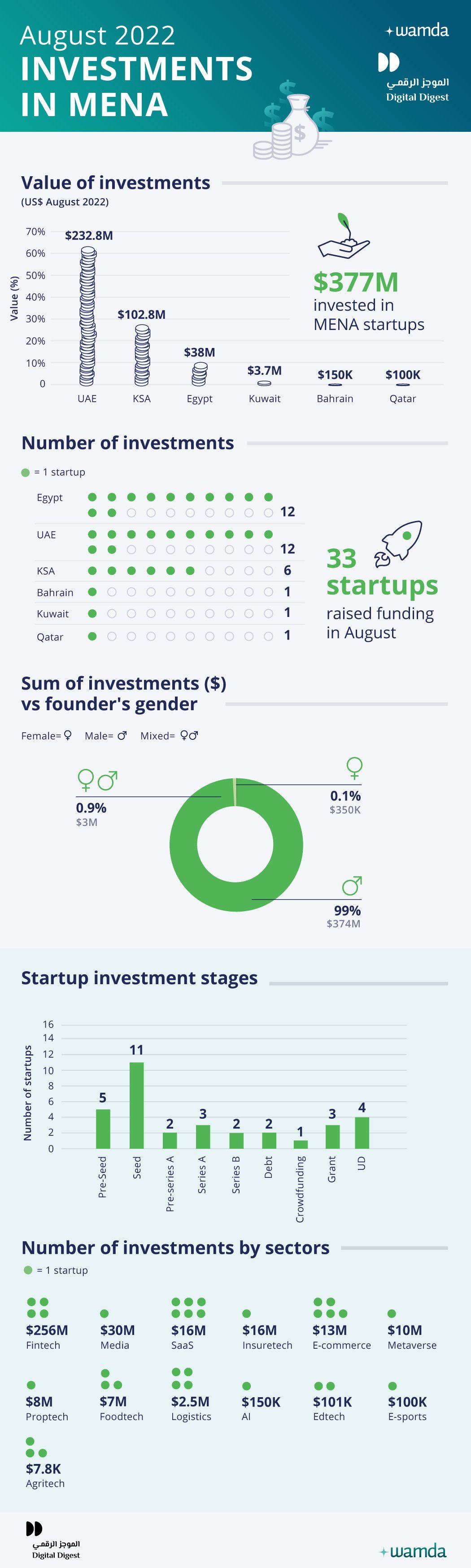
Startups in the Middle East and North Africa region (Mena) raised $378 million across 33 deals, a 260 per cent increase in funding value month-on-month but a relative dip in terms of deal count.
This takes the total amassed in the past eight months to $2.2 billion, a 29 per cent increase from the $1.7 billion recorded during the same period last year.
Last month saw two of the biggest funding rounds recorded this year in the region's tech ecosystem, with fintechs Tabby and Tamara raising $150 million and $100 million respectively, making up 66 per cent of the VC funding value.
Setting aside the two outliers, just $128 million was invested in startups across Mena in August.
Thanks to Tabby's large round, the UAE attained the number one spot on the list of the countries that attracted the maximum funding with $233 million.
Saudi Arabia was the second largest recipient of funding with $103 million raised across six deals, with Tamara being its biggest fundraiser, while Egypt followed in the third position with $38 million. Both UAE and Egypt were neck to neck in terms of deal count.
The modest recovery seen in August has been widely felt across all funding stages with the earliest stages of funding witnessing the highest deal count. Out of 33 deals, 15 went to startups across the pre-Seed and Seed stages, cumulatively amounting to $14.5 million.
The lingering uncertainty in market conditions have largely dented the ability of growth stage companies to raise new rounds of equity, and so we are likely to see more extention or bridge rounds over the coming few months. This was evident in the case of Egypt's furniture e-commerce company Homzmart and UAE-based adtech ArabyAds and digital real estate investment platform Stake. These startups also happen to be among the top fundraisers last month.
Startups operating in the fintech space piqued investor interest in August particularly startups in buy now pay later, crypto currency and neobanking. In terms of value, fintech remains the best-funded sector, representing 68 per cent of the total funding activity. E-commerce came in second place with $32 million raised across five deals, followed closely by adtech. Yet, SaaS startups attracted the highest number of deals with six investments aggregating to $16 million.
Global funding activity remains subdued, with only 13 deals out of 33 attracting foreign direct investments.
Regionally, Saudi Arabia-based investors were the most active, taking part in 10 deals, followed by their counterparts from the UAE with eight deals.
As ever, startups with an all-male founding team attracted the bulk of funding last month with 99 per cent, while the remaining 1 per cent went to startups founded or co-founded by women.
Key market highlights
Apart from the funding, last month saw a rise in the mergers and acquisitions (M&A) activity.
UAE-based proptech Huspy, which recently closed a $37 million Series A round, announced its takeover of two mortgage brokers: Just Mortgages and Finance Labs, while logistics startup Cartlow purchased Melltoo. This came on the back of its recent completion of a $18 million round.
Other deals include Maya Group's acquisition of Conktr, Astratech of fintech PayBy and KABI of HR tech startup BLOOVO.
In August, a couple of startup-focused funds were launched. Algeria Startup Fund announced its new fund worth $411 million earmarked for local startups, while G42 also launched a $10 billion fund to invest in growth stage startups.
Last month, Mosool, Jwava, Cargoz, Mintroute, OBM Education and Sponix Tecb did not disclose the exact amount they raised. We have assigned them a conservative amount of $100,000 each.
These monthly reports are a collaboration between Wamda and Digital Digest.
September 8th 2022, 12:10 am
Endure Capital closes first round of $50 million fund
Wamda
- Egypt-based Endure Capital has completed the first close of its new $50 million fund to invest in early-stage startups across Africa. The limited partners who have invested in the fund include British International Investment (BII), and Egypt’s Micro, Small, and Medium Enterprise Development Agency (MSMEDA).
- Endure 21 is Endure Capital’s second early-stage VC fund that will focus its investments on impact-driven startups in Africa, with a selective approach to investing in growth-stage startups globally.
- Launched in 2015 by Tarek Fahim, Endure Capital was one of the investors in Careem, as well as MaxAB and Breadfast.
Press release:
Endure Capital announced that it has completed the first close of its new $50 million fund to invest in early-stage startups in pan-Africa. The fund, Endure 21, is Endure Capital’s second early-stage venture capital fund and will focus its investments primarily on impact-driven early-stage startups in Africa, with a selective approach to investing in growth-stage startups globally.
The limited partners who have invested in the fund include British International Investment (BII) – the UK’s Development Finance Institution and impact investor, formerly known as CDC Group; The Micro, Small, and Medium Enterprise Development Agency (MSMEDA) – Egypt’s Social Fund for Development; and founders of different leading startups of the region.
“BII is excited to be partnering with Endure Capital, a well-embedded leading local fund manager in Egypt’s entrepreneurial ecosystem. I am delighted that our partnership on Endure21 will help support the next generation of visionary entrepreneurs in Egypt, providing them with the capital to build transformative businesses that are creating innovative solutions and accelerating productive, sustainable and inclusive growth across society.” commented Abhinav Sinha, Managing Director and Head of Technology and Telecoms, British International Investment.
“MSMEDA is proud to partner with Endure Capital to promote the Egyptian economy by supporting the entrepreneurial environment and enabling young innovators and entrepreneurs,” commented Hany Emad, Director and Head of the central sector for financing small projects at MSMEDA.
Launched in 2015 by serial entrepreneur Tarek Fahim, Endure Capital has established itself as one of the leading VC firms in the region. Its first fund was one of the early institutional investors in Careem which was acquired by Uber for $3.1 billion in 2019. The acquisition remains the biggest tech exit the Middle East has seen. The investments from Endure’s first fund also include regional B2B e-commerce leader MaxAB and Breadfast, the grocery delivery startup that has pioneered dark stores in Egypt.
Endure’s debut portfolio also includes international iconic startups such as Boom Supersonic, Tribal Credit, and Aspect Biosystems. The first fund has made a 43 per cent IRR and 4.3x multiple on its investments, which puts it in the top quartile of performing funds of its vintage year.
Commenting on the first close of its second fund, Endure Capital’s founder Tarek Fahim, said, “Endure is committed to adding value to the region’s flourishing startup founders, and ecosystem, and we love to partner with founders that relentlessly pursue entrepreneurship as a means for value creation to society and who are building lasting businesses.”
With Endure 21, the firm will follow a sector-agnostic approach and invest in 24 companies. Endure Capital will reserve half the fund for follow-on investments in its top-performing companies from its portfolio.
For its second fund, Mohamed Noweir joined Endure Capital as a partner to lead the investment team. Noweir has over 15 years of business and startup experience across IBM, McKinsey & Company, Careem, and Rocket Internet.
The new fund has already made several investments including co-leading Series A of Brimore, Egypt’s leading social commerce platform; investing in Cassbana, a BNPL alternative credit solution for SMEs; and in Pylon, a smart infrastructure startup providing a subscription-based “Smart Metering as a Service” (SMaaS) for electricity and water companies in emerging markets.
“There are a lot of exceptional founders in the region and we are super excited to partner with them early on in their entrepreneurial journey. And we are also thrilled to kickstart “Endure…Pay it Forward” initiative where we work with our portfolio founders to mentor aspiring founders and give back to our new budding startup environment.” commented Mohamed Noweir.
Endure has also launched the Endure Opportunity Fund which will double down on its previous top investments. “We are here to serve our founders in the long-term, and want to invest in their startups’ entire lifecycle – our strategy as a firm is to provide patient, long-term support to entrepreneurs,” concluded Tarek Fahim.
September 7th 2022, 9:56 am
UAE-based fintech Ziina expands to Jordan
Wamda
- UAE-based fintech Ziina has extended its services to Jordan.
- Founded in 2020 by Faisa Toukan and Sarah Toukan, Ziina helps individuals send and receive payments through its app with just a phone number—no IBAN or swift code required. It launched its digital wallet in February 2022.
- The Y-Combinator-backed startup previously raised $9 million during a Seed round from Avenir Growth, Goodwater Capital, ANIM, Oman Technology Fund, Class 5 Global, Long Journey Ventures, Graph Ventures, Jabbar Internet Group, Wamda, and FJ Labs, as well as employees and execs at PayPal, Instagram, Stripe, Revolut, Venmo, Brex, Checkout.com, Notion, Block, Airbnb and Deel.
Press release:
Ziina, the UAE-based, YC-backed start-up on a mission to bring financial freedom to every person in the Middle East, is coming to Jordan. Having launched their digital wallet in February 2022, and their proprietary payment keyboard, the Ziiboard, just this month, the Jordanian expansion is the latest milestone in a rapid succession of innovation for the fintech company.
For co-founders Faisal and Sarah Toukan, Ziina’s first international foray represents a sort of homecoming. Both founders grew up in Amman before continuing their higher studies in the United States. Their decision to move to Jordan before any other Middle Eastern country came out of their desire to uplift and strengthen their home country by expanding access to financial services.
Faisal Toukan, CEO and Co-Founder of Ziina said, “The median age in Jordan is around 23 years old, which makes most of the population digitally native. The Central Bank of Jordan has recognized this, naming microfinance, digital financial services, and small and medium-sized enterprise finance among its core sectoral pillars. As a proud Jordanian, I am delighted to introduce Ziina to my home country. Our team have worked tirelessly to develop a product that makes the payment process infinitely faster and more convenient, while also prioritising a delightful user experience. We have no doubt that Ziina will make getting paid much easier for every single Jordanian.”
Today, Ziina is one of the few MENA companies to make it to the Y-Combinator. The company successfully raised $9 million during a Seed round from prominent investors, including Avenir Growth, Goodwater Capital, ANIM, Oman Technology Fund, Class 5 Global, Long Journey Ventures, Graph Ventures, Jabbar Internet Group, Wamda, and FJ Labs, as well as employees and execs at PayPal, Instagram, Stripe, Revolut, Venmo, Brex, Checkout.com, Notion, Block, Airbnb and Deel.
Heralding a new age of digital consumer finance requires a strong team. The Jordanian siblings along with their Californian cofounder Andrew Gold have recruited a world-class team with experience from the likes of Apple, Uber, Coinbase, Careem, Yandex, Funding Circle, Bain & Co, Talabat and Oracle.
A standout feature of Ziina’s product is its design, having been recognised and awarded nine international UI/UX design awards, including the Red Dot Award. The interface allows users to easily send and receive payments to anyone in just a few taps. Ziina eliminates the need for tedious IBAN and swift code entry and makes the payment experience seamless and social, with GIFs, photos, text and emojis.
Ziina believes access shouldn’t be a privilege but a right. The company is focused on developing state-of-the-art tools that are delightful to use, empowering individuals to gain more control of their financial future. Ziina believes this financial prosperity should be in the palm of your hand; it is pioneering the future of personal finance.
Peer-to-peer payment services are on the rise globally as they eliminate the need to make physical cash payments. For Ziina, Jordan represents the next exciting chapter in the company’s mission toward financial freedom in the Middle East.
September 7th 2022, 9:56 am
TruKKer raises $100 million pre-IPO round
Wamda
- Saudi Arabia-based digital freight network TruKKer, has raised $100 million in a pre-IPO round, led by Bahraini investment firm Investcorp who alone invested $51 million. This investment is part of the recently launched Investcorp Saudi Pre-IPO Growth Fund LP, targeting equity growth capital investments across a range of companies primarily based in Saudi Arabia with the potential to access the capital markets within three years.
- Founded in 2016 by Pradeep Mallavarapu and Gaurav Biswas, TruKKer currently serves over 700 enterprises and boasts a fleet of more than 40,000 trucks.
- Last February, TruKKer raised $96 million in a mix of equity and debt for its Series B financing, led by ADQ and STV, with participation from Mubadala and other investors.
Press release:
Investcorp, a leading global alternative investment firm, today announced that Investcorp Saudi Pre-IPO Growth Fund LP led the Pre-IPO round in privately-held TruKKer Holding Limited, MENA’s largest digital freight network with a leading position across Saudi Arabia, the United Arab Emirates, Egypt and neighbouring countries. Investcorp led the initial close of this round with a $51 million investment alongside new and existing investors.
Hazem Ben-Gacem, Co-Chief Executive Officer of Investcorp commented: “Saudi Arabia is increasingly rich in highly investable companies, from fast-growth technology businesses like TruKKer to long-established family businesses that have grown consistently and are now looking for capital to implement more ambitious expansion plans. We are seeing a lot of interest in pre-IPO rounds as scale-ups secure greater market share and more Saudi businesses prove themselves successful on a national and regional basis. TruKKer is just one example of the kind of company that we believe will prove attractive to institutional investors as the Saudi ecosystem matures, and our Pre-IPO fund will focus on exactly these kinds of high-growth businesses.”
“We are excited to add TruKKer to our portfolio and are keen to work with the founders of this regional champion to explore a possible market listing, as a continuation of our strategy and in line with our track record,” said Walid Majdalani, Head of Private Equity MENA and Southeast Asia at Investcorp. “Thanks to its proprietary technology, TruKKer is ideally positioned to continue its strong growth while reducing carbon emissions across its markets. We look forward to our partnership with TruKKer and contributing our strategic and capital markets resources as well as our local and global insights to accelerate the company’s next phase of growth.”
This investment is part of the recently launched Investcorp Saudi Pre-IPO Growth Fund LP, targeting equity growth capital investments across a range of companies primarily based in Saudi Arabia with the potential to access the capital markets within 3 years. The fund provides investors with an opportunity to gain exposure to growing and market-leading businesses in strategic, high growth and underserved sub-sectors such as business services, transport and logistics, healthcare and consumer.
The United Arab Emirates and Saudi Arabia are key markets for TruKKer and represent a significant portion of the company’s revenues. The United Arab Emirates market has witnessed strong growth over the years in large part due to the development of UAE – KSA cross-border lanes with over 30,000 annual shipments transported by TruKKer, a key value proposition as the company continues to focus on scaling its network and looking to gain market share.
“TruKKer is at a key inflection point towards scaling its network and market share. Today, the company continues to grow exponentially serving over 700 B2B enterprise clients and is on track to cross $200 million in revenues in 2022. The TruKKer team is proud to be delivering on its vision of making a positive contribution to the community by having close to 10,000 drivers generating more than 70% of their monthly income on the TruKKer platform. Our technology also enables us to optimize truckloads to reduce empty miles and idle time thereby helping us achieve our sustainability objectives.” commented Gaurav Biswas, Founder & CEO of TruKKer.
“We welcome Investcorp and are excited to partner with them through the next growth chapter of the company. Together with our partners, we look forward to continuing to bolster the company and create significant shareholder returns with a focus on healthy unit economics” adds Gaurav.
In 2008, Investcorp established a dedicated presence in Saudi Arabia, and TruKKer marks Investcorp’s eighth investment in the country, with multiple successful public listings on the Saudi Stock Exchange, including BinDawood Holdings, Theeb Rent A Car, Leejam Sports Company and L’Azurde.
September 7th 2022, 9:56 am
UAE’s Tabby expands to Egypt
Wamda
- UAE-based fintech Tabby has expanded to Egypt, announcing partnerships with several retailers to offer shoppers the chance to pay for their purchases in instalments in the North African country.
- Founded in 2019 by Hosam Arab, Tabby offers users a buy now pay later (BNPL) facility for shopping online and offline.
- Tabby has secured $275 million in funding to date, most recently raising $150 million in debt financing from Atalaya Capital Management and Partners for Growth (PFG) in August this year.
- Tabby is a Wamda portfolio company.
Press release:
Tabby, the Middle East’s leading payments and shopping app, announced its launch in Egypt, enabling shoppers to pay over time without any interest or fees. Tabby works with multiple brands including Lacoste, L'azurde, Faces, In Your Shoe, KAI Collections, Ariika, Marcqa, Dresscode and Floward, among others, to offer flexible payments at checkout, creating an opportunity for Egyptians to stay in control of their spending and make the most out of their money.
Tabby currently ranks among the top 10 shopping apps in the Middle East with more than two million active shoppers. With Tabby’s “Split in 4” product, shoppers will be able to split their purchases into four interest-free payments at store checkouts, both online and offline. The Tabby app lets customers discover where they can split their payments and track their spending. Tabby also helps drive high-intent traffic to thousands of its retail partners.
Ahmed Khalil, Tabby Egypt’s GM, said, “Expanding in Egypt is a proud moment for us at Tabby. We’re excited to provide Egyptians with flexible and honest payment experiences with no interest and no fees. We’re also delighted to be a growth partner for our retail partners by helping them tap into millions of active shoppers”. Khalil added, “After securing $275 million in funding from leading global and regional investors, we’re looking forward to becoming Egypt’s preferred BNPL services provider.”
Tabby’s launch in Egypt is an expansion of the growing maturity of the fintech landscape in the region and the rise of e-commerce in Egypt. The app is building financial products designed to create financial freedom in the way people shop, earn and save by reshaping their relationship with money. Built on trust, not interest, the app enables commerce while encouraging responsible spending by empowering its shoppers with more purchasing power.
Since its launch in 2019, the company has been committed to helping its customers navigate the complex relationship with money by crafting honest products and stories built to champion their financial goals and help them create a relationship with money they can be proud of.
September 6th 2022, 10:54 am
Flat6Labs, SANAD launch agritech accelerator in Egypt
Wamda
- Egypt-based VC Flat6labs and SANAD Entrepreneurship Academy have launched an agritech accelerator programme to assist 10 to 12 startups in each cycle.
- The programme will give startups access to capital and help them improve their business models, product development, customer relationships, marketing plans, and financial management.
- The collaboration marks the beginning of Flat6Labs’ mission to support emerging businesses in the agri-food, food security, and rural development sectors while aiding the development of the agritech industry in Egypt.
Press release:
Flat6labs, the region’s leading seed and early-stage venture capital firm, in collaboration with SANAD Entrepreneurship Academy, launched an agritech accelerator program to assist 10 to 12 startups in each cycle to improve their business models, product development, customer relationships, marketing plans, and financial management. The collaboration marks the beginning of Flat6Labs’ mission to support emerging businesses in the agri-food, food security, and rural development sectors while highlighting the value of the agritech industry in Egypt.
The agri-tech program will give startups access to capital, to grow faster and efficiently, encouraging the development of technologies that make the agriculture industry sustainable, safe, and environmentally friendly. These technologies optimize service quality in the agriculture industry, by facilitating data collection and analysis to quantify performances while limiting overprice of products/services.
‘’With digital transformation progressing rapidly across industries, and the agriculture industry being a core pillar of the Egyptian economy, the need to digitize the agriculture industry has increased dramatically. We are glad to launch this agritech accelerator program in collaboration with the SANAD Entrepreneurship Academy, as it will serve this need by supporting the startups that provide innovative technologies in the agriculture sector and will contribute to the sustainable growth of the Egyptian economy,” stated Hassan Mansi, Flat6Labs Head of Ecosystem Development Programs.
Empowering and promoting Egypt's Agri-digital sector would result in advancements in automated machinery and robotics, increasing the efficiency of agricultural productions by precisely locating nutrient availability, checking for diseases, predicting them, and many other useful facilities.
Kim Reichel, Chairperson of the SANAD Technical Assistance Facility Committee said, ”We are very much looking forward to our cooperation with Flat6Labs as they have shown a strong commitment to supporting innovative and technology-driven entrepreneurs across MENA. Together, we will create a positive impact by providing targeted support and enabling business owners to thrive. We believe that focusing on the agricultural sector, and specifically, agri-tech is vital in these challenging times and will contribute to increased food security across the region.”
Flat6Labs Egypt and SANAD Entrepreneurship Academy will continue to support bright, passionate, and tech-driven entrepreneurs in Egypt, by providing funding, technical assistance, and networking opportunities across the country and beyond. The venture capital firm will continue to be a cornerstone of the digital transformation of the Egyptian economy building successful job-creating startups that contribute to the economic development in Egypt.
September 6th 2022, 10:54 am
SVC invests in Jordan's Propeller's second fund
Wamda
- Saudi Venture Capital (SVC) has invested in Jordan-based Propeller's second fund. The value of the investment was not disclosed.
- Propeller is an early-stage venture capital (VC) firm that targets investments in startups working across enterprise SaaS and cloud computing. The company concluded its first fund last year.
- Since its establishment in 2018, SVC has invested in 30 VC funds across the region.
Source: Arab News
The Saudi Venture Capital Co. has invested in Jordan-based venture capital firm Propeller — which specializes in funding early stage software-as-a-service, enterprise software and cloud infrastructure startups.
The move comes within the company’s program to invest in funds and stimulating startups, especially in their early stages, Saudi Press Agency reported, citing CEO Nabeel Koshak.
He added that Saudi Arabia is witnessing unprecedented growth in the volume and quality of start-up deals.
This happens as a result of the emergence of many innovative entrepreneurs, VCs, and angel investor groups, in addition to the availability of a sophisticated regulatory and legislative environment.
The value of the investment was not specified.
Established in 2018, SVC is a government company that contributed to the development of the venture investment system by investing in 30 investment funds.
September 6th 2022, 10:54 am
Egyptian car service app 3atlana closes Seed round
Wamda
- Egypt-based car service app 3atlana, has raised a six-figure Seed round from Egypt’s automotive company Ghabbour Auto.
- Founded in 2020 by Sherif El Adham, Ahmed Hassan and Amr Hesham, 3atlana provides services for car owners and drivers, including scheduling maintenance, roadside assistance, and a connection to nearby service providers.
- The new funding will be used to strengthen the startup’s AI technology feature that provides users with innovative car service solutions.
Source: The Startup Scene
3atlana, an Egypt-based car service app, has raised a six-figure seed round from Ghabbour Auto, a leading automotive company in Egypt to strengthen their AI system.
Founded in 2020 by Sherif El Adham, Ahmed Hassan, and Amr Hesham, 3atlana aims to make essential car services easier, faster and more efficient by providing everything a driver may need, including scheduling maintenance, roadside assistance, and a connection to nearby service providers.
Through the 3atlana app, users will be able to access door-to-door services, where an engineer and mobile car centre will be sent to their location, and they will be able to purchase spare parts with a three-month guarantee. For those wishing to buy a used car, 3atlana can inspect the car through its resale car service, giving buyers the assurance they need before making their purchase.
“We are very proud to continue growing our company with support from one of the biggest automotive companies in Egypt,” Sherif El Adham, Co-Founder and Chief Operating Officer at 3atlana, tells StartupScene. “This round of funding comes at an ideal time as we’re looking to further advance our technology, and continue expanding locally as well as regionally across the Middle East.”
The new funding will be used to strengthen the startup’s AI technology feature, which in turn would allow them to continue providing users with innovative car service solutions. To date, the app has been downloaded more than 25,000 times, and over 9,500 cars have been serviced by 3atlana.
Although it is a young startup, 3atlana has participated in several incubators and accelerator programmes such as Enpact Covid-19 Relief Program and Flat6Labs Cairo. Flat6Labs Cairo and Ghabbour Auto are also board partners with 3atlana.
September 5th 2022, 10:39 am
Egypt's el-dokan raises $550,000 pre-Seed round
Wamda
- Egypt-based el-dokan, a company that specialises in enterprise e-commerce solutions, has raised a $550,000 pre-Seed round led by a group of local and regional investors including EFG EV and Flat6Labs, 500 Global and Hala Ventures.
- Founded in 2020 by Ahmed Maher, Mohammed Shirt and Sherif Alaa, el-dokan offers e-commerce technology to corporate clients to set up their web storefronts. It primarily caters to long-tail businesses, software houses as well as startups.
- The company said it helped its clients achieve $45 million in GMV sales.
Press release
el-dokan, the first-of-its-kind company to offer enterprise e-commerce technology, in MENA has announced that it successfully secured a $550,000 pre-Seed round, led by a cluster of local and regional investors including EFG EV and Flat6Labs, 500 Global and Hala Ventures.
E-commerce is now an integral part of every retailer’s business strategy, and technology builders and platforms are scrambling to provide retailers with the best technology to help them scale up and optimize their operations. Unlike companies like Shopify and other local shop builders in the region whose focus is to address the needs of smaller retailers, in its latest turn, el-dokan provides e-commerce APIs for large- and medium-sized retailers as well as startups, enabling them to build highly customized and personalized e-commerce stores.
Launched in late 2020 in Egypt, el-dokan primarily targets large retailers and chain stores seeking to expand their e-commerce market share, increase sales and operation automation.
Utilizing "headless e-commerce technology, el-dokan offers the optimal technology infrastructure that allows tech teams to develop highly customizable e-commerce with maximum flexibility to help businesses respond faster to changing business needs and keep up with the rapid changes in e-commerce.
Besides retailers, it also targets software companies and developers that work directly with enterprises looking to build their e-commerce stores in fast and cost-efficient manner, with 300+ available API endpoints.
Commenting on the announcement, Ahmed Maher, co-founder and chief executive officer (CEO) of el-dokan, said that the key reason behind the company's ability to earn the trust of investors and close its pre-Seed round is the fact that el-dokan is among the very select few companies that focus on building advanced software using cutting-edge technologies such as headless, composable e-commerce architecture.
"The majority of retailers have repeatedly shown the willingness to either replace the traditional e-commerce methods with more advanced and flexible technology. The technology pioneered by el-dokan 'changes the equation' by helping retailers drive sales growth while simultaneously bringing down maintenance costs, making it possible for our retailers to quickly and easily develop APIs connections with our partners to ensure the highest levels of operational efficiency. Our technology can easily integrate with any third-party providers like payments, shipping, point of sale (POS) and (ERP) systems," commented Mohamed Yousry, chief technology officer (CTO) and co-founder of el-dokan.
“After seeing the great impact el-dokan has had on enterprise businesses in MENA, and the profound growth we’ve experienced over a short period of time, we’re excited about the fact that our clients managed to achieve $45 million GMV after migrating from other global well-known software solutions that don’t meet the present-day challenges ours. We are now serving a global roster of clients such as Procter & Gamble (P&G), Misr Pharmacies, Mobily, Zahran stores and Apple Premium seller Switch Plus, along with grocery delivery app Appetito, among others. And this is a testament to the ability of regionally-based tech startups to develop leading-edge technologies trusted by large, international brands and compete with global counterparts," Yousry explained.
For his part, Walid Hassouna, CEO of valU, Egypt's leading buy now pay later (BNPL) platform expressed his excitement over the company's successful completion of its initial funding round which counts EFG EV among its earliest backers. "We are looking forward to exciting times ahead with el-dokan and its all-star team who are able to carve out a niche for themselves in the rapidly-evolving e-commerce market," said Hassouna.
September 5th 2022, 6:09 am
Carzami raises pre-Seed investment from Contact Financial Holding
Wamda
- Egypt-based second-hand cars marketplace Carzami has raised a pre-Seed round led by Contact Financial Holding. The amount raised was not disclosed.
- Founded in 2022 by Hussein Hosny and Adham Hosny, Carzami is an online platform for buying and selling used cars that offers its customers 360-degree virtual tours and inspection reports.
- Carzami plans to use the new funding to multiply its revenue to $30 million by 2024.
Press release:
Carzami, an online retailer for quality used cars and vehicle financing, today announced the close of a pre-seed round led by Contact Financial Holding, together with a scalable inventory financing facility, which it plans to use to transform Egypt’s used car market targeting $30 million in revenue by 2024.
With this strategic investment from Contact, Egypt’s largest non-bank financial services provider, Carzami is positioned to launch its innovative model for a digital car dealership while being able to offer crucial vehicle financing and insurance options.
Carzami aims to fix the Egyptian used car market by providing consumers with an online platform offering certified and reconditioned used cars with 360-degree virtual tours and inspection reports. Customers can order any car they like to be delivered to their doorstep to test drive, and then purchase with financing and insurance options.
Carzami understands that the fragmentation and mistrust that characterizes the used car industry is unconducive for business growth. With the funding, Carzami seeks to continue growing its inventory. Along with that, Carzami is looking to expand its fleet of delivery haulers, enhance its operational technology, build a productive team, and build a modern reconditioning facility. Importantly, Carzami will utilize the funding in optimizing its organizational efficiency and building on the existing functions, such as vehicle financing.
Carzami hopes to gain an advantageous edge over its competitors by providing exceptional services and building on its consumer trust. This will be achieved by premiering the 30-day Carzami Protection Program and a 7-day “Test to Own” service where potential buyers can try out a vehicle for 7 days/200km to reach a conclusion. Ultimately, they can get a full refund or trade in with another. Here, Carzami aims to ensure that consumers get value for their money. Carzami seeks to become a pioneer in the used car industry by offering consumers top-of-the-line services.
Hazem Moussa, Chairman of Contact Financial Holding, stated that “Our faith in digitizing the automotive market in Egypt has been with us from our early years, we launched contactcars.com in 2002 as the first car marketplace and community for both new and used cars. In addition, Contact pioneered financing of used cars over 10 years ago, now we believe we can support Carzami in its quest to re-invent the used car purchase experience”.
Said Zater, CEO of Contact Financial Holding added “Our support to Carzami comes as a part of our continuous effort to connect with the startup scene in all aspects we can complement their work with. We believe in the ongoing digitization of services led by exciting startups like Carzami”.
Co-founded in 2022 by Hussein Hosny and Adham Hosny; 2 seasoned entrepreneurs in the automotive space. They started this business venture to address the problems associated with buying and selling used cars. They define themselves as an online-based venture that helps clients to navigate the tedious process of buying and selling used cars.
Carzami Founders, Hussein Hosny & Adham Hosny, commented, “We aim to change the way people buy and sell used cars by providing a seamless one-stop-shop platform that offers online buying, selling, and high-quality financing options. Our experience is all about trust and transparency, allowing consumers to overcome the hassle of traditional dealerships”.
Both Hussein and Adham boast extensive experience in the automotive space. The duo co-founded Sa3ar; Egypt’s first data pricing engine for used cars, in partnership with Synapse Analytics, which is now also a partner in Carzami. With additional team experience from BMW, Mercedes, and Porsche, Carzami is gearing to be an industry leader for car needs and requirements across the region.
September 5th 2022, 2:39 am
Can the Mena region be a leader in inclusive capital?
Wamda
Regie Mauricio is the research manager at the Legatum Centre for Development and Entrepreneurship at MIT.
Dina H. Sherif is the executive director of the Legatum Centre for Development and Entrepreneurship at MIT and a senior lecturer at MIT’s Sloan School of Management.
In 2009, Yahoo acquired Maktoob, an Arabic-language online services company, for $175 million. For the entrepreneurship and innovation ecosystem in the Middle East and North Africa (Mena) region at the time, this was a big deal. It ultimately became the deal that ended up seeding Souq, an Arabic-language e-commerce platform, which Amazon acquired for $650 million in 2017.
Souq's success has provided countless entrepreneurs a selling platform and inspired a spectrum of e-commerce competitors in the Mena region, such as Noon.com and Mumzworld. We share this story because Maktoob’s exit, which took place more than a decade ago, sparked a “Cambrian moment” of entrepreneurship and innovation that has continued to create value for people across the region today.
Another prime example of this is Careem, the Mena region's leading ride-hailing platform headquartered in Dubai. Since its founding in 2012, its former employees have founded over 84 companies, almost half of which were created after Careem’s $3.1 billion exit in 2019. Most of these companies operate in Mena, though a growing contingent also works in Pakistan, Germany, and the US. As with Maktoob, the overnight infusion of capital is already accelerating the region’s entrepreneurship and innovation ecosystem. In fact, one of Careem’s former employees founded Swvl, a ride-hailing company that went public on the NASDAQ via a SPAC.
Moving on to Egypt, a consortium of investors acquired Fawry, an Egypt-based e-payment and financial services platform, for $100 million in 2015. The company is now the country’s first fintech company to be valued at $1 billion. In 2020, Mohamed Okasha, Fawry’s co-founder and former managing director, stepped down from his role and used the exit to found Disruptech, a $20 million fintech-focused fund in Egypt. The fund invested in three companies within its first month of establishment and is currently completing its seventh investment.
Some refer to these networks of ex-employees turned founders and investors as a “mafia” because they resemble an archetype: the “PayPal Mafia.” eBay acquired PayPal in 2002, and the exit made a handful of people very wealthy. The group of ex-PayPal employees has become infamous for giving rise to billionaires like Peter Thiel, Elon Musk, and Max Levchin. The PayPal Mafia has become a core part of the Silicon Valley ecosystem. Its founders started new industries, created startup culture, and continue to fund some of the most profitable businesses in tech.
Halfway across the world, ex-unicorn employees are also defining the startup ecosystem in Mena. The question for us in the region is: how can we make sure we move beyond a “mafia,” which lends itself to exclusivity, to something that is truly inclusive?
When exits become working capital for new innovation
When eBay acquired PayPal in 2002 for $1.5 billion, hundreds of the company’s employees became overnight millionaires. Ex-PayPal employees went on to found YouTube, Yelp, and LinkedIn as well as some of Silicon Valley's most successful venture capital (VC) funds, including The Founders Fund, Clarium Capital, and Sequoia Capital.
Similarly, Yahoo’s acquisition of Maktoob in 2009 seeded the initial $5-6 million investment in Souq. As this new company grew into the preeminent e-commerce platform in the region, the merchants on Souq increased their sales from a few dozen products a week to turnover topping millions of dollars a year. Souq’s down-market impact continues to grow after its $650 million acquisition by Amazon, which aims to expand the retailer’s reach to merchants and customers across the region.
Careem’s $3.1 billion exit also created immense wealth for the company’s founders and employees. At the time of acquisition, all of the platform’s 4,000 employees held shares in the company. Overnight, Uber’s buyout made 200 employees UAE dirham millionaires and 75 USD millionaires. The sudden infusion of capital seeded the founding of 84 startups and a VC fund.
Maktoob, Souq, and Careem’s exits have built a base infrastructure for the Mena entrepreneurship ecosystem to grow for decades to come. Newer unicorns have been able to find funding and scale faster because of the networks built by these earlier deals — a value cycle that only continues to grow.
When capital stays exclusive
Although PayPal employees went their separate ways professionally in the years following the acquisition, this group of colleagues continued to be one another's thought partners, guinea pigs, first investors, and peer mentors. The PayPal Mafia continued to exchange ideas and work together. Their partnerships are now at the core of many of Silicon Valley’s great success stories. For example, David Sacks, ex-COO of PayPal, made it a habit of investing in his former colleagues. He was one of the earliest investors in Elon Musk’s SpaceX and The Boring Company and held shares in Max Levchin’s Affirm and Peter Thiel’s Palantir. This group of innovators shared the ideas and capital that made them some of the most successful entrepreneurs in Silicon Valley. This group, however, has remained exclusive at a time when inclusivity is needed most.
Ex-Careem employees also continue to be one another’s best asset. They are one another’s best resource for workshopping ideas, recruiting talent, and raising capital. Mohamed Aboulnaga, ex-regional director of Careem Egypt, took 10 ex-Careem team members with him when founding Halan, a ride-hailing app. Moreover, many of Careem's initial investors are intent on continuing to back Careem alumni.
Ecosystems mature as successful entrepreneurs continue to share ideas and innovate. The companies mentioned above have all built communities of support that have seeded ecosystems where they reside. In a Covid-19 world, the question remains — can we build ecosystems that are more resilient and that make systems that work for everyone and not just the few who had the privilege of being a part of a unicorn?
Marks of success and cautionary tales
The PayPal Mafia, although successful, serves as a cautionary tale for the Mena region as we begin to see similar trends emerge. The group has been criticised as an exclusive boy's club.
Though still in its early days, the communities emerging from companies like Souq and Careem are more inclusive than PayPal’s. Women hold influential positions in the region’s unicorns, and contemporary unicorns are much more concerned with the societal impact that their companies are having. Tackling issues of social and economic inequality is unavoidable for a company operating in the Arab region. Employees who have graduated from some of these leading companies in the region are founding businesses in affordable education, accessible health care, social commerce, and financial inclusion. These new innovations have the potential to contribute to more inclusive prosperity in the region.
The Middle East can become a leader in building out more inclusive entrepreneurship and innovation ecosystems through the following:
- New entrepreneurship pipelines: Unicorns should play a key role in creating the pipeline for entrepreneurs of all backgrounds to succeed. As ex-employees often become founders, enacting proactive hiring policies that source a diverse talent pool can mint a new generation of entrepreneurs that hail from a diversity of backgrounds that are rooted in solving the problems of communities often unrepresented by startup culture.
- Sharing knowledge: Successful entrepreneurship communities should not keep their expertise and experience locked up in their networks. In particular, they should extend their reach beyond urban centres and enable scalable problem-solving throughout the region. They can create programmes to build capacity and generate thought-leadership to advocate for supporting a more inclusive ecosystem of entrepreneurs.
- Inclusive capital: Investors should commit to funding companies outside of a handful of serial founders. These funds should source founders of all genders, races, and urban/rural backgrounds to spark entrepreneurship communities throughout the region and not just in a few mega-city epicentres. Exits can seed ecosystems, and risk capital can make sure that these exits do not make capital exclusive, but inclusive.
Mena has an opportunity. The region can seize the Cambrian moment that it is in to create an inclusive environment that accelerates value creation for all or begin locking up the doors and keeping its wealth in the hands of a few.
This article was originally published by the Middle East Institute
September 4th 2022, 10:32 pm
KarmSolar announces new minority stake round
Wamda
- Egypt-based solar energy company KarmSolar, has initiated a round of capital increase, supported by US-based Synergy Consulting as the sell-side advisor.
- Founded in 2011 by Ahmed Zahran, Xavier Auclair, Yumna Madi, Randa Fahmy, KarmSolar aims to enlarge the private solar energy market in Egypt, offering its integrated solutions across the industrial, agricultural, commercial and tourism sectors.
- The capital injection will fund KarmSolar’s local and regional expansion plans, support its existing power generation and distribution businesses, and enable new business verticals such as solar water desalination solutions provider KarmWater, and electric mobility venture KarmCharge to flourish.
Press release:
KarmSolar, Egypt's leading private power utility and solar energy company, has initiated a round of capital increase to fund its local and regional expansion plans. US-based Synergy Consulting supports the new investment round as the sell-side advisor. The capital injection will support existing power generation and distribution businesses, as well as enable new business verticals such as solar water desalination solutions provider KarmWater, and electric mobility venture KarmCharge to flourish.
This comes in line with the evolution of the solar energy sector in Egypt, especially with KarmSolar’s long-term strategy to disrupt the existing utility business by developing a vertically integrated multi-utility platform with a specialization in solar power generation, as well as urban and regional power distribution.
Ahmed Zahran, CEO and co-founder of KarmSolar said: “Through the minority stake sale, we are seeking a new partner to join KarmSolar’s current shareholders and its strategic shareholder, EDF Renouvelables, in supporting the next stage of our journey. These are exciting times for the future of smart, connected utility platforms and we plan to be at the forefront of this paradigm shift in our region”.
Named by the Financial Times as one of the fastest growing companies in Egypt and 19th in Africa in 2022, KarmSolar has a strong presence across the energy value-chain from development, and generation until the distribution of power to consumers. Today the company holds a portfolio of 42 MW of secured and financed generation assets (of which 30 MW are operational) & 48 MVA of contracted distribution power capacity in the industrial, commercial, agricultural and tourism sectors (of which 12 MVA are operational).
Earlier this year, KarmSolar signed a 22 MW power distribution agreement with MARAKEZ, one of Egypt’s leading mixed-use real estate developers, for D5M, in its new mall in East Cairo. It also became the first private company to receive a permit to distribute electricity in the North Marsa Alam region by EgyptERA, signing agreements with eight resorts to join the Marsa Alam Solar grid.
September 4th 2022, 7:47 pm
Edtech Emonovo raises bridge round to grow its platform matching students with universities
Wamda
- Egypt-based edtech Emonovo (formerly MARJA3), has raised a new bridge led by angel investors from across the Middle East and North Africa (Mena), Europe and US, along with follow-on investment from Flat6Labs.
- Marj3 was founded by Abdo Samy, Sami Al-Ahmad, and Ahmed Elgebaly in July 2016 with the aim of offering global educational opportunities for Arab youth. In less than a year after its founding, the platform raised its initial pre-Seed funding from Flat6Labs’ FAC Egypt Fund.
- In 2020, it also raised an investment round from a US-based Expert Dojo, after which it managed to secure partnerships with more than 300 universities worldwide.
- Earlier this year, the startup pivoted its offerings from being focused on scholarships to matching students with universities.
- The new round will enable Emonovo to onboard more universities and student recruitment, as well as bolster the platform’s technology to optimise matching and data management.
Press release
Emonovo (formerly MARJ3), the MENA region’s leading Ed-tech platform, has successfully raised an undisclosed bridge round by strategic angel investors from US, Europe, and MENA and follow-on investment from Flat6Labs.
Emonovo (Formerly MARJ3) is the MENA region’s leading Ed-tech platform that utilizes technology and data to match MENA youth to the best-fit majors and universities worldwide. The participating angel investors compile extensive working experience in giant companies like META, Klarna, Alan, as well as prominent VC and Private Funds while having distinguished backgrounds in EdTech, FinTech, HR, and investment sectors.
“Flat6Labs has been a firm believer in Emonovo’s team and platform from day one. This investment is a testament to our belief in Emonovo’s mission to empower students in the MENA region in their educational journey. We’re excited to see how the team will develop their platform even further and support more potential students towards fulfilling their educational ambitions in the best universities around the world,” said Dina El-Shenoufy, Chief Investment Officer of Flat6Labs.
“I am a firm believer in the power of education to transform people’s lives, and I’m super excited to be backing the team behind Emonovo,” said Willie Elamien, an angel investor.
This investment is aimed to boost the new brand strategy and fuel the growth of university onboarding & student recruitment through the platform. It will also be used to update the platform technology to optimize matching and data management.
“As a proponent of tech and social impact, I’m delighted to invest in Emonovo, the future of higher education in the region,” said Rama A. Chakaki, an angel investor.
Marj3 platform was founded by Abdo Samy, Sami Al-Ahmad, and Ahmed Elgebaly in July 2016 as a comprehensive database containing educational opportunities worldwide for Arab youth in a simplified way. In 2017, within less than a year after its establishment, the platform obtained pre-seed funding from Flat6Labs’ FAC Egypt Fund, which enabled them to grow and reach a far larger segment of the target audience in the Middle East, achieving more than two million monthly visitors on Marj3’s website.
In 2020, as they continued to grow, they managed to obtain a new investment round from a US-based investor (Expert Dojo), synchronizing with the launch of Marj3 education services to help students in the Arab region find the best suitable universities for them worldwide. Then, after a short period, Marj3 managed to secure partnerships with more than 300 universities globally in various fields.
In 2022, the 3 co-founders decided to support students fully from A to Z in their experience to follow their educational journey. They shifted from scholarships to university and student matching arena. In March 2022, Marj3 became Emonovo with some internal and external adjustments and new branding.
“This strategic investment round is going to help us make Emonovo available to more students than ever before. Our mission is to help students achieve their educational dream, and I am super excited that our investors are aligned with us on making our unique solutions and technology experience available for everyone soon,” said Sami Al-Ahmad - CEO & Co-Founder at Emonovo.
September 4th 2022, 7:45 pm
Egypt’s Zeew raises $630,000 Seed
Wamda
The enterprise software as a service (SaaS) sector is one of the rising stars of the Egyptian startup ecosystem, with more companies scaling up and piquing investor interest.
Egypt-based e-commerce SaaS startup Zeew, has raised a $630,000 Seed round from Plug and Play, Poland Prize and a group of angel investors, bringing the total funds it has raised in the past couple of years to $1 million.
Founded by Mohamed Ghaith in 2017, Zeew lets companies launch their on-demand delivery businesses, enabling them to track and control their operations through its customisable, hyperlocal SaaS solution. Currently, Zeew is present across 100 countries, with merchants in different verticals including logistics, food and grocery, restaurants, pharmacy, etc.
The startup plans to use the newly acquired funding to grow its team to serve more customers worldwide.
September 4th 2022, 7:43 pm
eFlow: The Lebanese startup teaching courses on messenger
Wamda
Online learning became a necessity during the lockdowns, and while many tools became readily available, the vast majority catered to those with good internet connectivity and access to laptops and tablets. For many students in Lebanon, the political vacuum, devastated economy and crumbling infrastructure resulted in a lack of access to education.
So Samer Bawab and Bassel Jalaleddine alongside another partner came together in March 2020 to launch eFlow, an Arabic online learning platform suited to mobile phones thanks to its interactive chatbot that is integrated with WhatsApp and Telegram. Through eFlow's platform, courses are converted into short videos, images, and voice notes, after which learners receive messages individually through the educational chatbot and are able to reply back with text, emojis, images, videos, or voice notes. The chatbot is able to analyse a learner’s response then reply accordingly by taking into account the lesson learning objectives, the learner’s learning style, and their emotions. Eflow has worked with several international NGOs, including UNICEF and UNHCR and now has 12,000 learners on its platform, with plans to branch into English, Spanish and French. It recently won the UN-backed World Summit Awards for inclusion and empowerment.
We spoke with Samer Bawab about eFlow’s journey.
How did the idea for your edtech come about?
eFlow started its journey working in Lebanon with schools and learners across the country who were facing tremendous challenges with significant power cuts, lack of electricity, low digital capacity, and essentially no access to computers or laptops. The Lebanese government had completely abandoned the educational system which left it up to the NGOs and private organisations to serve these communities of schools, teachers, and learners who were struggling. Covid-19 and lockdown aside, many teachers were relying heavily on WhatsApp and more specifically WhatsApp groups where they were sending lessons and materials.
An organisation called Near East Foundation came to us to provide learners in marginalised communities with an online learning platform. So, we helped them build a specific tool that was essentially a chatbot to assist these learners as they were going through [course] materials online. We developed a web app and integrated it with WhatsApp and Facebook messenger. We saw very positive results.
We definitely believe there is still a big gap in the way high-quality education content is being delivered to communities around the world. Especially for those learners who are not as privileged or do not have the opportunities as their more fortunate classmates. Also, the platform can significantly save tremendous amounts of time and money for organisations that are sending field officers to gather information, as well as for teachers who are monitoring a large number of students across a big area or [across] multiple schools.
What were some of the difficulties that you faced during the early stages of eFlow’s conception?
As far as challenges go, we had a significant number of them. We were working during lockdown and the whole team was remote at the time [and] that was not an ideal environment. Here in Lebanon, we face a lot of challenges with connectivity and power. Having a connection and being able to work remotely and successfully doing client calls was a huge challenge we had to deal with and still do to this day. As a startup too, none of these organisations were familiar with our brand, so we struggled to get a few contracts signed at the beginning. However, our biggest contract was with UNICEF Lebanon, and we won a competition with them over WhatsApp. That was our big break that helped us secure a handful of contracts and other financial sponsors. Paying my team was also a quite hard, we were getting paid like $200/$300 a month. We weren't getting much money at the time, and it was quite tough to make ends meet until we could get some secure clients to pay us.
[When] the pandemic was a bit under control with the roll out of vaccinations, we thought our progress would stall, however, what we saw was people’s interests to adopt the hybrid mode of learning. In the case of Lebanon, insurgents can block the roads and kids cannot go to school so having an online, hybrid mode of schooling becomes the solution. And I think eFlow has been very helpful in that regard.
What are some of the mistakes that you wished you had not made during the establishment of eFlow?
First off, the UNHCR project was huge. We knew we were getting into a big beast of a company when we were working with them, and I think the mistake we may have made was we didn't staff enough people and we didn't expect the project to be as big, especially as a startup with only 13 people or 12 people. So, for us it was really about being able to gauge the level of effort, when you have these big clients. I probably would've hired 10 more people before the start of that project instead of waiting for us to hit a brick wall.
How is life as an entrepreneur in Lebanon today?
There’s a lot happening in Lebanon. The economy has crashed, the currency is devalued. And if you are looking to get a partner in the GCC, or even in the UK or in, in Europe or America, the clients are usually willing to pay less. They'll say, “we're going to pay you in dollars, but we're going to pay you half the amount because we know what's going on in the country right now and we want to mitigate the risks of any losses after investing. You should be glad we are making this investment in the first place because you are already struggling”. This makes it tougher for the entrepreneur who's trying to get a deal in a big project outside of Lebanon. There's this stigma now of Lebanon and people think they can take advantage of Lebanese resources that are coming out of the country because they're desperate. However, there's a lot of smart, hardworking entrepreneurs that are trying to make it so it creates this imbalance where investors think they can take advantage of Lebanese labour.
Have you noticed any changes in investment trends in edtech?
Since the start of the Covid-19 pandemic, my team and I have seen a significant uptick in investment trends focused on education technology, specifically due to the fact that many schools, learning centres and universities around the world shut down completely. This created a high demand in the market for full remote learning management systems, chatbots, and other mobile learning platforms as these educational organisations needed to find effective ways to support their teachers and students. This fuelled a big wave of funding from VCs and investors from all around the world who were seeking to generate profits from this unusual time in the world.
Even now in 2022, as we return slowly back to normal around the world, there is still high interest for technology solutions that can be utilised in hybrid learning models and to further enhance the learning experience. Furthermore, the investments we are seeing now are going to solutions and services companies that have a large user base, and that are creating impact and value for those users even after the lockdowns.
September 4th 2022, 7:43 pm
Stake raises $8 million pre-Series A round
Wamda
- UAE-based proptech Stake, has secured $8 million in pre-Series A funding round, backed by MEVP and BY Ventures, with participation from returning investors Vivium Holding and Combined Growth Real Estate.
- Founded in 2020 by Rami Tabbara, Manar Mahmassani, and Ricardo Brizido, Stake is a digital real estate investment platform providing options for income-generating properties in Dubai. The startup claims to have 42,000 users from over 80 countries.
- Stake plans to invest this new capital to advance its product and technology and expand its operations within the region.
- This round follows a $4 million Seed round back in June 2021, bringing their total raised funds to $12 million.
Press release:
Dubai-based digital real estate investment platform, Stake, secured over $8 million in an oversubscribed pre-Series A funding round. This follows a $4 million Seed round the company closed back in June 2021, bringing their total raised funds to over $12 million.
Backed by some of the region’s leading venture capital investors, MEVP and BY Ventures, and participation from returning investors Vivium Holding and Combined Growth Real Estate, the funding marks the largest capital raise by a real estate investment platform in the MENA region.
With a base of 42,000 users from over 80 countries and 150 nationalities, Stake plans to invest this new capital in advancing its product and technology, upscaling its brand, and expanding operations within the region with the vision of enabling a borderless, liquid, and accessible market for quality real estate investments.
The company expects to continue fueling growth in the platform as regional investors flock to real estate for stability in today’s volatile global markets. This has led Stake to register an average 17% monthly growth rate in both investors and Assets Under Management (AUM), and 500% overall growth in AUMs in the past 12 months alone.
Rami Tabbara, Manar Mahmassani, and Ricardo Brizido, co-founders of Stake commented: “Investors in the region and beyond deserve a more transparent, digital-friendly means of investing in real estate. This round is a testament to our mission at Stake to bring access and liquidity to the oldest, largest, and most sought-after asset class in the world. The proceeds will allow us to continue attracting the best talent to the team and cement Stake’s position as the category leader in the MENA region.”
The region’s real estate surge has motivated Stake to enter two more markets by Q1 2023: Saudi Arabia and Egypt. The startup aims to direct the Kingdom’s proactive investors and encourage young Egyptians to tap into the rapidly growing asset class created in their domestic markets.
Currently, at 30+ team members, Stake is gearing towards recruiting new talent and doubling the team size in its expansion markets. The startup will provide investors with more liquidity and democratize the real estate asset class, as the region calls for a better real estate investment journey for its population of over 400 million, saving upwards of US$500 billion a year.
Riyad Abou Jaoudeh, Partner at MEVP says, "We believe that the future of property investment is digital, fractional, and hassle-free. The team at Stake has enabled thousands to become real estate investors and we are excited to partner with them as they scale in MENA.”
Despite global tensions and rising inflation concerns in the region, UAE’s real estate market continues to thrive, with Q2 2022 witnessing the highest quarterly volume of sales and 22.5K+ transactions taking place, valued at US$16.1 billion. As such, the real estate industry emerges as one of the top five sub-sectors by deal value in the Middle East, ranked alongside consumer products, banking and capital markets, asset management, and transportation.
Abdallah Yafi, Founder and Managing Partner at BY Ventures added, “We are delighted to welcome Stake to the BY portfolio and to be partnering with such an incredible team led by Rami, Manar and Ricardo in their mission-driven journey to build the go-to platform for fractional real estate investing in MENA. We’re proud of their early success in the UAE and excited about the potential in the wider MENA region. We strongly believe in the execution capabilities of the Stake team and their ability to build a dominant business while focusing on delivering profitable growth.”
Stake has grown from strength to strength since launching the Middle East’s first mobile application for fractional real estate investing in March 2022. On a mission to empower everyone to own and build wealth through real estate, Stake aims to multiply its active investor base tenfold, becoming the category leader in KSA and UAE.
Elie Khouri, Founder of Vivium Holding, further commented, "We believe that property investment stands at the core of any wealth-building strategy and we continue to stand behind Stake as they are democratizing real estate ownership across the region.”
September 4th 2022, 7:43 pm
Why is Grubtech shifting its focus to Egypt?
Wamda
The foodtech space remains one of the most dynamic in the Middle East, thanks to the region’s insatiable appetite for food delivery and eating out. Last year, foodtech startups across Mena raised over $896 million, about 28 per cent of the $3.17 billion raised in total. These startups ranged from cloud kitchens and food ordering platforms to POS systems.
While diners have embraced eating out since the end of lockdowns, food delivery has not waned. This has sparked demand for all-in-one software solutions from restaurant operators, to allow for quick updates based on the business' changing needs.
One startup offering such a solution is Grubtech, founded by Mohamed Al Fayed, Mohamed Hamedi and Omar Rifai, in 2019 as cloud kitchens were beginning to take hold in the UAE in particular. Grubtech’s solution focuses solely on fulfilling the needs of delivery-oriented virtual and hybrid restaurants, offering a full suite of end-to-end services such as software, third party integration and payment solutions. The technology offered by Grubtech cuts across several touchpoints in the supply chain, helping restaurant owners better manage their inventory, reduce wastage and increase labour utilisation. It claims that its solution helps expedite the order delivery cycle by 25 per cent, saving its clients up to 15 per cent of their gross payroll.
Grubtech currently serves customers in 18 countries across different regions, with the GCC being its biggest market. Earlier in May, the company expanded to Egypt, and relocated its entire back office functions to Cairo to serve its clients from all over the world. This came a year after it raised a $13 million Seed round.
"We had tremendous success in Pakistan, a country that operates very much like the Egyptian market. We're taking this knowledge, packaging it and localising it to the local market. We have a dedicated team that educates the restaurant community from [a] technology perspective and we work constantly on pricing and bundling our product in a way that makes it attractive for the restaurants to adopt," says Al Fayed.
But it is not just the market opportunity in Egypt that has driven Grubtech’s pivot to the country. The main reason is gaining access to a wider pool of talent.
“[Egypt] boasts abundant yet affordable talent, which can otherwise be difficult to find in the GCC, especially amid the current push towards nationalisation of the workforce adopted by governments across the region," says Osama Harfoush, country manager at Grubtech
Grubtech is the second regionally-based restaurant-focused SaaS startup to expand to Egypt after Saudi Arabia-based Foodics, which announced its foray into the Egyptian market back in 2020.
Online versus offline food delivery
Given the majority of food delivery orders in Egypt are placed through offline channels, the potential of e-commerce in the food delivery market remains largely untapped. Riding on the opportunity, Grubtech looks to win over restaurants seeking to expand their delivery footprint as well as bring about the parity between online and offline delivery.
"Around 80 per cent of the food consumed in Egypt is coming from deliveries placed offline. [We] firmly believe that consumer behaviour is going to change and shift to digital versus analogue, as it happens in a large market like Egypt where we estimate our addressable market is more than 40,000 restaurants," says Al Fayed.
Our initial stages of discovery showed that the large restaurants that we are targeting are using a very archaic technology, which causes a dent in their entire operations. The large multi-channel brands have exasperated challenges because they use central kitchens and stores for deliveries. We have a full team that trains the restaurants on not just the technology, but how to use the technology effectively in their operations," he further adds.
The offline-to-online conversion rates have been on an upwards trend thanks to a surge in popularity and use of food aggregators and a rise in digital payments options.
Despite being a "winner takes it all'' market, the food delivery sector has long been on the radar of global players. Turkey-based q-commerce and courier services provider Getir and UK-based online delivery platform Deliveroo, had reportedly made plans to enter the Egyptian market, but these plans were shelved due to the ongoing economic crisis, perhaps indefinitely.
"[Food aggregators] are going to educate and improve the customer experience on the mobile digital channel to shift from calling the number of the restaurant to order and placing it directly on the application. Sometimes, brands are not willing to collaborate with food aggregators and lean on third-party logistics for delivery. We help them do that through our automated solution. In general, local brands are increasingly becoming aware of the significance of having a robust digital presence, " Harfoush elucidates.
While the demand is mostly seen in the big cities of Cairo and Alexanderia, the online food delivery services are increasingly taking hold in the smaller cities of Egypt. From there, the cloud kitchens serve a huge role in enabling restaurant owners to roll out into new geographies without incurring the hefty expenses of setup.
The change in consumer behaviour and the brand owners' growing need to switch to more digital ways of communications are key factors facilitating Grubtech’s smooth market entry.
"The cloud kitchens segment is gaining ground among local brands, and it is growing at least at a convincing pace. Unlike in the past, the market now boasts a handful of cloud kitchen operators, owing to the obvious pumped up demand for delivery services," Harfoush adds.
September 4th 2022, 7:43 pm
CarLogik raises $272,000 pre-Seed round
Wamda
- UAE-based autotech CarLogik, has raised $272,000 in a pre-Seed round funded by angel investors.
- Founded in March 2022 by Ali Omari and Wael Sasso, CarLogik aims to simplify the aftermarket auto service industry.
- The company will use the newly acquired funding to expand its footprint throughout the UAE, enhance its product line-up, and utilise its data-driven marketing to grow its customer base.
Press release:
Dubai-based autotech startup, CarLogik, has raised AED 1 million in a Pre-Seed round funded by angel investors. Founded by Ali Omari and Wael Sasso and launched in March 2022, the start-up is on a mission to simplify and streamline the aftermarket auto service industry. The team will use the newly acquired funding to expand the startup’s footprint throughout the UAE, enhance its product line-up, and utilize data-driven marketing to grow its customer base.
CarLogik.com is an auto repair and service marketplace serving both sides of the industry - car owners and auto repair workshops. As it stands, the aftermarket auto service industry, is traditional, analogue and suffers from a ‘bad reputation in terms of trust, pricing and transparency. The common problem faced by a lot of out-of-warranty car owners is the struggle to find an agency alternative service provider that is trustworthy, convenient and reasonably priced. CarLogik closes this trust gap, by being a customer-centric online booking marketplace empowering car owners to take control of their car-related maintenance and repair needs in a hassle-free way.
The start-up gives customers the ability to book services or repairs with top-rated workshops through a simplified online process. Once a customer enters their car details and selects the needed services, the platform will indicate the exact checks and parts required, based on the vehicle manufacturer's recommendations, and propose a list of workshops organized by live prices, specializations, availabilities, and ratings. As for the workshops, the platform is a digital solution offering online visibility to promote their services, allows them to utilize a booking and scheduling system, approve new jobs, issue quotations and accept digital payments.
When asked “What drives the company?”, the team stressed their desire to build a solution that, leveraging innovations, empowers customers to effectively shop and book a car service, as they would shop for their next meal on Deliveroo. While at the same time improving workshops’ economics. A win-win solution for both sides of the marketplace.
At this stage of the startup’s growth, the team is working toward educating customers and changing their perceptions of how the auto repair industry operates while establishing a trustworthy brand name in the UAE.
September 4th 2022, 7:43 pm
Talpods: Mentoring a new generation of software engineers
Wamda
Ask any entrepreneur what the most important element is to their survival and success and the answer almost always will be ‘talent’.
Hiring the right team is crucial, not only to build the products and services, but to build the business too. Commonly among tech-led startups, it is the technology itself that is the product and so hiring the right software engineers to build the technology is essential.
But software engineers are scarce in many parts of the region. A recent report published by The Institution of Engineering and Technology highlighted the lack of engineers in the UAE, while the quality of new recruits is also lacking, with 58 per cent of large companies saying they are struggling to find applicants with the right technical skills.
Most startups based in the GCC turn to Egypt, Jordan, Eastern Europe or Asia to recruit software engineers, but hiring remotely carries with it its own set of challenges and risks.
This dearth of talent encouraged Ameer Jawad and Lijeesh Majeed to co-found Talpods in January 2021 at a time when investment in the region’s startups was on the rise.
“We noticed the shortage in high quality tech talent became more of a problem during the height of the pandemic. The right way to solve a supply shortage problem is to introduce new supply so we invest in young engineers and make them immediately effective,” says Jawad.
Talpods initially started as an online bootcamp which lasted three months, targeting young graduates with a strong foundation in data structures and algorithms.
"What we are doing is finding those rough diamonds, carefully polishing them and then hand-holding them into tech roles with VC-backed startups in the region. With intense mentoring and support, we are able to turn these young people into highly productive engineers.”
While demand for such talent has always been high, Jawad claims that the need is now “exploding” given the rapid growth of the region’s startup sector over the past couple of years. It can take months to recruit a software engineer, with good talent commonly poached by startups with larger pockets.
"’People’ is the fuel of startups, yet our tech scene is growing faster than the availability of talent,” he explains. "We're betting our money on the young and creative minds and we're nurturing them in order to continue fueling that exciting growth".
Talpods developed its model from a bootcamp to one that includes a mentorship scheme, pairing a full time junior engineer who has undergone the three-month training, with a “Talpod lead”, an experienced engineer with a minimum of eight years experience. This phase of the Talpod journey lasts 12-18 months, which enhances the execution of the junior engineer to mid and senior level standards.
"These mentors are senior and lead engineers who are experts in their tech stack, and they also have a passion for nurturing the next generation of world class engineers," says Jawad. "They roll up their sleeves and show them the ropes, indulging in pair programming and code reviews, helping them to navigate complex problems and execute with speed and quality, and they mentor them through office-place challenges like dealing with pressure and stakeholder management."
To date, Talpods has worked with several startups in the region, who pay a monthly fee to host these junior engineers. Among its clients is Kuwait-based online flowers and gifting platform Floward, whose chief technology officer, Diyaa Hamza, claims the service saves both time and effort when it comes to training new engineers.
"One of our main challenges was hiring and investing in junior engineers because that will require a lot of time and dedication from our senior engineers to help guide them, which will lead to a major slowdown in our roadmap execution. Something we can’t afford to do,” says Hamza.
Startups, particularly those in the growth stages, require tech talent with the ability to keep up with the pace of change.
"Startups, because of their fast growth nature, usually come with complex legacy code, probably with little to no documentation, all the while still moving at an incredible pace. That level of speed and engineering is a tough environment for inexperienced talent to work in without substantial support, and they will struggle to cope with the pressure or make an impact without weighing the team down," says Jawad.
Another challenge facing the majority of startups, particularly those based in the GCC, is the cost of tech talent. The salary of a good engineer with three to five years experience will on average be Dh25,000 in the UAE, whereas an engineer with the same level of experience and talent in North Africa will cost Dh10-15,000 per month. Talpods typically trains engineers in Egypt and Lebanon, providing the startups who hire them well-trained and vetted talent.
"It’s a sustainable social impact model where everyone wins. Right now we're creating prosperous tech careers for talent in Egypt and Lebanon, and we want to propagate this opportunity across other developing communities. They pay nothing to enter the programme because we want to make it totally accessible for them, and once they're placed they earn at the top bracket of what they expect in their home country."
Talpods-trained engineers are typically paid a $750 monthly salary during their mentorship phase. After completing their training, their salary could double according to Jawad.
"Our vision is for our region to be a self-sufficient tech hub, one with its own pool of high quality talent who are home-grown and a stronger fit culturally than traditional outsourcing routes in foreign tech hubs. Our young population here offers us an abundant source of ambitious talent who have the potential to fill that gap, and we’re playing the role of turning that potential into a reality," he adds.
What makes a successful engineer?
Good engineers have a strong technical foundation alongside soft skills, but according to Jawad, exceptional engineers embrace the following principles:
1 - Growth mindset - it’s a certain kind of talent who are hungry for challenges and persevere in the face of hardship. Their success is the result of learning from many failures, and they embrace feedback and criticism as an opportunity for learning and growth.
2 - Ownership - great engineers own the role they take on - they take ownership not only of their individual role, but they are mission-aligned and take accountability in the collective goal that their organisation wants to achieve.
3 - Agile thinking - a firm belief in industry values and best practices such as Design Thinking and Extreme Programming that result in the more efficient mode of delivery, maximising productivity and minimising errors."
September 4th 2022, 7:43 pm
Egypt’s mental health startup Shezlong expands to South Africa
Wamda
- Egypt-based healthtech startup Shezlong, has announced the expansion of its business to South Africa under the brand name of Upright.
- The expansion came a couple of years after the startup raised a funding round from Singapore-based AAIC, which is focused on the healthcare sector in Africa, Mohamed El Khamissy, chairman of MK Capital, and Khaled Ismail, chairman of HIMangel, an angel fund in Egypt and one of Shezlong’s early investors.
- Founded in 2014 by Ahmed Abu ElHaz, Mohammad ElShami, Shezlong offers a platform that connects users with licensed therapists through video calls.
Press release
As part of its strategic expansion plan abroad, the Egyptian startup Shezlong, the first and largest psychotherapy platform in the MENA region, announced the launch of its business in South Africa under the name of “Upright”.
Due to the mental health crisis in South Africa, Shezlong felt it was its duty to step up and provide them with the help they need. Shezlong chose this country specifically as a lot of research called attention to its need for mental healthcare services and more specifically, e-mental healthcare.
Expanding to South Africa would help reach marginalized populations who are underserved by the health system and are suffering from various mental health issues that are significantly affecting their quality of life.
The people of South Africa are exposed to various incidents that affect their mental health significantly such as a high rate of gender-based violence, lack of adequate care during pregnancy and unemployment, among many other factors.
Shezlong constructed a dedicated website and application with the brand identity of Upright. This is just a stepping stone to its larger goal, which is to make mental healthcare available and accessible to each person on this planet as everyone deserves to have the best quality of life possible.
Shezlong believes in its mission, and surely, it will achieve it one day. it truly believes in the necessity of mental healthcare, which is why they are starting with the most underserved population and countries.
“We are proceeding according to a clear strategy and a firm vision towards expansion and growth. We are aiming to make mental wellness a daily routine for every individual in Africa to help build resilient communities, hence, induce a positive impact on the welfare of the society through innovative, accessible and easy to use technologies. ” Mohamed Alaa the CEO of Shezlong said.
September 4th 2022, 7:43 pm
Aramco’s Wa’ed Ventures co-invests €13 million Series A round in OQ Technology
Wamda
- Luxembourg-based 5G satellite operator OQ Technology, has closed a €13 million Series A funding round co-led by Saudi Arabia’s Wa’ed Ventures, the venture capital arm of Aramco and Phaistos Investment Fund, part of 5G Ventures in Greece.
- Founded in 2016 by Omar Qaise, OQ Technology is a satellite cellular 5G IoT operator that provides global cellular Internet-of-Things and Machine-to-Machine communication solutions through satellites.
- The funding will be used to expand the operations of OQ globally, and also in Saudi Arabia and Greece.
Press release:
OQ Technology, a global 5G IoT (Internet of Things) satellite operator, has closed a €13 million Series A funding round led by Wa’ed Ventures, the venture capital arm of Aramco, and Phaistos Investment Fund, managed by 5G Ventures in Greece.
OQ Technology will use the funds to grow its 5G IoT satellite constellation, further develop its proprietary technologies and acquire more licenses. OQ’s technology enables applications requiring fast and real-time data processing in remote and rural areas via small satellites in low Earth orbit (LEO).
Earlier this year, OQ Technology launched its third satellite mission, Tiger-3, aboard the SpaceX Falcon 9 rideshare mission Transporter-4. The company has more planned satellites that will be launched soon to further grow its constellation.
“Against a challenging economic backdrop, our decision to seek funding was rewarded with a raise that will help us achieve our immediate goals in terms of growth, expansion into the Middle East, Africa, Asia, South America, and Oceania, increasing our spectrum licenses and patents portfolio, and further our product development,” said Omar Qaise, founder and CEO of OQ Technology.
“We have pioneered satellite-based 5G communications with the world’s first universal IoT device that can provide connectivity using satellite in low Earth orbit (LEO) and other patented technologies. Since 2019, we had many successful missions with more in the pipeline, and we had successful service demos with Global Fortune 500 companies. This investment is a testament to the strength of our business plans, capabilities, and technology that OQ has been implementing since its inception, and a clear differentiator from many other satellite IoT companies.”
Fahad Alidi, Managing Director and CEO at Wa’ed Ventures has commented; “Our investment in OQ Technology, a global pioneer in satellite technology, is the true manifestation of our mission to position the Kingdom as the centre of gravity for global tech ventures.” He added, “we envision OQ to become the nucleus to building a full spacetech ecosystem that starts with the Kingdom and outspreads to the surrounding region.”
5G Ventures CEO Antonis Tzortzakakis said: "We consider there is great potential for 5G IoT technology, and we are very excited to invest in OQ Technology, together with Aramco's Wa'ed Ventures. The investment fits perfectly in 5G Ventures' strategy for supporting innovative 5G-related technologies that are capable of creating value and contributing to the evolution of an ecosystem of innovation in Greece,"
As part of OQ’s expansion strategy, OQ Technology is in the process of establishing two global subsidiaries, one in Saudi Arabia, the first of its kind in the Kingdom and the only 5G space network operations centre in the MENA region, and one in Greece under the name ‘OQ Technology Hellas’.
The Saudi subsidiary, headquartered in Al Khobar, will host one of the largest data and network operations centres in the Middle East for 5G satellite services and will pioneer many of the business engagements with large oil and gas companies in the region. The centre will develop new products to engage with the local industrial ecosystem and universities in line with Saudi Arabia’s space initiatives as part of Vision 2030.
According to GSMA Intelligence report published this year, the global direct-to-satellite (D2D) market is growing at a fast rate with 3GPP standardized technology offering access to new revenue for telcos, which will be worth over $30 billion by 2035.
September 4th 2022, 7:43 pm
Bahrain’s Faceki raises undisclosed Seed round from Tenmou
Wamda
- Bahrain-based AI startup Faceki, has raised an undisclosed Seed round from Bahraini business angel network Tenmou.
- Founded in 2020 by Hamza Al Ghatam, Mustafa Marhama and Nabeel Radhi, Faceki specialises in AI-powered digital identity verification, know-your-customer (KYC), digital onboarding and biometric facial authentication.
- The new funding will help Faceki accelerate technology innovation, and reach new markets globally.
Source: Startup MGZN
Tenmou, Bahrain’s first Business Angels Company, which provides both mentorship and capital to high-potential, innovative Bahraini entrepreneurs from the seed stage, announced its investment in Faceki.
Faceki is a Bahraini startup specialising in AI-powered Digital Identity Verification, Know-Your-Customer (KYC), Digital onboarding and Biometric Facial Authentication. Serving customers from more than 110 countries worldwide. Focusing on simplifying users’ journeys and fighting fraud to create safer, more accessible user experiences.
The platform uses AI and machine learning to power its certified liveness and anti-spoofing detection technology which help verify if the users really are who they claim to be. Protecting customers and enterprises, and reducing onboarding process time and cost by up to 95%.
Tenmou emphasises the support and mentoring provided by its Angel shareholders, all of whom are established businessmen and successful entrepreneurs, whereas it has invested in 27 startups and created over $100 million in follow-on funding.
The company stresses that the aim of this investment is to support Bahrain’s goal to be the leading digital economy in the region.
Commenting on this occasion, Tenmou CEO Mr Nawaf Al Kooheji, said: “We’re very proud in investing in local AI platform that allows many other startups and even government entities to stop relying on different devices to provide biometric solutions to customers.”
“Faceki unifies user experience cross-devices and cross-platform capabilities. It ensures a smooth user experience over the board. We in Tenmou, encourage all AI startups which follow Bahrain’s plans for digital transformation, regulatory framework, and digital infrastructure development.”
He noted that Bahrain has created a digital ecosystem that makes business more efficient and competitive, with the essential support for a smooth digital transformation at the national level.
Mr Al Kooheji pointed out the Kingdom ranked 4th in the Arab digital economy report 2020 and ranked 3rd among Arab states and 40th globally in the 2021 “Heritage” index of economic freedom and it is now the leading country in the region in financial technology fintech.
“We aspire to provide a more convenient and frictionless verification solution to help make customer onboarding experience simple, safe and more secure.” Said Hamza Al-Ghatam, Co-founder and CEO of FACEKI. “We are delighted to have Tenmou as an investor and a partner, with the aim to help us accelerate technology innovation, and reach new markets globally.”
It is worth noting that Faceki has won Globee Excellence Award for Artificial Intelligence Award in Security this year.
August 7th 2022, 7:33 am
Procurified raises $1.1 million Seed funding
Wamda
- UAE-based construction bid management platform Procurified has raised a $ 1.1 million Seed Round, led by UAE-based Aditum Investment Management, with participation from US-based Signal Peak Ventures, Al Hathboor Group, Empede Capital and some angel investors.
- Founded in 2019 by Marc Lemmens and Rupert Tait, Procurified connects buyers to their vendors to automate the manual excel and PDF-reliant process of project bidding.
- The new funding will accelerate the startup’s growth by acquiring new talent.
Press release:
Dubai-based construction bid management platform Procurified has raised $ 1.1 million for its Seed Round. The Round was led by DIFC-based Aditum Investment Management, with participation from US-based Signal Peak Ventures, Al Hathboor Group, Empede Capital and strategic Angels.
“We are thrilled to partner with the great team at Procurified. Rupert and Marc are solving a very challenging problem in a big market. The Founders’ insight into these challenges is reflected in their product design and business model with a hyper-focus on reducing friction for customers to adopt and a very short ‘time to value’ from adoption,” Lachlan Hughes of Aditum commented.
Procurified connects Buyers to their vendors to automate a very manual excel and PDF-reliant process of project bidding. “We are delighted to have closed our seed round with really great Investors. Our priority now is to establish an awesome team so we are hiring for key roles in product, engineering and sales. We are excited about our ambitious growth trajectory, with our Series A Round in the next 12-18 months,” said Rupert Tait, co-founder.
August 6th 2022, 3:31 pm
Mena startups raised $105 million in July, lowest amount so far in 2022
Wamda

Startups in the Middle East and North Africa (Mena) raised $105 million across 44 deals in July 2022, marking a significant slowdown in investments so far this year. In terms of investment value, this is a drop of 84 per cent year-on-year and a 68 per cent drop month-on-month. Even without Kitopi’s record-breaking $415 million Series C round announced in July last year, the amount raised last month fell by more than 50 per cent.
The number of deals fell by almost a third when compared to June and has halved when compared to July 2021. Investment announcements typically fall during the summer months, but it seems like this slowdown is reflective of wider global trends that have impacted investor sentiment. Investment in startups worldwide fell by 23 per cent in the second quarter this year, according to CB Insights due to growing economic uncertainty and a decline in tech stocks.
Most of the investment in July was concentrated in the fintech sector thanks to UAE-based Yap’s $41 million growth round. This one deal accounted for more than half of the amount raised in the UAE alone.
Saudi Arabia, which to date has seen investment in its startup rise steadily, saw a 55 per cent drop in investment value in July when compared to June 2022, while investments in UAE startups dropped 73 per cent.
Egypt was the only country that saw its investments rise, with a 72 per cent increase in investment value thanks mainly to Cartona’s $12 million Series A round.
Activity in Lebanon also picked up, due to the Energy Innovation Hub’s accelerator programme which saw 13 startups receive a grant of $12,000 each, most of them in the cleantech and sustainability sectors. Yap’s large round propelled fintech to the top of the rankings in terms of investment value with $53 million raised across eight deals.
Just 12 of the startups that raised investment in July attracted foreign investment, of which US investors participated in eight of the deals. Regionally, Lebanon’s Innovation Hub was the most active investor in terms of number of deals, followed by UAE investors with 11 deals and then Saudi Arabia-based investors who participated in eight deals.
Female-founded startups raised just 0.1 per cent of the $105 million, the lowest so far this year, while startups founded by men raised $95 million, or just under 91 per cent. Startups with both male and female co-founders raised $9.6 million, or 9 per cent of the total.
Last month, six startups did not disclose the amount they raised. They include Lun Startup Studio, Modesta, Orisdi, Paymee, Sol, Stllr Network. We have assigned them a conservative amount of $100,000 each.
These monthly reports are a collaboration between Wamda and Digital Digest.
August 6th 2022, 3:31 pm
Barakah raises $300,000 pre-Seed round
Wamda
- Saudi Arabia-based food delivery startup Barakah has secured $300,000 in a pre-Seed round from Alriyadah Investments.
- Founded in 2021 by Rabah Habiss and Munira AlMuammar, Barakah aims to achieve sustainability and tackle food waste by allowing restaurants to list their unsold meals on Barakah’s surplus marketplace where consumers can find nearby discounted meals.
Press release:
The KSA-based food delivery startup Barakah has secured $300,000 in a pre-Seed round from Alriyadah Investments. Alriyadah Investments is a family-owned closed real estate and energy development fund headquartered in Jeddah, Saudi Arabia. Barakah aims to harness digital innovation and social awareness to tackle food waste in restaurants, bakeries, hotels and groceries by offering a green discount on their surplus goods through an innovative mobile app in real time. It aims to help businesses drive profit and empowers them and their consumers to join the global movement against food waste.
The company shared that their motivation for starting Barakah was centred around sustainability and tackling the global and systemic issue of food waste in their own backyard. 40% of all food is wasted, in monetary terms, this amounts to $1.2 trillion globally and SAR 40 billion in Saudi, representing 10% of the world's greenhouse gas emissions. The Islamic teachings were another major influence on the initiative, as they instilled the importance of preserving food. The word "Barakah" means blessing in Arabic.
Barakah wants to utilise technology to address a significant socio-economic issue where there is a clear gap in the market. That gap is creating the first discounted surplus marketplace in Saudi Arabia. The startup targets both businesses and consumers - for businesses they work with restaurants, bakeries, cafes, hotels, buffets, and grocery stores to put their surplus on the map. Generating an untapped source of revenue for our vendors. For consumers, the app appeals to value discerning and eco-conscious customers.
The app introduces a real-time surplus management platform for businesses in the food service industry. Restaurants list their unsold meals on Barakah’s surplus marketplace where consumers can easily explore the map and find nearby discounted meals from their favourite shops, saving these items from going to waste.
August 3rd 2022, 3:46 pm
BNPL Tabby secures $150 million credit facility
Wamda
- UAE-based fintech Tabby, has secured $150 million in debt financing from Atalaya Capital Management and existing investor Partners for Growth (PFG).
- Founded in 2019 by Hosam Arab, tabby is a fintech startup that offers users a buy now pay later (BNPL) facility for shopping online and offline.
- The investment will help Tabby to sustain its growth in transaction volumes and product expansion.
- Following Tabby’s Series B extension earlier this year, its total capital raised to date amounts to $275 million.
Press release:
Tabby, MENA’s leading payments and shopping app, has secured $150 million in debt financing from Atalaya Capital Management and existing investor Partners for Growth (PFG).
Headquartered in New York, this facility marks Atalaya Capital Management’s first deal in the MENA region. In addition, San Francisco Bay Area-based Partners for Growth (PFG), have upsized their initial $50M commitment under the new facility. In aggregate, this represents the largest credit facility ever secured by a fintech in the GCC. Following Tabby’s Series B extension earlier this year, Tabby’s total capital raised to date amounts to $275 million.
The investment fortifies Tabby’s balance sheet and supports its sustained growth in transaction volumes and product expansion. In the last few months, major brands like H&M, Bath & Body Works, Nike, Swarovski and more have chosen Tabby as their payments partner. Tabby will continue to provide MENA’s consumers with access to credit otherwise unavailable to them, without charging any interest or other fees.
In May, Tabby announced the launch of Tabby Card, a first-of-its-kind solution in MENA tapping into 90% of the retail opportunity that happens offline.
The BNPL environment in MENA
MENA’s market dynamics make BNPL highly more relevant compared to developed markets where players continue to face challenges. In Saudi Arabia, the Arab world’s largest economy, less than 20% of the population has a credit card in comparison to over 70% of the population in the United States. The limited access to credit solutions in the Kingdom makes Tabby a much-needed solution for consumers to add more flexibility and control over their finances.
Tabby has grown 10x in revenue, 8x in active customers and 3x in active retailer partners in the first half of 2022, compared to the same period last year. Tabby continues to operate with superior economics driven by controlled risk in a market where access to credit is scarce and consumers cannot easily overextend themselves.
Hosam Arab, CEO and Co-Founder of Tabby, said: “Debt commitments from two reputable institutions is the validation of our strong track record and business model. As we near profitability, we’re in the fortunate position of not having to raise equity under the current market conditions and as such are thrilled to partner with the like-minded people at PFG and Atalaya.”
Justin Burns, Managing Director of Atalaya Capital, said: “Atalaya is excited to partner with Tabby in its mission to expand access to credit and payments in markets where there are limited existing options.”
Max Penel, Co-Head of Global Fintech at PFG, said: “We continue to be impressed by Tabby’s ongoing rapid growth whilst materially improving its' unit economics and PFG is excited to continue to support Tabby through an upsize of our existing facility."
August 3rd 2022, 6:34 am
SWVL suspends $100 million acquisition of UK’s Zeelo
Wamda
Dubai-headquartered transport and mobility solutions provider SWVL, has canceled the proposed acquisition of Zeelo, a UK-based B2B smart buses operator. The deal dates back to April this year and was worth $100 million.
The company said in a statement issued on Friday that the decision came as a response to the current turmoil in the global financial markets. It also added that it previously invested a total of $5,000,000 in the said startup.
Excluding Zeelo, SWVL also acquired five global startups.The latest addition to its buying spree was Mexico-based mass mobility startup Urbvan.
Earlier in May, the Nasdaq-listed company sacked 30 per cent of its employees, as part of its plans to achieve profitability in 2023. A month later, it halted its operations in Kenya and Pakistan as well as suspended a number of routes in its home market of Egypt.
August 1st 2022, 11:56 am
All Over Group’s Khaled Al Refaai acquires 25 pre cent of Blockat for $3.6 million
Wamda
- Khaled Al Rafaai, CEO of Kuwait-based media production company All Over Group, has acquired 25 per cent of e-commerce platform Blockat, in a deal valued at $3.6 million.
- Founded in 2021 by Thamer Al Thamer, Blockat sells various products that cater to the needs of parents and their children.
Source: Waya
All Over Group has announced that its CEO, Khaled Al Rafaai, has acquired 25% of Blockat, Kuwait’s e-commerce platform.
The deal, which accounted for $1.12m Kuwaiti dinars equivalent to $3.6m US dollars, also includes plans to list the platform on the stock exchange.
It is worth mentioning that All Over Group is a Kuwaiti media production company, while Blockat is an e-commerce platform focusing on products for kids and teenagers in specific.
“This strategic partnership between Blockat and All Over Group is considered the start of a new era for integrating E-commerce and the content industry with artistic production and advertising, with the aim of creating a unique case of artistic creativity that reflects the rapid spread and expansion of the customer base in the region.” commented Blockat via Linkedin.
August 1st 2022, 11:26 am
Homzmart raises $23 million pre-Series B round
Wamda
- Egypt-based furniture and home supplies marketplace Homzmart, has raised a $23 million pre-Series B round from STV, Impact46, Outliers Ventures, Rise Capital and NUWA Capital.
- This round brings the company’s total funding to $40 million.
- Founded in 2020 by Mahmoud Ibrahim, former COO of Daraz, and Ibrahim Mohamed, former head of logistics at Jumia, Homzmart enables furniture suppliers and retailers to connect directly with consumers and transact through multiple payment solutions.
- In May last year, Homzmart raised a $15 million Series A round. Shortly after, it expanded to the Saudi market, which currently represents 25-30 per cent of its revenues.
- It said that it will use the new capital to continue market expansion and product development as well as improve its logistics operations.
Source: Reuters
Furniture and home goods e-commerce platform Homzmart has closed one of the past year's biggest funding rounds for a Middle Eastern and North Africa start-up, raising $23 million, its chief executive said.
The company, launched in 2020, will use the new funding to expand services, especially logistics, and fill gaps that appear in supply chains, co-founder and CEO Mahmoud Ibrahim said in an interview with Reuters.
The latest pre series B round funding round, which included participation from Riyadh-based technology venture capital fund STV, Impact46, Outliers Ventures, Rise Capital and NUWA Capital, brings its total funding to about $40 million.
It raised $15 million in an earlier round that closed in the second quarter of last year, after an initial round in which it raised about $2.5 million.
Homzmart started by connecting brands and manufacturers with customers in the Arab world's most populous country. But it found gaps in supply chains that prompted it to create a logistics arm, and now has about 100 trucks.
It also in March acquired Berlin-based home interior design firm MockUp Studio, which uses artificial intelligence to make designs.
Earlier this year the company's activities expanded to Saudi Arabia, and Ibrahim said it had achieved solid growth there. "The percentage of activity in the Kingdom is now between 25% and 30% of the total volume of Homzmart business," he said in the interview on Sunday.
The company says it serves 25 million houses in Egypt and Saudi Arabia, with more than 150,000 products on the platform.
Homzmart has not yet achieved profitability but Ibrahim said it is still focused on expansion and building market share "through lazer-focused profitability milestones".
August 1st 2022, 9:41 am
Kuwait’s Teeela raises $3.75 million pre-Series A
Wamda
- Kuwait-based gifting platform Teeela, has raised $3.75 million in a pre-Series A funding round, led by Saudi Arabian investment firm Wealth Well and supported by strategic investment from Mad’a Investment Company, Al-Akeel family and other investors.
- Founded in 2018 by Abdulwahab Alkhulaifi, Ibrahim Al-khulaifi and Yahya Al Refaei, Teeela provides its users with customised and personalised gifting options including bespoke wrapping and last-minute ordering, with a same-day delivery option.
- The funding will fuel Teeela’s expansion plans across the GCC, product development and team growth.
Press release:
Teeela, an innovative and rapidly-scaling gifting platform and app has raised $3.75 million in a pre-Series A. The round was led by Saudi Arabian investment firm Wealth Well and supported by strategic investment from Mad’a Investment Company, Al-Akeel family and other prominent investors.
The funding will fuel the growth of Teeela across the GCC, with imminent strategic expansion in the Kingdom of Saudi Arabia and the United Arab Emirates. This will strengthen Teeela’s regional presence beyond its Kuwait headquarters as it targets the Middle East’s $30 billion gifting market, including family products, children’s goods and toys.
Abdulwahab Al-Khulaifi, co-founder and CEO of Teeela said, “We are proud to receive the backing of such well-respected investors who believe in our vision to be the number one choice for family gifting experiences. There is a huge opportunity to serve the gifting market with an exceptional range of products and personalized gift-wrapping options, providing customers with unmatched speed and convenience. This funding will underpin our regional expansion, support product development and strengthen our ability to attract top regional talent to be part of our journey.”
Wealth Well CEO Aqeel Alrajhi said, “Teeela’s team is committed to delivering a unique customer experience, ranging from the app journey to various new and innovative products. Teeela is well-positioned to take advantage of the rapidly changing e-commerce market and expanding its presence across the GCC and the broader MENA region.”
Abdullah Abdulaziz Al-Othaim, CEO of Mad’a Investment Company added, “Teeela has carved a strong ecommerce niche in Kuwait which, through the right strategic partnerships and investment, can proliferate across the Middle East. The business is ideally suited to meet the high online retail expectations of GCC consumers.”
Teeela provides a large selection of thousands of toys, with customised and personalized gifting options including bespoke wrapping and last-minute ordering. With super-fast, same-day delivery and an average time from order to handover of just four hours, Teeela provides a uniquely fast and seamless experience. The business has grown rapidly from its founding team to more than 60 colleagues in just four years.
The app has proven to be very popular and successful amongst customers, with conversion rates between four to five times higher than average ecommerce marketplaces and high customer retention. Teeela is also growing its team and bringing in key regional talent as part of a recruitment phase in the second half of 2022.
August 1st 2022, 6:58 am
What is the state of open banking regulations in Mena today?
Wamda
Abdulla Almoayed is the founder and CEO of Tarabut Gateway, an open banking startup headquartered in the UAE
The tide of open banking regulation in the Middle East is rapidly evolving. In the past year, we witnessed preparatory outlines and regulatory discussions for open banking implementation. This year, the conversation continues, and implementation plans are set in motion with regulators leading the market.
Open banking’s value proposition hinges on the availability of dynamic and straightforward regulatory frameworks. Ecosystem scaling requires fintechs, banks, and third-party service providers (TPPs) to be able to interact without friction when building new products and services.
The Middle East and North Africa's (Mena) overall regulatory landscape is a picture of rapid improvement and development. The Dubai Financial Services Authority (DFSA) has introduced licences authorising the provision of account information services (AIS) and payment initiation services (PIS) activities.
On the other hand, Saudi Arabia is putting its 2021-introduced open banking policy into practice as part of the country’s "Vision 2030" plan to optimally position the kingdom for a digitised world economy. In its endeavours to encourage open banking and fintech innovation, the Saudi Central Bank (SAMA) is leading the way, now requiring banks to open their APIs.
Outside of the GCC, open banking is increasingly high on the agenda. For example, while Egypt’s regulatory situation is not yet formalised, its central bank recently made its national payments system more versatile, paving the way for the growth of an open banking ecosystem. While Morocco has introduced bespoke payments on regulation and is working on an open banking framework. Similarly, Jordan is at the preparatory stage of open banking regulation.
Regional powerhouses moving towards open banking: UAE and Saudi Arabia.
In a milestone decision in April, the Dubai Financial Services Authority (DFSA) granted its very first open banking licence to Tarabut Gateway. The legitimacy and reassurance bestowed upon open banking service providers through licensing is key for collaboration among disruptors and legacy players across the financial system.
The DFSA operates on a licensing framework enabling AIS and PIS activities ahead of final regulatory clarity. Similarly, Abu Dhabi Global Markets has contributed a licensing framework attempting to map a way forward for the emerging open banking and open finance sectors.
In keeping with the Emirates’ ambitious ‘Vision 2030’, on 28 June - the Dubai International Financial Center launched its Open Finance Lab, an exploratory incubator for open finance solutions with Tarabut Gateway as its preferred platform partner.
Meanwhile, the drafting of high-level regulation happens at the Central Bank of UAE. The federal institution is consulting with government and private entities about the extent of binding laws and the long-term regulatory environment for open banking.
Open banking in Saudi Arabia has been characterised by incredible speed when it comes to ecosystem and regulatory innovation this year. Observing and learning from the UK’s regime on open banking, SAMA has moved boldly in recent months, drawing up comprehensive fintech regulations and gearing its financial services towards innovation. An AIS and PIS licensing regime is expected very shortly.
Synergies in Saudi Arabia multiply, as the country’s ‘Vision 2030’ – aiming at the transition to a knowledge-based economy – aligns companies and state actors on innovative sector goals. The kingdom has declared its intention to achieve 70 per cent digital payment transactions by 2030, which open banking can help empower by enabling instant and direct bank to bank payments that removes frictions in the current payment journey.
For potential fintech customers, the Saudi market is compelling with a young population of underserved but tech-savvy potential users. At the start of 2022, the country counted 81 fintech startups, recording a 37 per cent increase over the course of last year.
The kingdom has already become a viable centre of peer-to-peer (P2P) lending ventures, with P2P players benefitting from novel digital banking infrastructure, e-KYC standards, and a Credit Bureau.
Bahrain as a fintech pioneer
The region’s fintech pioneer, Bahrain, has steadily grown its domestic fintech ecosystem. The Central Bank of Bahrain’s (CBB) Financial Services Development Strategy maps out the sector’s development goals between 2022 and 2026.
June 2022 has seen implemented rules mandating financial institutions to make data available about ATM and branch locations, and domestic and international payments - another step towards an open data environment.
Having successfully nurtured regional fintech champions, Bahrain’s focus in 2022 and beyond will be to increase investments in the sector, introduce a digital version of its currency - the ‘digital dinar’ - and implement an open finance framework, the next step in the open banking’s movement.
Up and coming: Oman and Egypt
In early 2022, Oman joined its neighbours by deliberating on an open banking API strategy. The country’s roadmap plans several ecosystem accelerators including a regulatory sandbox, a cloud computing framework and an e-KYC initiative.
In light of the Gulf’s thriving fintech ecosystem and forward-looking regulatory approach, Egypt has also made notable advances. Its central bank (The CBE) is actively pushing for a national network of instantaneous payments. Since launching its InstaPay app in March 2022, a network of ten banks now support Egypt’s move towards a digitised banking system. In March, the CBE introduced a KYC project to facilitate online banking account creation, thus eliminating a crucial obstacle for wider open banking adoption.
What lies ahead for the ecosystem?
Considering the recent and ongoing developments, fintech innovators may look forward to the next step in open banking implementation across Mena.
Examples of use cases likely to dominate the industry in 2022 include digital payments and instant cross-border payments, ‘buy now, pay later’ (BNPL), AIS & PIS products, KYC, and personalised digital banking. For instance, 21 per cent of total online payments will be made through wallets by 2024, overtaking cash on delivery transactions.
Open Banking API infrastructure sits at the intersection of all use-cases. Tarabut Gateway empowers banks, fintechs and TPPs to build out the concrete ecosystem that forward-looking regulation has provided the safeguards for - so all boats may rise with the tide.
Open banking will not stop at transactions and payments. The first cross-sector collaborations are already underway and developing towards an open finance data sharing model, integrating telecommunications, insurance, utilities, transportation, and health.
August 1st 2022, 4:54 am
Openner launches Web3-focused Qurious Labs
Wamda
- Egypt-based VC firm Openner has launched Qurious Labs, a Web3-focused venture studio, to help develop markets and aid them to access the global technology, talent and capital pool.
- Founded in 2017 by Ashraf Rofail, Openner is a VC focused on early-stage startups.
- Qurious Labs will offer an inclusive ecosystem for builders to launch their Web3 ventures and brands to explore Web3 business models through a one-stop shop for them to build and launch their projects.
Press release:
Qurious Labs is the first Web3-focused Venture Studio model to hit the MENA market. This model serves to back bold entrepreneurs in MENA building web3 companies that utilise blockchain, digital currencies, NFTs, gaming as well as explore the Metaverse and decentralised applications leveraging.
By combining the incentive structure of a co-founder, the resources of a development agency, and the venture fund network, Qurious Labs can work with Web3 creatives and technologists who have extremely limited resources and launch world-class products with them.
The Venture Studio is backed by Openner, a Venture Capital firm in Egypt, and is confident more VCs will realise the value of the Venture Studio model and the potential web3 has on emerging markets when it comes to utilising open protocols on the blockchain and token economics.
As a studio, its goal is to help developing markets in accessing a global talent and capital pool while empowering people to earn and own a piece of this new internet. "We deeply believe that web3 will have the biggest impact on society and business since the introduction of the internet", says Ahmed El Wassimy, Studio Director. "Over half a million developers around the world are building the infrastructure that will shape an always-on, economically equitable future for society leveraging web3 and we're excited to embark on this journey to bridge the gap between web3 and emerging marketing in the Middle East and North Africa."
Qurious Labs has a primary goal, and that is to offer a complete ecosystem for builders to launch their web3 ventures and brands to explore web3 business models. They do so by supporting builders by being a one-stop shop for them to build and launch their web3 projects. Builders get insightful knowledge from experienced builders, thought leaders, and veteran investors to build and fund resilient communities, platforms, and economies.
Qurious Labs is growing a network of web3 talent and expertise in many fields, from UX/UI, full-stack, content creation, community building, marketing, and game design & development, to leverage and contribute to web3 projects they work on and have 'ownership' in high-quality projects before anyone else.
"Web3 is the golden age for creators and artists," says Kareem Karam, Venture Architect at Qurious Labs, "We see the potential of Web3 as a force for good, and we are eager to work with policymakers to define a vision for how to use these powerful new tools to benefit society and ensure they realise their full potential.”
Many renowned VCs are betting big on web3 business models and gaming. After this global recession storm passes, the team at Qurious Labs believes this is when web3 will start getting most of the attention. "The old ways of raising money and growing at all costs are over with. Web3 communities and networks will motivate participants to become owners and investors in the networks they want to be a part of and help grow. This will be a whole new way of raising capital from your early believers and die-hard fans. That's the power of web3 and there’s no better time to build for it." says El Wassimy.
Qurious Labs is focusing on venture building and venture support that will on-ramp adoption for emerging markets in MENA while delivering and capturing value with web3 communities globally. Qurious Labs hires talent from all around the world to build upon existing infrastructure and looks forward to working with partners in government, the private sector, and civil society in UAE, Saudi Arabia, and Egypt to shape what promises to be one of the most consequential conversations of our time.
"The way we coordinate, govern, and participate in networks will change the way we work and value our time with the growth of web3 and we believe that Qurious Labs is well positioned and resourced to unlock that potential and prioritise the development of world-class, decentralized digital infrastructure for communities everywhere," says Ash Rofail, General Partner at Openner.
July 31st 2022, 10:13 am
ChatFood raises $3 million bridge round led by Antler
Wamda
- UAE-based foodtech ChatFood, has announced a bridge round of $3 million led by Antler with a reserved amount for key strategic Saudi partners. Other participants in the round include 6G Capital and existing investors such as Guillaume Pousaz’s Zinal Growth.
- Founded in 2019 by Benjamin Mouflard and Vinicius Rodrigues, ChatFood is an omnichannel ordering and data-driven marketing platform that aims to help hospitality businesses regain control of their relationship with customers and start selling online. It has built a mobile ordering solution to enable restaurants to sell from Instagram and WhatsApp.
- The funds will support the company’s plans to expand into Saudi Arabia, as well as product development with the aim to unlock further efficiencies for restaurants, bars, hotels, and entertainment venues.
- The latest round brings ChatFood’s funding to date to $7 million after last year's Seed round led by Wamda Capital and BECO.
Press release:
UAE-headquartered omnichannel ordering and data-driven marketing platform, ChatFood, has announced a bridge round of $3 million led by Antler with a reserved amount for key strategic Saudi partners. Other participants in the round include family offices such as 6G Capital and existing investors such as Guillaume Pousaz’s Zinal Growth. This brings ChatFood’s funding to date to $7 million after last year's seed round led by leading regional VC funds BECO & Wamda Capital.
The funds will be primarily applied towards setting up operations in Saudi Arabia, where the market is expected to reach over $25 billion by 2026, as well as product development with the aim to unlock further efficiencies for restaurants, bars, hotels, and entertainment venues.
ChatFood’s co-founder and CEO, Benjamin Mouflard, shares, "We are looking forward to providing our services in Saudi Arabia as the market is set to witness phenomenal growth within the next four years, further strengthening ChatFood’s leading position in the GCC”
ChatFood has already empowered over 3,000 hospitality venues across the Middle East to drive more than $100 million in sales and convert more than 1 million visitors into direct customers, growing at an impressive 260% YoY. ChatFood’s newly launched NFC/QR ordering system has been able to deliver outstanding results for its partners: 35% higher average spend, 3x more tips, and 25% more labour efficiency. This has allowed ChatFood to unlock revenue and margins at a time of surging food costs, labour shortages, and increasing commissions for hospitality venues.
Christopher Dix, Global Capital Director and Head of MENAP at Antler, said: “We believe Ben and an exceptional ChatFood team are building a ubiquitous digital solution across the F&B value chain. Creating a single platform that combines digital ordering, payments, logistics, analytics, and marketing offers up an invaluable proposition.”
Further commenting, Christopher Dix said “ChatFood at its core enables F&B and hospitality operators to improve margins and run their venues more efficiently, whilst also ensuring an optimal customer experience – a mutualistic solution across the board. We believe ChatFood is the right team to build the leading omnichannel ordering and payments solution and look forward to helping them cement their MENAP leadership position against an exciting and ever-evolving regional backdrop.”
July 28th 2022, 10:52 am
Artifi raises $3.26 million in investment
Wamda
- UAE-based blockchain NFT ecosystem Artfi, has received funds worth $3.26 million at a valuation of $100 million from Sheikha Hend Al Qassemi, a member of the ruling family of Sharjah and Raza Beig, director of Landmark Group, among other angel investors.
- Founded in 2021 by Asif Kamal, Artfi was launched with a vision to make art accessible to everyone.
- Artfi will use this capital to build a dedicated marketplace for fine art NFTs, as well as for product and team development.
Source: Business Insider
Artfi, a Dubai-based blockchain NFT ecosystem received funds worth $3.26 million at a valuation of $100 million. Investors that participated in this round include Sheikha Hend Al Qassemi, a member of the ruling family of Sharjah; Raza Beig, director of Landmark Group, UAE among others.
Founded by art connoisseur Asif Kamal, this startup will concentrate on creating fine art NFTs. Artfi will use this capital to build a dedicated marketplace for fine art NFTs, as well as for product and team development.
“Artfi was launched with a vision to make art accessible to everyone. Each art piece that we bring and fractionalize into 5-10k NFTs will be priced at the real value of art with predefined coordinates and fraction number, unlike super inflated JPEG NFTs that is crashing badly today,” said Asif Kamal, founder and CEO of Artfi.
It is building fine arts NFTs which represent iconic blue-chip artworks of world-renowned artists like Picasso, VS Gaitonde, M F Husain, Sacha Jafri, and Banksy among others. Blue-chip artworks are made by renowned artists.
The funding comes when NFT transaction activity has declined from $3.9 billion in February 2022 to less than $1 billion in March 2022.
“This is an opportunity for people to now diversify their portfolios from stocks and fixed deposits and invest in one of the largest asset classes that have outperformed all these traditional investments for over 30 years,” said Asif Kamal, founder and CEO of Artfi.
The global art market has a total estimated global sales of $65 billion, according to Statista. The fine art fintech company is also gearing up for whitelisting of its offerings from August — which means users get guaranteed early access.